Finding high-quality drinkware for your brand feels like it should be simple, but the search for insulated stainless steel tumblers made in USA or Europe can be frustrating. You're trying to guarantee quality and safety, but you keep hitting dead ends or finding options with sky-high costs. The truth is, the search for a great product doesn't start with a location, but with asking the right questions.
Yes, a small number of companies assemble or decorate insulated stainless steel tumblers in the USA and Europe. However, the vast majority of the core vacuum-insulated stainless steel vessels are manufactured in Asia1, even for many well-known Western brands. The "Made in USA/Europe" label often refers to final-stage processes like printing, powder coating, or packaging of globally sourced components.2
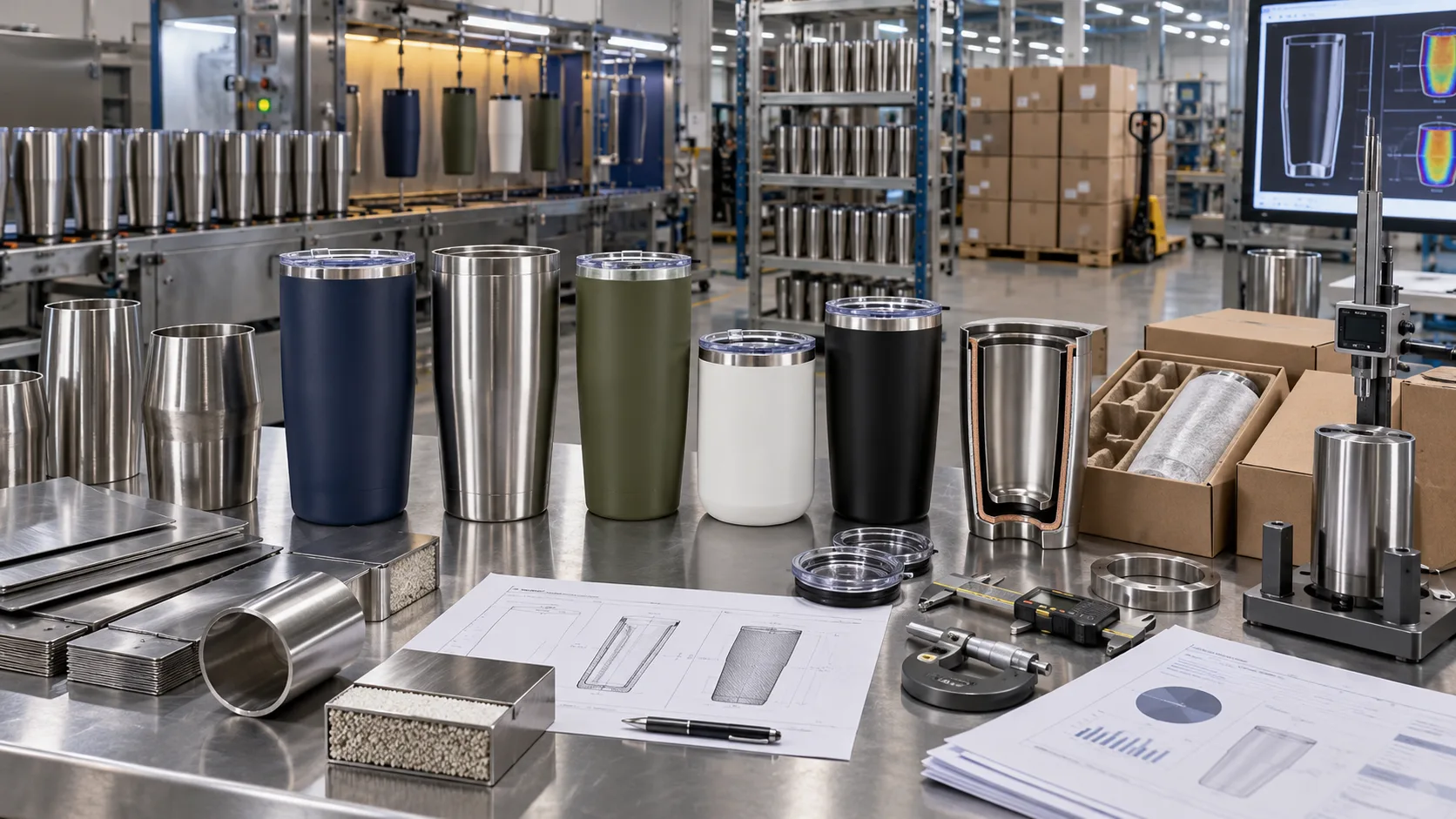
This isn't a secret or a problem; it's just the reality of modern global manufacturing. Understanding this allows you to shift your strategy from a frustrating geographical search to a much more powerful and effective method of supplier verification. Let's dive into what you're really looking for and how to find it.
What Are Buyers Really Looking For with "Made in USA" Tumblers?
When you search for locally made tumblers, you're not just buying a location. You're trying to buy peace of mind and avoid the horror stories you've heard about overseas production—poor quality, unsafe materials, or communication black holes.
What brand owners and product managers are really seeking are assurances of quality, safety, and reliability. The "Made in USA" or "Made in Europe" label often feels like a simple shortcut to get those things.
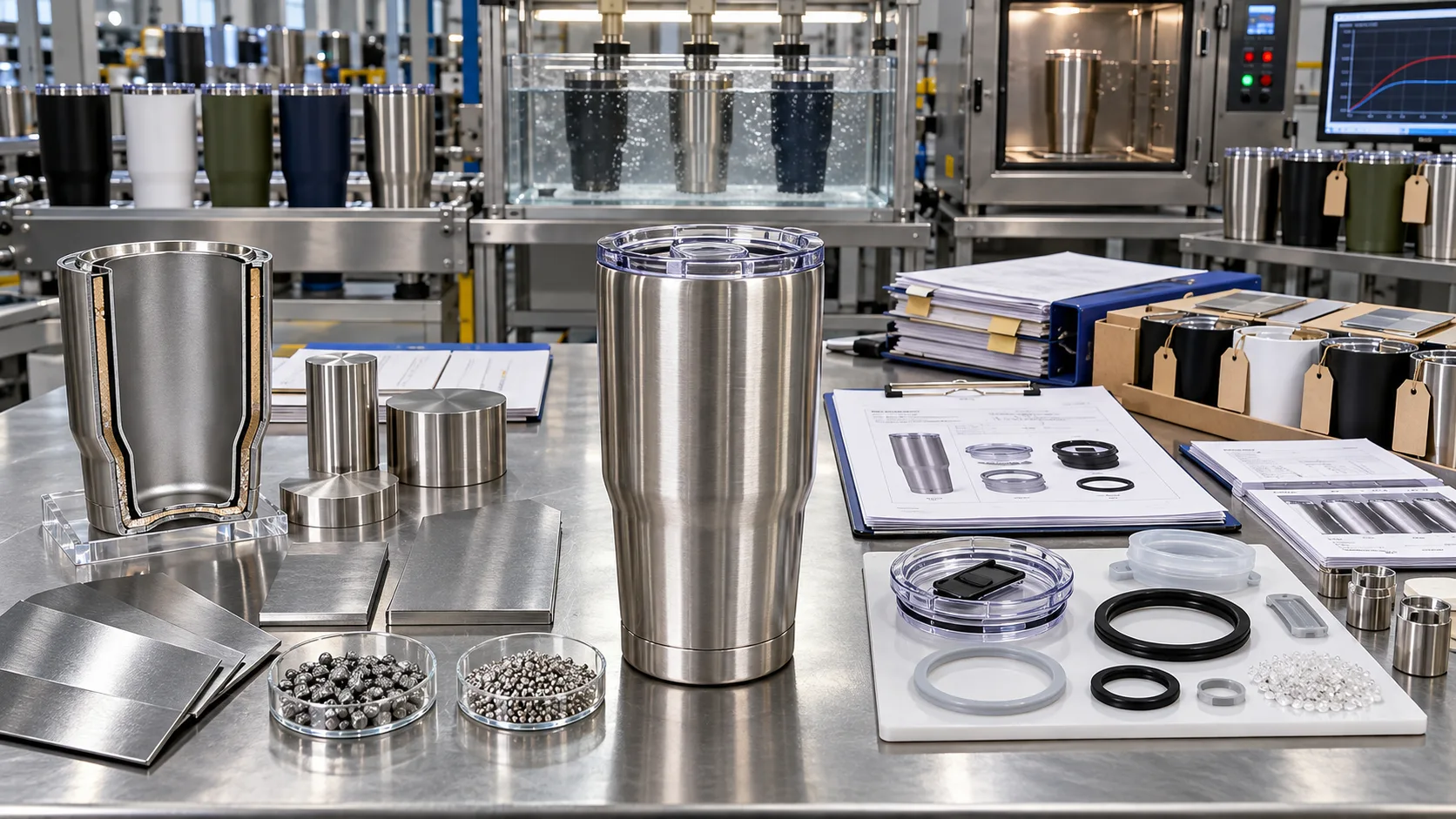
Dive Deeper: Deconstructing the Search for Quality & Safety
In my experience talking with brands every day, the desire for locally made drinkware breaks down into three core needs. The good news is that you can secure all of them from a global partner if you know what to ask for.
1. The Assurance of High-Quality Materials and Construction
The primary fear is ending up with a product that feels cheap, breaks easily, or doesn't perform. You associate Western manufacturing with a higher standard of craftsmanship, and that's a valid starting point. For tumblers, this translates to specific technical features:
- Food-Grade Stainless Steel: The industry standard for quality is 18/8 (or Grade 304) stainless steel.3 This alloy contains 18% chromium and 8% nickel, giving it excellent rust resistance and durability. A great supplier will provide material certification reports to prove they are using genuine 18/8 steel, not a cheaper, less stable alternative.
- Effective Vacuum Insulation: The "magic" of an insulated tumbler is the vacuum layer between the inner and outer walls. Poor manufacturing can lead to a compromised vacuum, meaning your customer's coffee gets cold in an hour.4 Quality control checks, including temperature tests on a portion of the production run, are essential.
- Durable Finish and Construction: You want a powder coat that doesn't chip, a weld seam that is invisible, and a lid that seals perfectly. These are all signs of a manufacturer with mature processes and strict quality control.
2. Verifiable Product Safety and Compliance
This is a non-negotiable, and it's probably the biggest driver behind the search for insulated stainless steel tumblers made in the USA. Brands are rightly concerned about:
- Lead-Free Construction: Some low-cost manufacturing methods use a lead-based solder to seal the vacuum port5 at the bottom of a tumbler. While this spot is typically covered, the risk of exposure is a massive liability. Reputable manufacturers use a lead-free glass solder.
- BPA-Free Materials: All plastic components that come into contact with the beverage, like the lid and slider, must be free of Bisphenol A (BPA) and other harmful chemicals6.
- Compliance with Food-Contact Regulations: Your products must meet the standards of the regions where you sell them. In the US, this is primarily FDA (Food and Drug Administration) regulation.7 In Europe, it's LFGB8. A good supplier won't just claim compliance; they will provide you with recent, third-party test reports for their products.
A supplier's location does not guarantee this safety. Verifiable, third-party documentation is the only real proof.
3. A Reliable and Communicative Supply Chain
Many brands assume a local supplier means easier communication, faster shipping, and less risk. While time zones can be a factor, the quality of communication is about the supplier's culture, not their geography.
I've spoken with many founders who are more frustrated with a slow, uncommunicative domestic decorator than a proactive, organized overseas partner. A great manufacturing partner, regardless of location, acts like an extension of your team. They provide clear updates, anticipate problems, and work with you collaboratively. This is what truly de-risks your supply chain.
What's the Reality of Manufacturing Insulated Tumblers in the USA or Europe?
You're probably wondering why, if the demand exists, there isn't a booming industry for insulated stainless steel tumblers made in USA. You imagine a factory taking raw steel and producing a finished tumbler, all under one roof, but the reality is more complex.
The specialized equipment, multi-stage processes, and deep ecosystem of expertise required for creating vacuum-insulated vessels are overwhelmingly concentrated in Asia. Consequently, Western facilities that do offer "Made in USA" tumblers are typically focused on the final, high-value stages of customization.
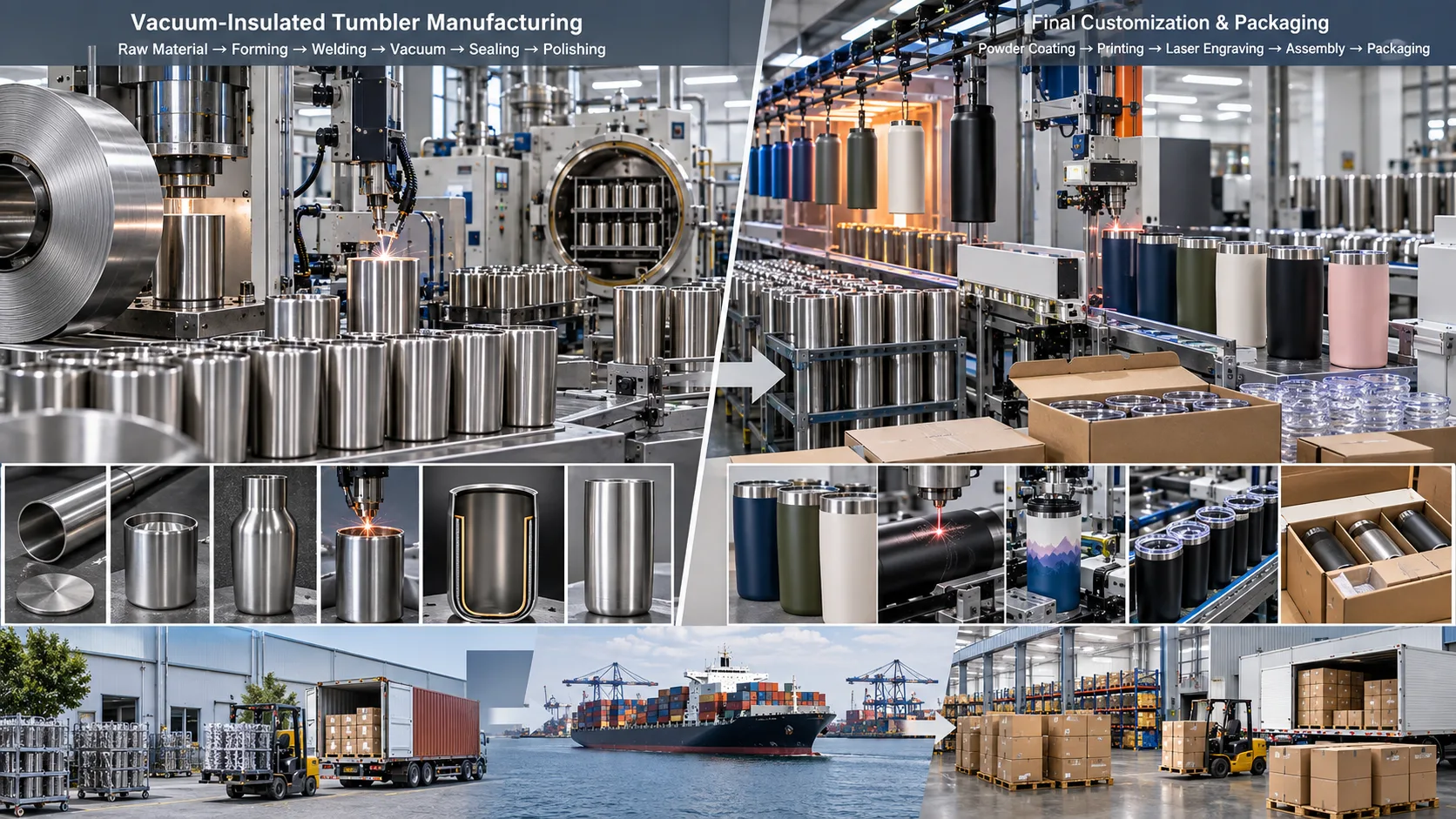
The Global Manufacturing Ecosystem
Making a high-quality insulated tumbler is surprisingly complex. It's not just about bending a piece of metal. It involves a highly specialized, multi-step production line that requires massive capital investment and a skilled labor force.
Here's a simplified look at the process:
- Pipe Cutting & Shaping: It starts with a stainless steel pipe that is cut to size.
- Deep Drawing & Water Swelling: A series of machines press, stretch, and shape the steel into the inner and outer shells of the tumbler. This requires immense force and precise tooling.
- Welding & Assembly: The inner and outer shells are joined, often by laser welding at the top rim.
- Vacuumization: This is the most critical step. The assembled tumblers are placed in a massive, high-temperature vacuum furnace. All the air between the two walls is pumped out, creating the vacuum layer that stops heat transfer.
- Sealing & Testing: A small port at the bottom is sealed (using lead-free solder in good factories), and the vacuum integrity is tested.
- Polishing & Coating: The tumblers are polished to a smooth finish before heading to the powder coating or painting line.
This entire ecosystem—from the machinery manufacturers to the engineers who run the vacuum furnaces—has been built and perfected in Asia over decades.9 Replicating it from scratch in the US or Europe would require an astronomical investment, which leads directly to the next point: cost.
The Cost Structure Reality
Even if a company were to build a full production line in the West, the unit economics would be challenging for most consumer brands. Here’s a rough comparison of the cost factors:
| Cost Factor | Asia (Established Hub) | USA/Europe (Hypothetical) |
|---|---|---|
| Specialized Labor | Widely available, competitive wages | Scarce, significantly higher wages |
| Tooling & Molds | Mature industry, lower costs | High custom fabrication costs |
| Machinery | Optimized ecosystem, lower capex | High import & setup costs |
| Energy Costs | Lower industrial rates | Significantly higher |
| Regulatory Overhead | Streamlined for export | High compliance burden |
This is why the hybrid model is so common. A brand can benefit from the cost-effective and high-quality production of the tumbler "body" in Asia, then ship these blanks to a domestic facility for final printing, laser engraving, and packing. This gives them local control over the final branding and can shorten lead times for customized orders.
How Can I Vet a Supplier to Ensure Quality, Regardless of Location?
If location isn't the magic bullet, you might feel like you're back at square one. How do you find a fantastic partner and avoid getting burned by a low-quality factory? The thought of vetting an overseas supplier can feel daunting.
The key is to shift your focus from a supplier's location to their documented processes and verifiable credentials. By using a structured vetting checklist, you can build the confidence to assess any manufacturer, anywhere in the world.
Dive Deeper: Your Actionable Supplier Vetting Checklist
When you're evaluating a potential manufacturing partner, don't just ask "Can you make this for me?" Instead, treat it like an interview. Your job is to verify their capabilities. Here are the four areas you must investigate.
1. Material & Safety Certifications
This is your first line of defense. A professional supplier will have this documentation ready. If they hesitate or can't provide it, that's a major red flag.
-
What to ask for:
- Raw Material Reports: Ask for test reports verifying the grade of stainless steel (should be 304 or 18/8).
- Food-Contact Safety Reports: Request third-party test reports showing compliance with FDA (for the US) and/or LFGB (for Europe). This should cover the steel body, the plastic lid, and any silicone seals.
- Lead-Free & BPA-Free Verification: Ensure these specific tests are included in the reports.
-
What to look for: Check that the reports are recent (ideally within the last 1-2 years) and from a reputable testing lab (like SGS, Intertek, or TUV).
2. Factory Audits and Quality Systems
While safety reports cover the final product, factory audits tell you about the professionalism and ethics of the operation itself.
-
What to ask for: "Do you have any recent factory audits like BSCI, Sedex, or ISO 900110?"
- BSCI / Sedex: These are social compliance audits that focus on ethical labor practices, health, and safety. They show the supplier is a responsible employer.
- ISO 900111: This is a certification for a Quality Management System (QMS). It indicates the factory has formal, repeatable processes for ensuring quality, which is a very good sign.
-
Why it matters: A supplier invested in these audits is showing a long-term commitment to professional, ethical, and high-quality manufacturing.
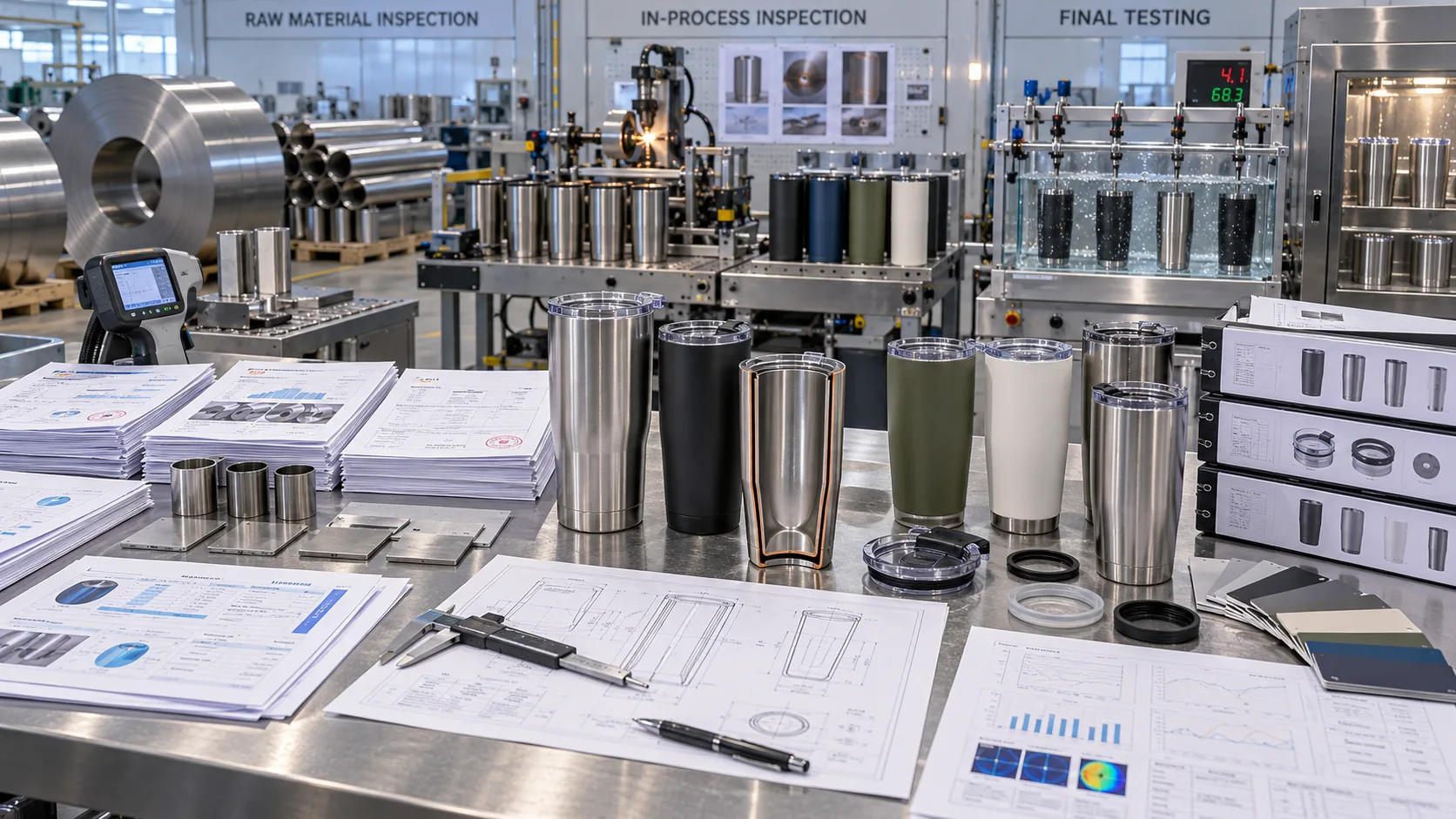
3. Their In-House Quality Control (QC) Process
This is where you learn how they prevent mistakes. Ask them to walk you through their process.
- What to ask for: "Can you explain your quality control process from raw materials to final shipment?"
- What to listen for: Look for a multi-stage process. A great factory won't just inspect the finished product; they check for quality at every step.
- IQC (Incoming Quality Control): They inspect raw materials like steel coils and plastic pellets when they arrive.
- IPQC (In-Process Quality Control): They have inspectors on the production line checking for things like welding defects, polishing issues, or painting flaws.
- FQC (Final Quality Control): They perform a final, comprehensive inspection on a percentage of the finished goods before they are packed. This should include a vacuum performance test (e.g., filling with hot water and checking the temperature after several hours).
4. Product Development & Communication Style
A supplier is a partner, not just a vendor. Their ability to work with you on developing a unique product is critical.
-
What to ask for:
- "Can you show me examples or case studies of custom projects you've done for other brands?"
- "What is your process for developing a new design, from concept to sample to mass production?"
-
How to test communication: Pay close attention during your initial conversations. Are they responsive? Do they answer your questions clearly and thoroughly? Do they ask smart questions about your brand and your goals? A partner who communicates well upfront is likely to be a reliable partner long-term.
Frequently Asked Questions
Are tumblers made in China safe?
Yes, tumblers made in China from a reputable, vetted manufacturer are perfectly safe. Safety is determined by the supplier's commitment to quality control, material verification, and third-party testing—not their geographic location. Always demand and verify FDA or LFGB compliance reports.
What is 18/8 or 304 stainless steel?
This is the industry-standard food-grade stainless steel for high-quality drinkware. The name refers to its composition of approximately 18% chromium and 8% nickel. This alloy provides excellent corrosion resistance and durability, ensuring the tumbler won't rust or impart any metallic taste.12
Can I get my tumblers printed in the USA on imported bodies?
Absolutely. This is a very common and effective "hybrid" manufacturing strategy. Brands can leverage the cost and quality advantages of Asian manufacturing for the base tumbler, and then use a domestic decorator for printing, laser engraving, or assembly. This offers a great balance of cost, quality, and local control over customization.
What is a BSCI or Sedex audit?
BSCI (Business Social Compliance Initiative) and Sedex (Supplier Ethical Data Exchange) are internationally recognized programs that audit factories for social and ethical compliance. They cover areas like fair wages, working hours, and workplace safety. A recent audit from either is a strong signal that you're working with a responsible and ethical manufacturer.
Conclusion
The search for insulated stainless steel tumblers made in USA or Europe often begins as a proxy for quality, safety, and reliability. While some domestic assembly and decoration exists, the global manufacturing reality is that the core of this specialized industry lies in Asia. Rather than getting stuck on an often-fruitless geographical hunt, the smartest move for any brand is to shift focus from where a product is made to how it is made.
By becoming an expert at vetting suppliers—demanding material certifications, reviewing factory audits, understanding their QC process, and assessing their communication— you can secure a high-quality, safe, and reliable supply chain from anywhere in the world. This empowers you to find a true partner who can help you build an exceptional product line.
If you are looking for a collaborative manufacturing partner who understands the critical details of quality control, material safety, and custom product development, we're here to help. Reach out to our team to discuss how we can bring your brand's vision for the perfect drinkware to life.
"Insulated Drinkware Market Size, Share, Trends, Industry ...", https://www.marketresearchfuture.com/reports/insulated-drinkware-market-24445. Market research and trade data indicate that the manufacturing of vacuum-insulated stainless steel products is heavily concentrated in Asia, with China being the leading producer by a significant margin. Evidence role: statistic; source type: research. Supports: The claim that Asia, particularly China, is the dominant global producer of vacuum-insulated stainless steel vessels.. Scope note: Specific market share percentages can vary between reports and may fluctuate annually. ↩
"Complying with the Made in USA Standard", https://www.ftc.gov/business-guidance/resources/complying-made-usa-standard. The U.S. Federal Trade Commission's (FTC) 'Made in USA' standard requires that a product be 'all or virtually all' made in the U.S. However, products can be labeled as 'Assembled in USA' or similar if the principal assembly takes place domestically and the product is substantially transformed. Evidence role: definition; source type: government. Supports: The claim that a 'Made in USA' label can be applied to products where significant final processing occurs domestically, even if components are imported.. Scope note: The source would primarily explain the U.S. legal framework, while European rules can differ by country. ↩
"Austenitic stainless steel", https://en.wikipedia.org/wiki/Austenitic_stainless_steel. Grade 304 stainless steel, also known as 18/8, is an austenitic steel containing approximately 18% chromium and 8% nickel. Its composition provides strong corrosion resistance, making it a common choice for food handling and processing equipment. Evidence role: definition; source type: encyclopedia. Supports: The definition and properties of 18/8 (Grade 304) stainless steel, including its composition and suitability for food-grade applications.. ↩
"Vacuum Flask", http://hyperphysics.phy-astr.gsu.edu/hbase/thermo/vacfla.html. Vacuum flasks function by creating a near-vacuum between two walls of glass or steel, which minimizes heat transfer by conduction and convection. If this vacuum is compromised by gas molecules, thermal energy can be transferred much more easily, causing the contents to quickly approach ambient temperature. Evidence role: mechanism; source type: education. Supports: The claim that a compromised vacuum layer negates the insulating properties of a tumbler.. ↩
"Assessing risk of lead exposure from insulated beverage ...", https://hsph.harvard.edu/news/assessing-risk-of-lead-exposure-from-insulated-beverage-containers/. Investigations by consumer advocacy groups and journalists have found that some insulated tumblers are manufactured using a lead-based solder to seal the vacuum insulation point, typically located at the bottom of the vessel and covered by a cap. Evidence role: case_reference; source type: institution. Supports: The claim that lead solder has been identified as a material used in the manufacturing of some insulated drinkware.. Scope note: These findings apply to specific products and manufacturers and do not indicate an industry-wide practice. ↩
"Bisphenol A (BPA): Use in Food Contact Application", https://www.fda.gov/food/food-packaging-other-substances-come-contact-food-information-consumers/bisphenol-bpa-use-food-contact-application. The U.S. Food and Drug Administration (FDA) has stated that BPA is safe at the current low levels occurring in foods, but its use has been restricted in certain products like baby bottles. Due to consumer demand and ongoing research, many manufacturers voluntarily produce BPA-free plastics for food-contact items. Evidence role: general_support; source type: government. Supports: The claim that BPA is a chemical of concern for food-contact materials.. Scope note: The source would clarify that while there is concern, a complete ban in all food-contact applications is not in place in all jurisdictions. ↩
"Food Packaging & Other Substances that Come in Contact ...", https://www.fda.gov/food/food-ingredients-packaging/food-packaging-other-substances-come-contact-food-information-consumers. In the United States, materials that come into contact with food are regulated by the FDA as 'Food Contact Substances.' The relevant regulations are primarily found in Title 21 of the Code of Federal Regulations (CFR). Evidence role: definition; source type: government. Supports: The claim that the FDA is the primary body regulating food-contact materials in the United States.. ↩
"The Difference Between FDA & LFGB Certified Silicone ...", https://www.justsmartkitchenware.com/the-difference-between-fda-lfgb-certified-silicone-products/?srsltid=AfmBOoqvJzcp0jh4TUV7KWHCnQ6qN8S7NBQ5jb1aseOf4F0Xfws61tFx. The 'Lebensmittel-, Bedarfsgegenstände- und Futtermittelgesetzbuch' (LFGB) is German food safety legislation. While pan-European regulations exist (such as EC 1935/2004), the LFGB is often cited as a high standard for compliance within the EU market due to its rigorous testing requirements. Evidence role: definition; source type: institution. Supports: The claim that LFGB is a key standard for food-contact material safety in the European market.. Scope note: The source clarifies that LFGB is a German national law, not a direct EU-wide regulation, though it is influential. ↩
"Zhejiang", https://en.wikipedia.org/wiki/Zhejiang. Economic studies and industry histories document the development of industrial clusters in regions of Asia, particularly in China's Zhejiang province, which specialized in the mass production of stainless steel goods, including vacuum flasks, starting in the late 20th century. This led to a deep ecosystem of specialized machinery, skilled labor, and supply chains. Evidence role: historical_context; source type: research. Supports: The claim that the expertise and infrastructure for vacuum vessel manufacturing are heavily concentrated in Asia due to decades of development.. ↩
"Understanding BSCI Compliance | What is BSCI?", https://www.factoredquality.com/resource/understanding-bsci-compliance. The Business Social Compliance Initiative (BSCI), run by amfori, and the Supplier Ethical Data Exchange (Sedex) are leading platforms that enable companies to audit and manage social and ethical performance in their supply chains, covering topics like labor rights, health, and safety. Evidence role: definition; source type: institution. Supports: The definition of BSCI and Sedex as social compliance audit programs.. Scope note: The source would define the purpose of the audits, not guarantee that any specific audited factory is without issues. ↩
"ISO 9000 family", https://en.wikipedia.org/wiki/ISO_9000_family. ISO 9001 is an international standard published by the International Organization for Standardization (ISO) that specifies requirements for a quality management system (QMS). Organizations use the standard to demonstrate the ability to consistently provide products and services that meet customer and regulatory requirements. Evidence role: definition; source type: institution. Supports: The definition of the ISO 9001 standard.. ↩
"Case Study: How Chromium Protects Steel - UMich MSE", https://mse.engin.umich.edu/internal/demos/case-study-how-chromium-protects-steel. The high chromium content in 18/8 stainless steel forms a passive, self-repairing layer of chromium oxide on the surface. This microscopic layer is inert and protects the underlying iron from oxidation (rust) and prevents the leaching of metallic ions that could cause a metallic taste. Evidence role: mechanism; source type: paper. Supports: The claim that the composition of 18/8 stainless steel provides corrosion resistance.. ↩