
When developing a new drinkware product, you often see capacity listed in milliliters (ml) on manufacturer specs, but your target market thinks in ounces (oz). This discrepancy can lead to confusion, and simply converting the numbers isn't enough. Understanding how many ounces is 1000 ml is the first step, but the key is knowing what this measurement truly means for your product's design and your customers' experience.
1000 milliliters (ml) is equal to approximately 33.8 US fluid ounces1. It is important to note this is different from the Imperial fluid ounce used in the UK, where 1000 ml is about 35.2 fl oz2. For global sourcing, specifying volume in milliliters is the industry standard3 to prevent costly miscommunication.
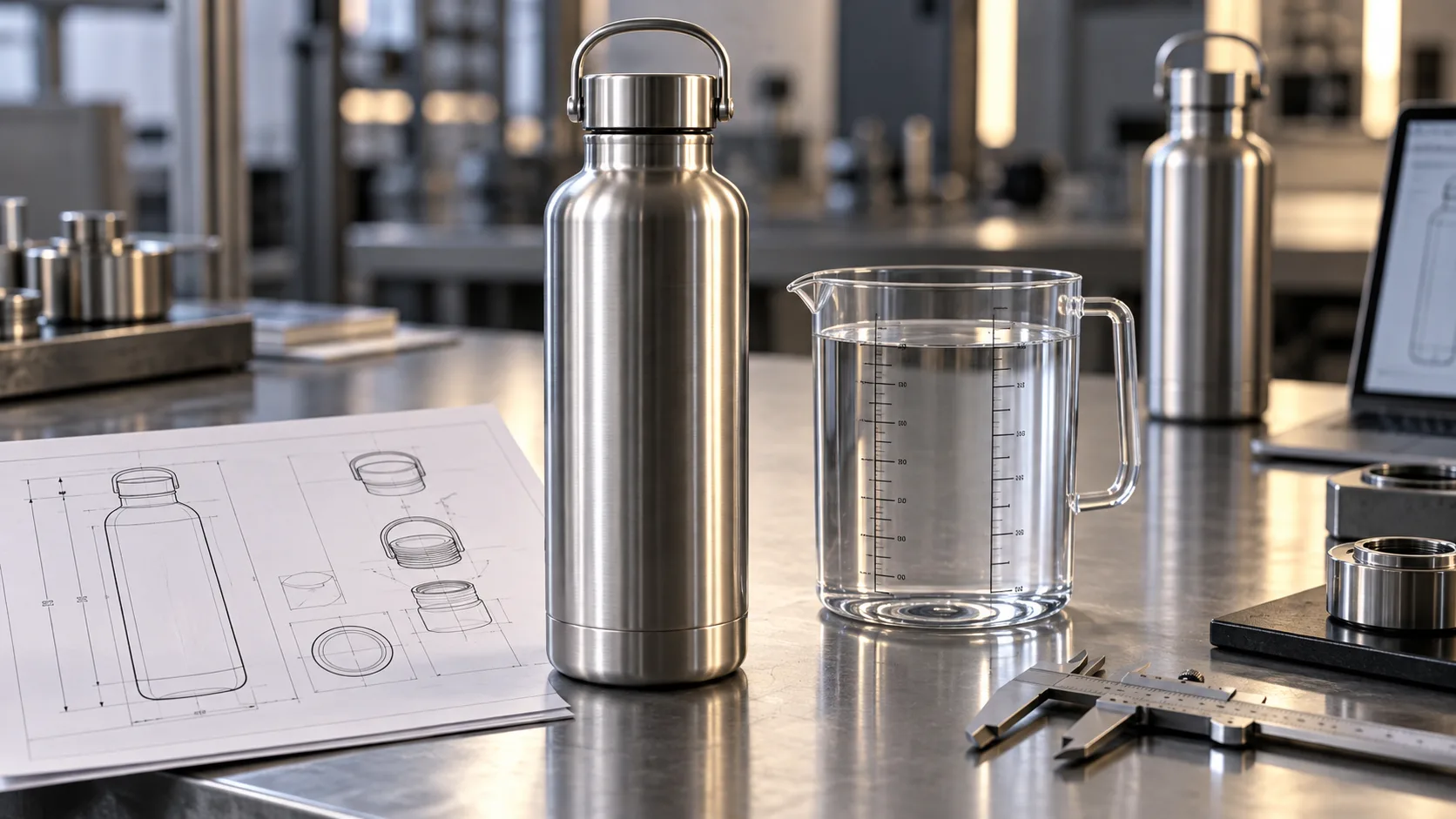
That simple conversion, however, is just the beginning. The number on a spec sheet rarely tells the whole story. To develop a successful product, you need to look beyond the direct translation and consider how capacity impacts the physical product your customer will hold and use every day.
Stated Capacity vs. Usable Volume: What’s the Real-World Difference?
You’ve specified a 1000 ml bottle and launched your product. But soon, customer reviews complain that it spills when they try to fill it completely. This happens because the stated capacity isn't what the customer can actually use. Understanding this distinction is crucial for honest marketing and customer satisfaction.
The stated capacity (e.g., 1000 ml) is the brimful capacity4—the total volume of liquid a bottle holds when filled to the absolute top edge. However, the usable volume is the practical amount of liquid it can contain with the lid screwed on and a small air gap to prevent spills.
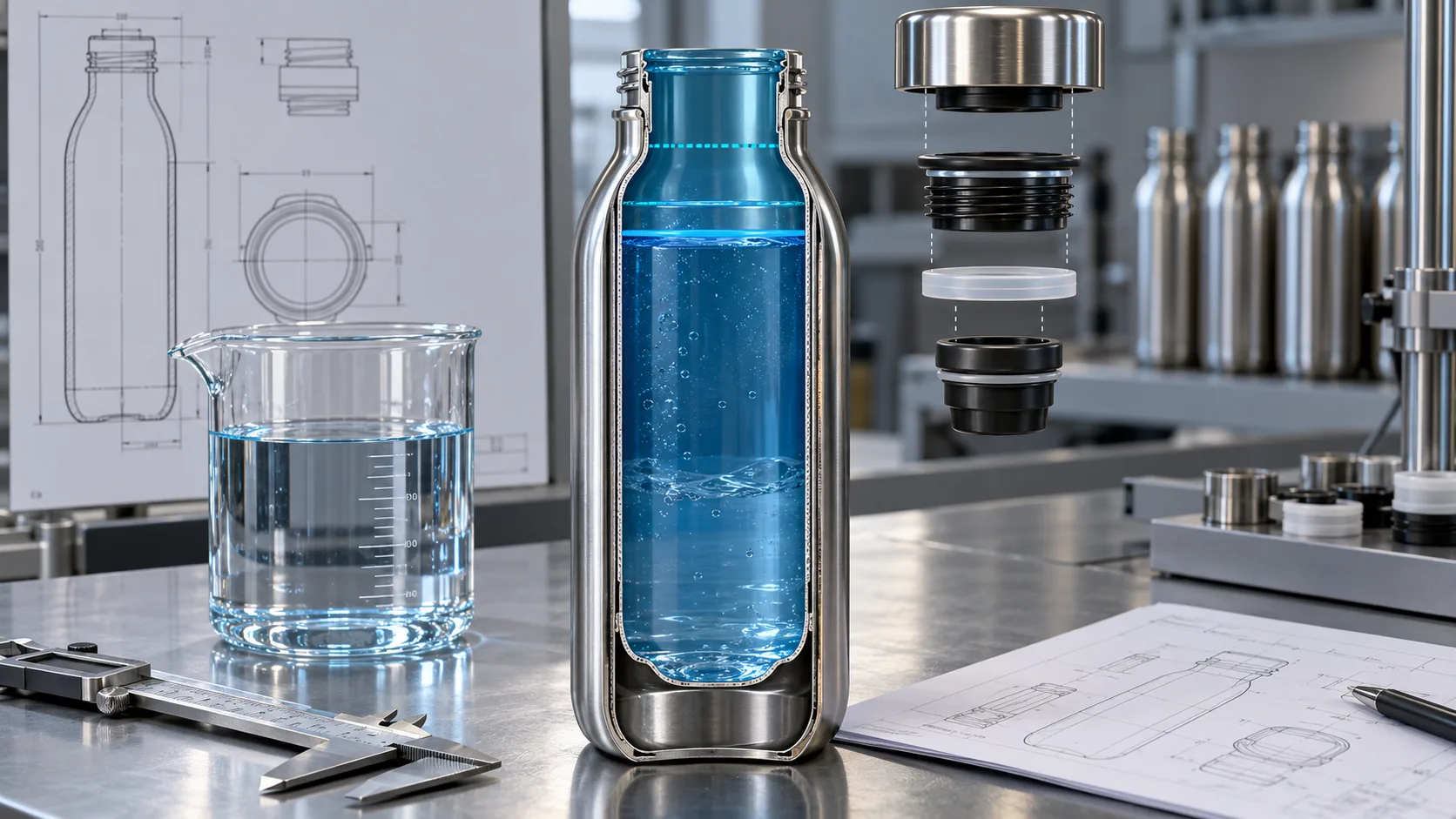
In my experience reviewing product briefs, the gap between stated and usable volume is a common source of confusion for brands new to the drinkware space. A brand might market a bottle as "34 oz" because its brimful capacity is 1000 ml, but the usable volume could be closer to 950 ml (about 32 oz). This 2 oz difference matters.
Here’s what causes the discrepancy:
- Lid Displacement: The threads and internal structure of the lid take up space. When you screw the lid on, it displaces liquid. A lid with a deep-set seal or complex mechanism can reduce the usable volume significantly.
- User Experience: No one fills a bottle perfectly to the brim for daily use. It's impractical and guarantees spills. Users naturally leave a small gap at the top, which further reduces the functional volume.
As a brand, marketing a bottle based on its brimful capacity can feel deceptive to the end-user. To avoid this, you should always ask potential suppliers for two key specifications:
- Brimful Capacity: The total volume in ml.
- Recommended Fill Line: The manufacturer's suggested maximum volume for practical use.
The best practice is always to request physical samples. Fill the bottle to a reasonable level, screw on the lid, and then pour the water into a measuring cup. This simple test gives you the true usable volume and allows you to market your product with confidence and transparency.
How Does 1000 ml Capacity Impact Product Design?
You've settled on a 1000 ml capacity to meet the "all-day hydration" trend. But now you face critical design choices. A tall, skinny bottle might be unstable, while a short, wide one won't fit anywhere. Thinking of capacity as a core design constraint helps you create a product that perfectly suits your target user.
A 1000 ml or ~34 oz capacity is a strategic choice that strongly influences a bottle's final form factor. This volume dictates the product's overall dimensions, weight, and portability, which in turn define its ideal use case and target market.
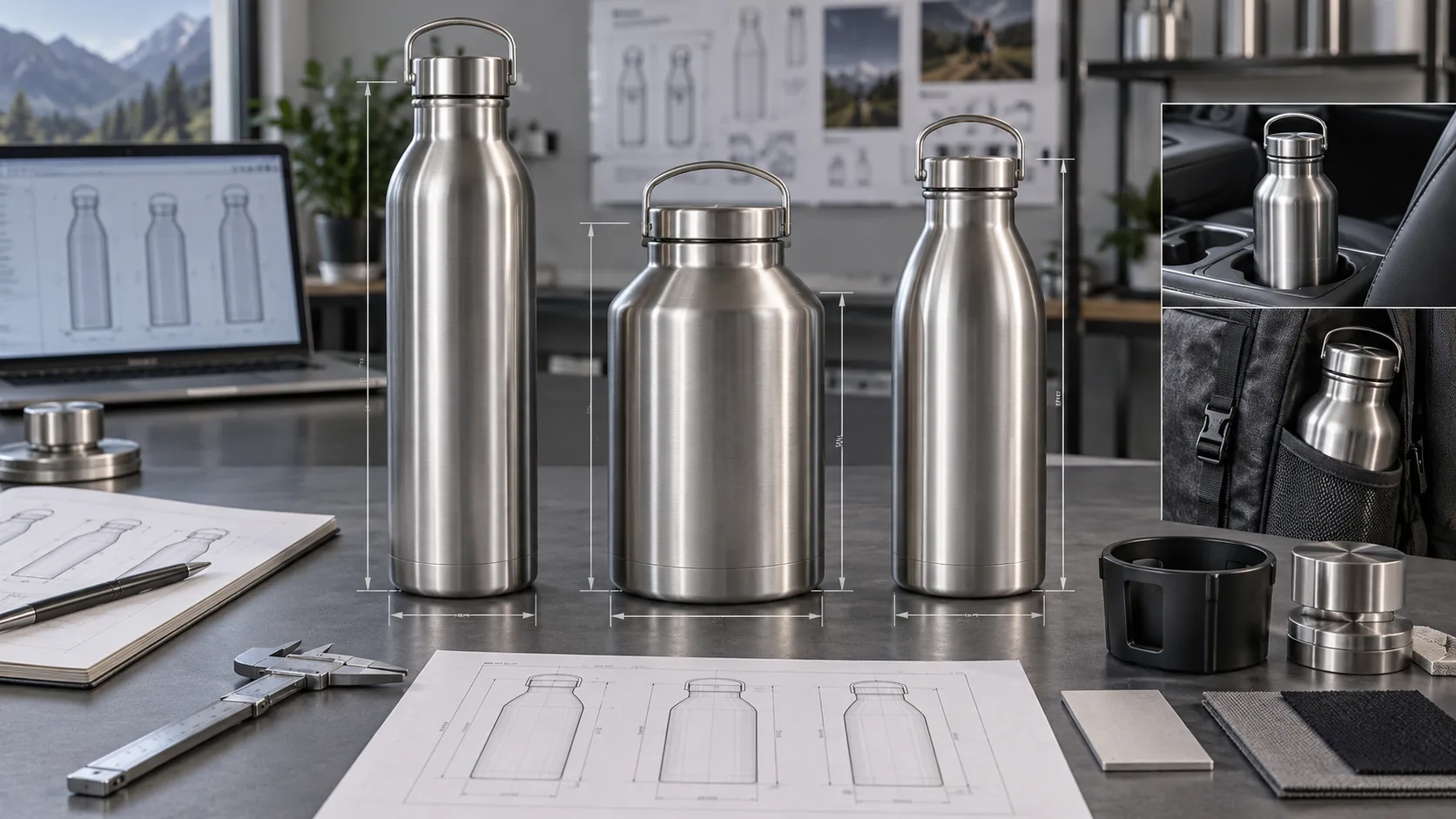
When a client requests a 1000 ml bottle, our design discussion immediately turns to these trade-offs. The total volume is fixed, so we must balance height and diameter to achieve the desired functionality.
Diameter and Portability
This is arguably the most important decision.
- Wide Diameter (e.g., 90mm+): A wider bottle is more stable and less likely to be knocked over on a desk. However, it almost certainly won't fit in a standard car cup holder (~75-80mm)5 or the side pockets of many backpacks. This design is better suited for gym-goers, office workers, or home use.
- Narrow Diameter (e.g., 80-85mm): To achieve 1000 ml in a narrower footprint, the bottle must be taller. While it may be more portable, its height can make it top-heavy and less stable.
Weight and Material
A 1000 ml bottle is not a lightweight product. The water itself weighs 1 kilogram (2.2 lbs)6. An empty double-wall insulated stainless steel bottle of this size can add another 400-500 grams (around 1 lb)7.
- Total Weight: Fully loaded, the bottle will weigh approximately 1.5 kg (3.3 lbs)8.
- Market Positioning: This weight makes it an excellent choice for someone who drives to the gym or wants to stay hydrated at their desk. However, it's likely too heavy for a long-distance hiker, a cyclist, or a child9, who would be better served by a smaller, lighter bottle.
By considering these factors, you can position your 1000 ml bottle not just as a container, but as a purpose-built accessory for a specific lifestyle.
Frequently Asked Questions
Why do manufacturers use ml instead of oz?
Manufacturers use milliliters (ml) because it is a unit within the metric system, which is the global standard for science and manufacturing10. It provides a universal measurement that avoids confusion between US fluid ounces and Imperial fluid ounces, ensuring precision in global sourcing and production.
What is a standard 32 oz water bottle in ml?
A standard 32 US fluid ounce water bottle is approximately 946 ml11. Interestingly, many bottles marketed as "32 oz" are built using a 1000 ml mold for manufacturing efficiency. This often results in the customer receiving a bottle with slightly more capacity than advertised.
How much does a full 1000 ml stainless steel bottle weigh?
A full 1000 ml insulated stainless steel bottle weighs roughly 1.5 kg (or 3.3 lbs). The water itself accounts for 1 kg (2.2 lbs), and the empty bottle typically weighs between 400 and 500 grams (about 1 lb), depending on its construction and features.
Conclusion
So, while the direct answer to how many ounces is 1000 ml is 33.8 US fl oz, that number is just a starting point. For brands developing a new drinkware product, the more important considerations are the difference between stated and usable volume, the distinction between US and Imperial ounces, and the profound impact that a 1000 ml capacity has on a product's design, weight, and market fit. Getting these details right is the key to creating a bottle that customers will love and use daily.
If you're ready to move from basic questions to developing a high-quality, custom water bottle that truly represents your brand, our team is here to help. We specialize in guiding brands through the entire OEM/ODM process, from initial design to final production. Contact us to discuss your project.
"General Tables of Units of Measurement", https://www.nist.gov/document/appc-18-hb44-finalpdf. A source from a national standards body, such as the U.S. National Institute of Standards and Technology (NIST), can confirm the precise conversion factor between milliliters (a unit of the International System of Units) and US customary units like the fluid ounce. Evidence role: definition; source type: government. Supports: The official conversion factor between milliliters and US fluid ounces.. ↩
"Weights and Measures Acts (UK)", https://en.wikipedia.org/wiki/Weights_and_Measures_Acts_(UK). A source from a government body responsible for weights and measures, such as the UK's government, can provide the official definition and conversion factor for the Imperial fluid ounce, which differs from the US fluid ounce. Evidence role: definition; source type: government. Supports: The official conversion factor between milliliters and Imperial fluid ounces.. ↩
"Measuring international trade", https://www.oecd.org/en/topics/sub-issues/measuring-international-trade.html. Sources from international standards organizations or trade bodies often detail the widespread adoption of the International System of Units (SI), including the liter and milliliter, to facilitate global commerce and prevent errors in technical specifications. Evidence role: general_support; source type: institution. Supports: The use of the metric system as a standard for international trade and manufacturing to ensure consistency.. Scope note: The source may discuss the general use of SI units in manufacturing rather than specifically mentioning the drinkware industry. ↩
"Intermodal container", https://en.wikipedia.org/wiki/Intermodal_container. International standards, such as those from the International Organization for Standardization (ISO), provide precise definitions for container measurements, including 'brimful capacity,' which is the total volume of a container when filled to its very edge. Evidence role: definition; source type: institution. Supports: The technical definition of 'brimful capacity' in the context of packaging and container manufacturing.. ↩
"Is there a standardized cupholder design ...", https://www.reddit.com/r/AskEngineers/comments/1ae3t9b/is_there_a_standardized_cupholder_designstandard/. While no single universal standard exists, automotive reviews and aftermarket accessory manufacturers often indicate that most car cup holders are designed with a diameter ranging from approximately 75 to 80 millimeters to accommodate common beverage containers. Evidence role: statistic; source type: other. Supports: The typical diameter range for cup holders in most passenger vehicles.. Scope note: The source will likely confirm this is a common range rather than a formal, universally-enforced standard, as dimensions can vary by vehicle manufacturer and model. ↩
"Kilogram", https://en.wikipedia.org/wiki/Kilogram. The definition of the kilogram was historically based on the mass of one liter (1000 cm³) of water at the temperature of its maximum density (approximately 4 °C). For practical purposes, the mass of 1000 ml of water is considered to be 1 kg. Evidence role: definition; source type: encyclopedia. Supports: The mass of one liter of water is approximately one kilogram.. ↩
"Water bottle weight roundup : r/Ultralight", https://www.reddit.com/r/Ultralight/comments/rfy7go/water_bottle_weight_roundup/. A review of technical specifications from various popular drinkware brands shows that an empty 32-34 oz (approx. 1000 ml) double-wall insulated stainless steel bottle typically weighs between 400 and 550 grams, depending on the specific design and lid type. Evidence role: general_support; source type: other. Supports: The typical weight range for an empty, insulated, 1-liter stainless steel water bottle.. Scope note: This data is based on a survey of commercial products and is not a formal standard; individual product weights may fall outside this range. ↩
"1 Liter Insulated Bottle", https://www.amazon.com/1-liter-insulated-bottle/s?k=1+liter+insulated+bottle. Based on the combined weight of 1 kg for the water and approximately 0.4-0.5 kg for the bottle itself, the total weight of a full 1-liter insulated stainless steel bottle is around 1.5 kg (3.3 lbs), a figure often noted in gear reviews for hiking or travel. Evidence role: statistic; source type: other. Supports: The approximate total weight of a 1000 ml insulated bottle when filled with water.. Scope note: The exact weight will vary based on the specific bottle's construction and material thickness. ↩
"What base weight is reasonable? : r/lightweight", https://www.reddit.com/r/lightweight/comments/11p00mj/what_base_weight_is_reasonable/. Expert sources in fields like long-distance hiking and pediatrics provide guidelines on managing carried weight. For example, backpacking communities often focus on minimizing 'base weight,' where a 1.5 kg item for hydration alone would be considered excessively heavy, and pediatric guidelines recommend children carry backpacks weighing no more than 10-20% of their body weight. Evidence role: expert_consensus; source type: research. Supports: The recommended weight limits for gear in activities like hiking and for items carried by children.. Scope note: The source will provide general weight guidelines rather than specifically critiquing a 1.5 kg water bottle. ↩
"Metrication", https://en.wikipedia.org/wiki/Metrication. The International System of Units (SI), the modern form of the metric system, is the only system of measurement with an official status in nearly every country in the world, serving as the universal language for science, manufacturing, and international trade. Evidence role: historical_context; source type: institution. Supports: The status of the metric system (specifically the International System of Units or SI) as the internationally recognized standard for science, technology, and commerce.. ↩
"Unit Conversion", https://www.nist.gov/pml/owm/metric-si/unit-conversion. According to standard conversion factors provided by bodies like the National Institute of Standards and Technology (NIST), one US fluid ounce is equal to 29.5735 milliliters, making 32 US fluid ounces equal to approximately 946 ml. Evidence role: definition; source type: government. Supports: The conversion of 32 US fluid ounces to milliliters.. ↩