
Worried that your favorite sports drink or a salty broth might damage your trusty stainless steel jug? It's a valid concern we often hear from customers. While these jugs are known for their durability, the interaction with salt is complex. The solution lies in understanding the type of steel and how long the salty liquid stays inside.
For short-term use, such as a few hours during a workout or a hike, putting salt water in a standard food-grade (304/18-8) stainless steel jug is generally fine, provided you clean it thoroughly afterward. However, long-term storage is not recommended, as the chloride in salt will inevitably cause pitting corrosion and damage the steel1.
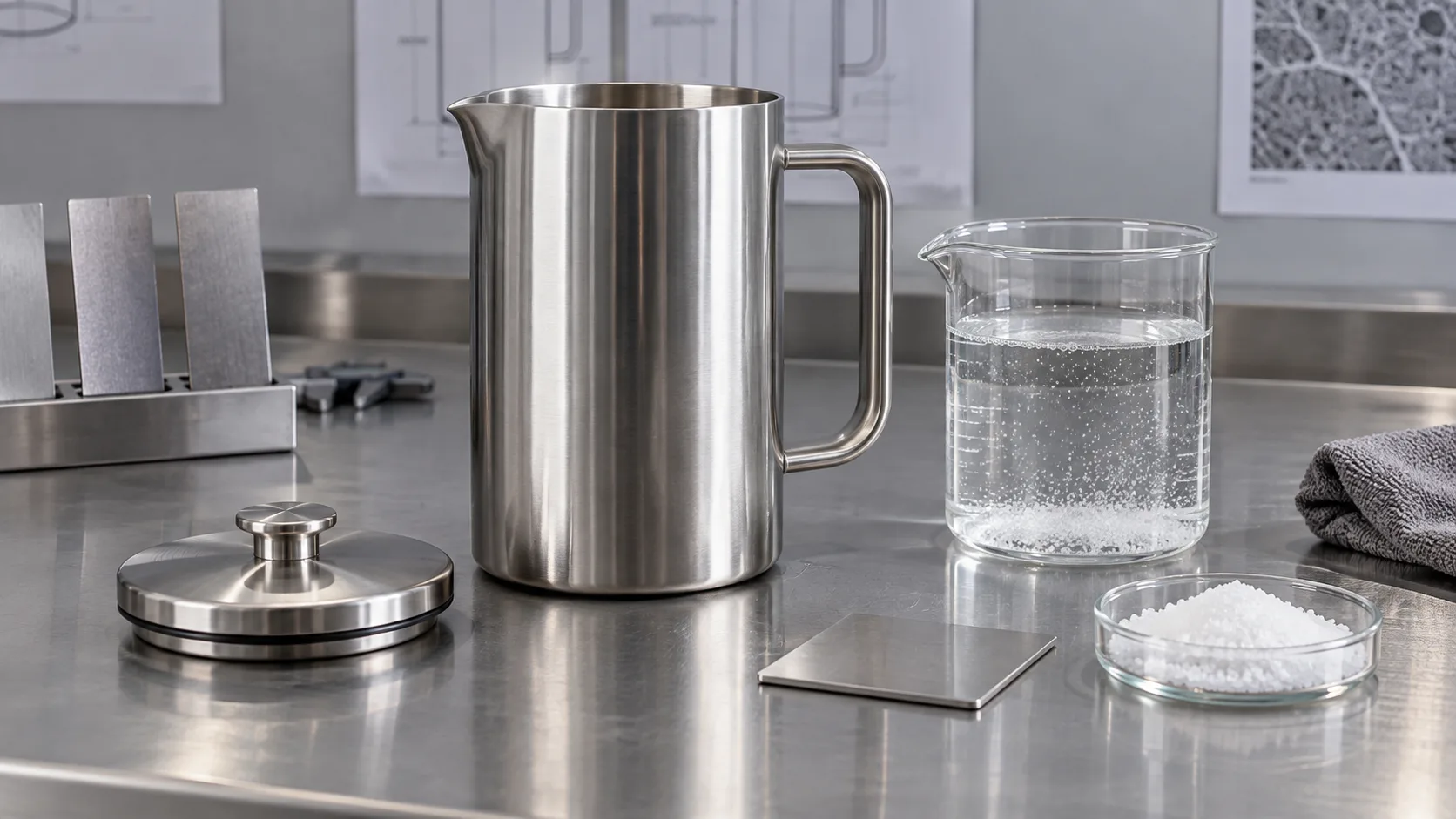
So, while a quick sip of an electrolyte drink won't ruin your bottle, there's more to the story. The real risk depends on the specific grade of steel and the duration of exposure. Let's explore what actually happens when salt meets steel.
What does salt water actually do to a stainless steel jug?
You might think steel is invincible, but certain chemicals can find its weak spots. Are you worried that an invisible process is slowly degrading your jug from the inside out? You're right to be cautious.
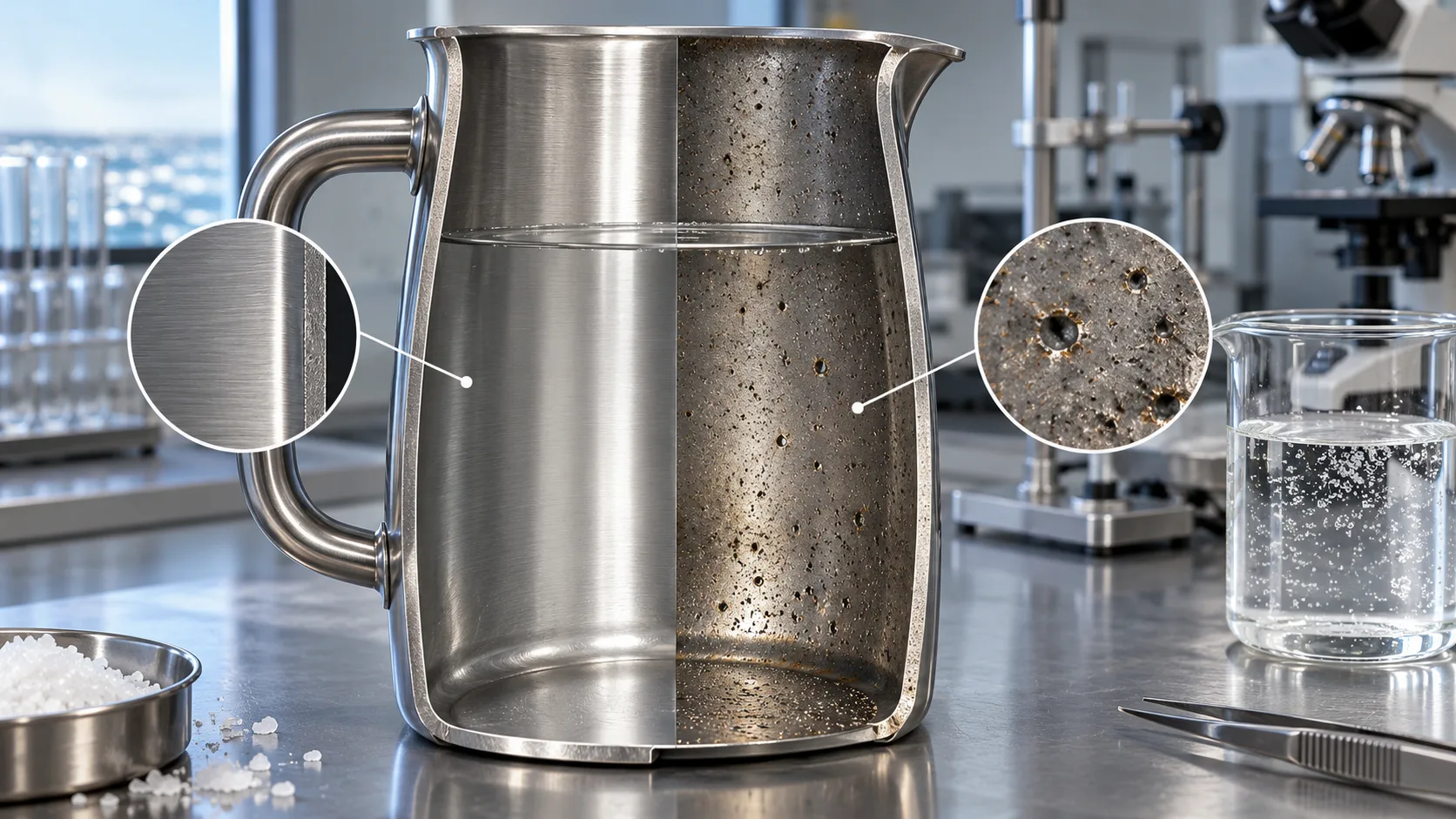
The chloride ions present in salt are aggressive toward stainless steel. They attack the passive chromium oxide layer that protects the steel from rust, leading to a specific type of damage called pitting corrosion.2
The Science of Pitting Corrosion
The "stainless" quality of your stainless steel jug comes from a microscopic, invisible layer of chromium oxide on its surface. This passive layer forms instantly when the steel is exposed to oxygen and acts as a shield against rust and corrosion. It’s incredibly effective against most things, but it has an enemy: chloride.
When you add salt (sodium chloride) to water, it dissolves into sodium and chloride ions. The chloride ions are particularly effective at breaking down this protective layer. They create tiny, localized breaches, or "pits."
Here's why this is a problem:
- It's Insidious: Pitting corrosion starts as microscopic holes that are nearly impossible to see with the naked eye. You might not notice any damage until it's significant.
- It Accelerates: Once a pit forms, the corrosive environment inside it becomes even more aggressive, causing the pit to deepen and grow faster.3
- It Affects Quality: This corrosion can leach metallic tastes into your water and, over time, compromise the structural integrity of the jug itself.4
For this reason, using a stainless steel jug for short-term transport of an electrolyte drink is low-risk, but using it for long-term brining or saltwater storage is a recipe for permanent damage.
Are all stainless steel jugs equally resistant to salt?
If you assume all stainless steel offers the same level of protection, you might be setting your drinkware up for failure. This assumption can lead to unexpected corrosion, especially in coastal environments or with frequent sports drink use.
No, not all steel is created equal. Most standard drinkware uses 18/8 (or 304) stainless steel.5 For superior corrosion resistance, 316 "marine-grade" stainless steel is the better, albeit more expensive, option.6 <img src="https://customwaterbottlemanufacturer.com/wp-content/uploads/2026/09/bottle-28.webp" alt="" width="1672" height="941" class="alignnone size-full wp-image-1124" />
304 vs. 316 Stainless Steel
In the drinkware industry, we primarily work with two grades of food-safe stainless steel: 304 and 316. While they look identical, their performance against salt is very different.
- 304 (18/8) Stainless Steel: This is the workhorse of the kitchen and drinkware world. The "18/8" refers to its composition of 18% chromium and 8% nickel.7 It offers excellent general corrosion resistance and is perfect for water, coffee, and most other beverages. It is cost-effective and durable, making it the standard for most products.
- 316 Stainless Steel: Often called "marine-grade," 316 steel has a secret weapon: molybdenum. This element, typically added at around 2%, dramatically enhances resistance to chloride corrosion.8 It's the material of choice for equipment used in marine, chemical, and medical applications9.
| Feature | 304 (18/8) Stainless Steel | 316 Stainless Steel |
|---|---|---|
| Primary Use | General Drinkware, Kitchenware | Marine, Medical, Chemical |
| Chloride Resistance | Good | Excellent |
| Key Alloy | Chromium, Nickel | Chromium, Nickel, Molybdenum |
| Cost | Standard | Higher |
When we develop products for brands whose customers are sailors, coastal residents, or serious athletes, we often recommend using 316 steel to ensure long-term durability against sweat and electrolyte drinks.
Frequently Asked Questions
How long can I leave an electrolyte drink in my stainless steel jug?
For a standard 304 stainless steel jug, it's best to limit contact to a single day10 (e.g., for a workout or hike). Always rinse the jug thoroughly with fresh water immediately after you're finished to prevent chloride from sitting on the surface.
Will boiling salt water in my jug damage it faster?
Yes, heat accelerates chemical reactions. Boiling salt water in a stainless steel container, especially a 304-grade one, will significantly speed up the corrosion process.11 We strongly advise against using your drinking jug for this purpose.
How do I clean my jug after using it for salt water?
The key is immediate and thorough rinsing with fresh, clean water. After rinsing, wash it as you normally would with warm, soapy water and a bottle brush. Ensure it is completely dry before storing it to prevent any residual moisture from causing issues.
Conclusion
Ultimately, the answer to whether you can put salt water in a stainless steel jug is about managing risk. While short-term exposure in a standard 304-grade jug is acceptable with proper cleaning, long-term storage will lead to damaging pitting corrosion. For anyone who frequently uses sports drinks or lives in a coastal environment, investing in a jug made from 316 marine-grade steel is a wise choice for ensuring longevity and preserving the taste of your beverage. Understanding the material of your stainless steel jug is the first step to making it last a lifetime.
If you're a brand looking to develop high-performance drinkware with specific material requirements, our team can help you select the right grade of steel for your product line. Contact us to discuss your custom project.
"Corrosion Behavior of Sensitized AISI 304 Stainless Steel in ...", https://pmc.ncbi.nlm.nih.gov/articles/PMC9740934/. Studies on stainless steel show that in the presence of chloride ions, the protective passive film can break down, initiating localized corrosion pits that can propagate and cause damage, particularly during prolonged exposure. Evidence role: mechanism; source type: research. Supports: The source should explain how chloride ions in a solution break down the passive layer of 304 stainless steel, leading to localized pitting corrosion.. ↩
"Unmasking chloride attack on the passive film of metals - PMC", https://pmc.ncbi.nlm.nih.gov/articles/PMC6028649/. The protective quality of stainless steel relies on a passive chromium oxide film, which is susceptible to localized breakdown by aggressive anions, most notably chloride, leading to the initiation of pitting corrosion. Evidence role: mechanism; source type: paper. Supports: The source should describe the electrochemical process by which chloride ions penetrate or dissolve the passive chromium oxide film on stainless steel.. ↩
"Pitting corrosion", https://en.wikipedia.org/wiki/Pitting_corrosion. The propagation of a corrosion pit is an autocatalytic process, where the restricted geometry of the pit creates an aggressive local chemistry—characterized by high concentrations of hydrogen and chloride ions—that accelerates the dissolution of the metal. Evidence role: mechanism; source type: paper. Supports: The source should explain the chemical changes that occur inside a corrosion pit, such as hydrolysis of metal ions, a drop in pH, and an increase in chloride concentration.. ↩
"Stainless Steel Leaches Nickel and Chromium into Foods ...", https://pmc.ncbi.nlm.nih.gov/articles/PMC4284091/. Research indicates that under corrosive conditions, metal ions can leach from stainless steel surfaces into adjacent liquids. Furthermore, pitting corrosion can propagate through a material, potentially compromising its structural integrity over time. Evidence role: general_support; source type: research. Supports: The source should show that corrosion of stainless steel can lead to the migration of metal ions (like nickel and chromium) into solutions and that pitting can lead to perforation or reduced mechanical strength.. ↩
"Stuff versus Stuff: Which water bottle?", https://sustainability.mit.edu/article/stuff-versus-stuff-which-water-bottle. Due to its good corrosion resistance in many environments, formability, and cost-effectiveness, Type 304 stainless steel is the most widely used grade for food and beverage applications, including cutlery, cookware, and containers. Evidence role: general_support; source type: institution. Supports: The source should confirm that Type 304 stainless steel is a common and standard material for manufacturing kitchenware and beverage containers.. ↩
"Marine grade stainless", https://en.wikipedia.org/wiki/Marine_grade_stainless. While Type 304 stainless steel provides good general corrosion resistance, Type 316 is specifically formulated with molybdenum to offer superior resistance to pitting and crevice corrosion in chloride-rich environments, such as those involving seawater or de-icing salts. Evidence role: general_support; source type: education. Supports: The source should compare the properties of 304 and 316 stainless steel, highlighting the superior resistance of 316 to chloride-induced corrosion.. ↩
"SAE 304 stainless steel", https://en.wikipedia.org/wiki/SAE_304_stainless_steel. The designation '18/8' for stainless steel indicates that the alloy contains approximately 18% chromium and 8% nickel by weight, a composition typical of the 304 grade. Evidence role: definition; source type: encyclopedia. Supports: The source should define '18/8' as it relates to stainless steel composition.. ↩
"Combined role of molybdenum and nitrogen in Limiting ...", https://pmc.ncbi.nlm.nih.gov/articles/PMC10875432/. The addition of molybdenum to austenitic stainless steels, typically in amounts of 2-3% for Type 316, is known to significantly enhance the stability of the passive film and increase its resistance to breakdown by chlorides, thereby preventing pitting corrosion. Evidence role: mechanism; source type: research. Supports: The source should explain how molybdenum improves the corrosion resistance of stainless steel in chloride environments.. ↩
"SAE 316L stainless steel", https://en.wikipedia.org/wiki/SAE_316L_stainless_steel. Owing to its enhanced resistance to chloride corrosion, Type 316 stainless steel is widely specified for applications involving exposure to marine atmospheres, various industrial chemicals, and for biomedical implants where physiological saline is present. Evidence role: case_reference; source type: institution. Supports: The source should list common uses for 316 stainless steel, demonstrating its suitability for corrosive environments.. ↩
"Corrosion of Borated Stainless Steel in Water and Humid Air.", https://www.nrc.gov/docs/ML1129/ML112920913.pdf. Corrosion studies show that the initiation of pitting is time-dependent, and longer exposure periods to chloride-containing media increase the probability of passive film breakdown and pit formation on 304 stainless steel. Evidence role: general_support; source type: research. Supports: The source should demonstrate that the risk or severity of pitting corrosion increases with the duration of exposure to a chloride solution.. Scope note: The source supports the principle that shorter exposure is better but may not specify an exact time limit like 'a single day' for this specific application. ↩
"Effect of Temperature on the Corrosion Behavior and ... - PMC", https://pmc.ncbi.nlm.nih.gov/articles/PMC8879375/. The rate of most chemical reactions, including the electrochemical processes that drive corrosion, increases with temperature. For stainless steels in chloride solutions, higher temperatures lower the resistance to pitting corrosion and accelerate corrosion rates once initiated. Evidence role: mechanism; source type: paper. Supports: The source should explain that increased temperature accelerates the electrochemical reactions involved in corrosion.. ↩