You have a stunning, full-color design for your new drink bottle line, but you're worried the final product won't live up to your vision, leading to costly reworks and delays.
Sublimation transfer printing is an excellent choice for complex, full-wrap graphics on stainless steel bottles. Success hinges on three facts: the bottle must have a special polymer coating, final colors will differ slightly from your screen, and the finish has specific durability limits.
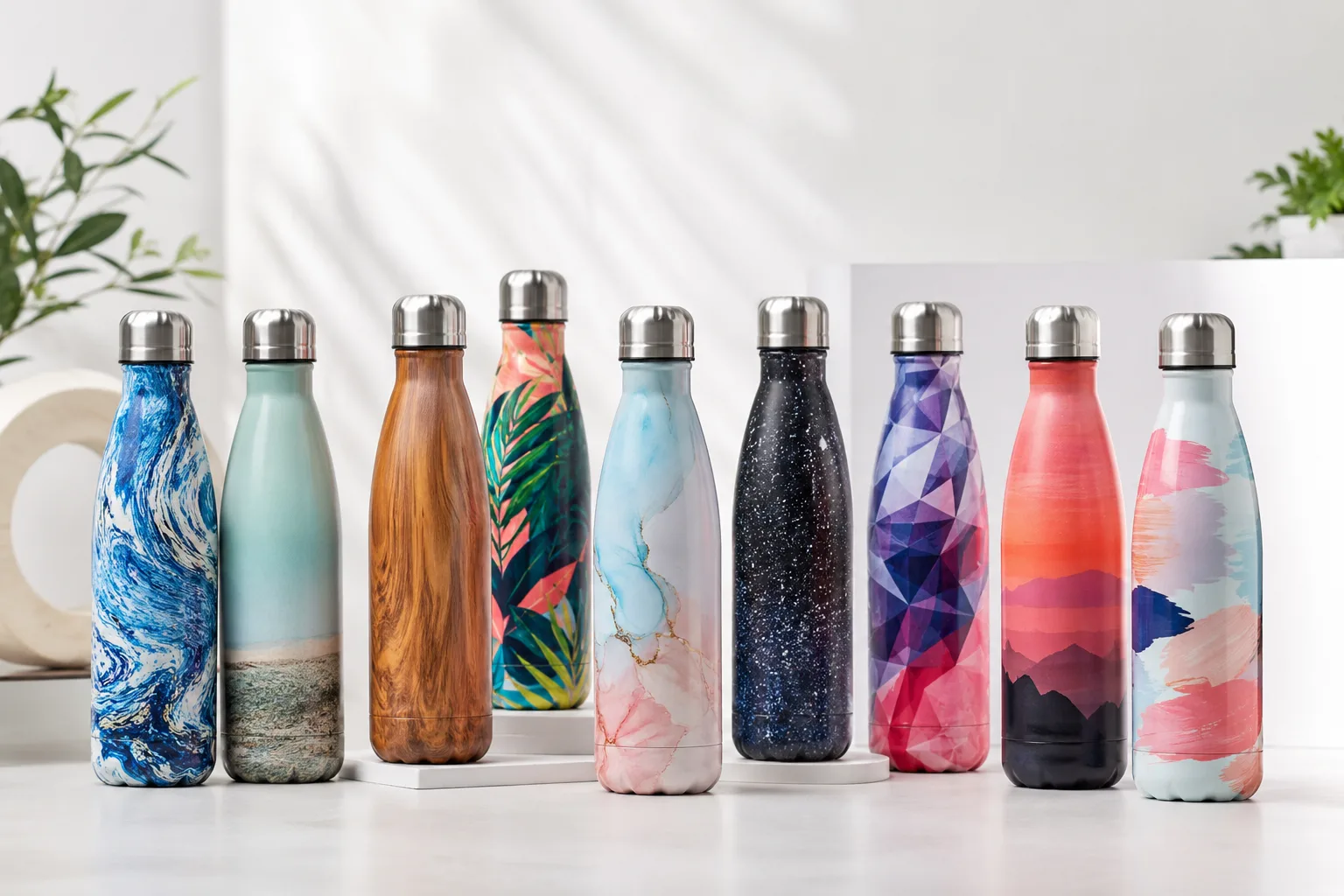
The visual appeal of a seamless, photo-quality design wrapped around a bottle is what draws most brands to sublimation. It opens up creative possibilities that other printing methods can't match. But from my experience in pre-sales, I’ve seen that the most successful projects are the ones where the client understands the process before we even make the first sample. Let’s walk through the three non-negotiable details that I've seen make or break an order, so you can decide if this technique is perfect for your brand.
Why Does My Bottle Need a Special Coating for Sublimation?
You've found the perfect stainless steel bottle shape, but then you're told it can't be sublimated. This can feel like a major setback, potentially derailing your launch schedule.
Sublimation ink doesn't bond with bare metal. It requires a special polymer coating to infuse into1. Without this factory-applied layer, the vibrant, permanent design you want is physically impossible to create. You must always confirm your chosen bottle is "sublimation-ready" before sampling.
%Close-up shot showing the smooth, coated surface of a sublimation-ready bottle
In my conversations with new clients, the single biggest point of confusion is the coating. Many assume we can print on any stainless steel surface, but the science of sublimation works differently. The process turns solid ink into a gas using heat and pressure2. This gas then permeates a polymer (plastic-based) surface before turning back into a solid, becoming a permanent part of the coating. Bare stainless steel has no pores for the ink gas to enter3.
This is why you can't simply buy an off-the-shelf bottle and expect it to be sublimated. The bottle must be manufactured with this special coating from the start.
Key Bottle Characteristics to Verify
| Feature | Sublimation-Ready Bottle | Standard Stainless Steel Bottle |
|---|---|---|
| Surface | Pre-applied polymer coating | Bare or powder-coated metal |
| Compatibility | Yes, designed for ink infusion | No, ink has nothing to bond with |
| Verification | Ask manufacturer for "sublimation-ready" spec | Not suitable for this process |
A common issue we see is a brand owner sourcing blank bottles from one factory and asking us to print them. When we explain the coating requirement, it often means they have to start their sourcing process over. Furthermore, this coating must meet food-contact safety standards like FDA and LFGB4. It's a critical question for your manufacturer to ensure your final product is not only beautiful but also safe and compliant.
Will My Final Bottle's Color Exactly Match My Digital Design?
Your brand has a very specific Pantone color that defines its entire identity. You're rightfully concerned that if the final product looks "off," it could cheapen your brand's image.
No, the final printed color will not be a pixel-perfect match to what you see on your computer screen. Colors are influenced by the coating, heat, and ink. The only reliable way to approve color is by reviewing a physical sample, not just a digital mockup.
%Side-by-side comparison of a digital design file on a screen and the final sublimated bottle
The phrase I use most often with clients is "approve the sample, not the screen." A computer monitor uses projected light (RGB color model) to show you a design, while your finished bottle reflects light off a physical surface (using CMYK inks)5. This fundamental difference means colors will always look different. On top of that, several manufacturing variables affect the final color output: the specific ink batch, the density of the coating, and the precise temperature and time in the heat press6. A slightly different setting can subtly alter the final shade.
A digital mockup is great for confirming the size and placement of your art, but it cannot predict the final color.
Understanding the Color Shift Process
| Stage | What Happens | Key Factor |
|---|---|---|
| 1. Digital File | Your design is created on a screen. | RGB color space, screen calibration. |
| 2. Print Preparation | The file is converted for printing. | CMYK color profile conversion. |
| 3. Heat Transfer | Ink becomes gas and infuses the coating. | Heat, pressure, and time influence color. |
| 4. Final Product | The design is permanently on the bottle. | Perceived color under reflected light. |
I always advise clients to build time for physical sample approval into their project timeline. It might add a couple of weeks, but it eliminates the risk of receiving thousands of units that don't meet your brand's color standard. Trusting a PDF proof for color accuracy is one of the fastest paths to disappointment in custom manufacturing. Approving a real, physical bottle is the only way to move into mass production with complete confidence.
How Durable is a Sublimated Print on a Stainless Steel Bottle?
You want a beautiful design for your customers, but you're worried that printed bottles can scratch easily, making your product look worn out after only a few uses.
A sublimated print is extremely durable against fading and peeling7 because the ink is infused into the bottle's coating8. However, the coating itself can be scratched by sharp objects or heavy abrasion. It is less scratch-resistant than laser engraving9 but offers far superior color and design complexity.
%A sublimated bottle next to a laser-engraved bottle to show the difference in finish
Think of sublimation not as a layer of paint sitting on top of the bottle, but as a tattoo for the bottle. The design becomes part of the surface itself. This is why it won't flake off or fade from UV exposure10 and regular washing like a sticker or a poorly applied screen print might. For everyday use, it's a very robust decoration.
However, the durability is tied to the coating. If you take a key and drag it hard across the surface, you can scratch the coating. If the scratch is deep enough to go through the coating, it will remove the print in that specific area. This is why it’s so important to match the decoration method to your customer's lifestyle. I often ask clients, "Where and how will your customer be using this bottle?" The answer helps us decide on the best finish.
Comparing Decoration Methods
| Decoration Type | Color Capability | Scratch Resistance | Best For |
|---|---|---|---|
| Sublimation | Full color, gradients, photos | Medium | Vibrant brand expressions, corporate gifts, retail products. |
| Screen Printing11 | 1-4 solid colors | Medium | Simple logos and text, cost-effective at scale. |
| Laser Engraving | No color (reveals steel) | High12 | Minimalist logos, text, extreme-use outdoor/gym bottles. |
For a bottle that will live on a desk or be carried in a tote bag, sublimation's visual impact is unmatched. But for a bottle that might be clipped to a rock-climbing harness or tossed in a tool bag, the superior scratch resistance of laser engraving might be a more practical choice. Being honest about this trade-off ensures your customers get a product that not only looks great but also holds up to their specific needs.
Conclusion
To ensure your sublimation project is a success, remember these three things: confirm your bottle has the correct coating, approve a physical sample for color, and match the durability to the end-user.
"The Truth About “Metal Prints” aka Dye Sublimation | Los Angeles", https://fineartprinting.la/the-truth-about-metal-prints-aka-dye-sublimation/. A source on the chemistry of dye-sublimation can confirm that the process relies on gaseous dye permeating and bonding with polymer molecules, a process that cannot occur on bare metal surfaces which lack the necessary molecular structure. Evidence role: mechanism; source type: paper. Supports: The source should explain the chemical process by which dye-sublimation inks bond with polyester or polymer coatings, and why they cannot bond with non-porous, uncoated surfaces like bare metal.. ↩
"Sublimation (phase transition) - Wikipedia", https://en.wikipedia.org/wiki/Sublimation_(phase_transition). An encyclopedia or physics resource can define sublimation as a phase transition from solid to gas, which is the core principle behind how dye-sublimation inks are transferred to a substrate under heat and pressure. Evidence role: definition; source type: encyclopedia. Supports: The source should define the physical process of sublimation, where a substance transitions directly from a solid to a gas state without passing through a liquid phase, and confirm this is the principle used in dye-sublimation printing.. ↩
"Stainless steel", https://en.wikipedia.org/wiki/Stainless_steel. A source from materials science can support the claim by describing the dense, non-porous surface structure of stainless steel, which lacks the interstitial spaces necessary for gaseous dye molecules to penetrate and form a permanent bond. Evidence role: mechanism; source type: research. Supports: The source should describe the surface properties of stainless steel, confirming its non-porous nature at a microscopic level, which prevents the infusion of gaseous dye particles.. ↩
"21 CFR 175.300 -- Resinous and polymeric coatings. - eCFR", https://www.ecfr.gov/current/title-21/chapter-I/subchapter-B/part-175/subpart-C/section-175.300. Regulations from government bodies like the U.S. Food and Drug Administration (FDA) or European standards such as the German Food and Feed Code (LFGB) specify the safety requirements for materials, including polymer coatings, that are used in food-contact applications like drinkware. Evidence role: general_support; source type: government. Supports: The source should be an official document from the FDA or a similar body (like the German LFGB) outlining the requirements for substances, including polymers, that are intended to come into contact with food.. ↩
"Additive & Subtractive Color Models > DINFOS Pavilion > Article", https://pavilion.dinfos.edu/Article/Article/2355687/additive-subtractive-color-models/. A source on color theory explains that digital screens use the additive RGB (Red, Green, Blue) model to create colors by emitting light, whereas the printing process uses the subtractive CMYK (Cyan, Magenta, Yellow, Key/Black) model, which creates color by absorbing certain wavelengths of light and reflecting others. Evidence role: definition; source type: education. Supports: The source should define the RGB (additive) and CMYK (subtractive) color models, explaining that the former is used for digital displays that emit light and the latter for printed materials that reflect light.. ↩
"Optimizing Sublimation Transfer Printing - Clemson OPEN", https://open.clemson.edu/cgi/viewcontent.cgi?article=5453&context=all_theses. Research in textile or materials engineering demonstrates that variables such as heat press temperature, dwell time, pressure, and the chemical properties of specific ink and coating batches significantly influence the final color output in the dye-sublimation process. Evidence role: mechanism; source type: paper. Supports: The source should detail how process parameters in dye-sublimation printing influence the final color and quality of the print.. ↩
"Durability of Printed Photos (Dye-Sub Printers)", https://support.usa.canon.com/kb/s/article/ART151002. Studies and industry tests on dye-sublimation prints often show high resistance to fading from UV exposure and degradation from washing, as the dye is infused into the substrate's coating rather than layered on top. Evidence role: statistic; source type: research. Supports: The source should provide data from tests (e.g., ASTM standards) on the fade resistance (lightfastness) and adhesion (resistance to peeling) of sublimated coatings after exposure to UV light and repeated washing.. Scope note: The exact level of durability can vary based on the quality of the coating, inks, and application process, so test results may not apply universally to all sublimated products. ↩
"Dye-sublimation printing - Wikipedia", https://en.wikipedia.org/wiki/Dye-sublimation_printing. Technical analyses of the dye-sublimation process confirm that under heat, the polymer coating's pores open to allow gaseous dye to enter; upon cooling, the pores close, physically trapping the solidified dye particles within the coating, resulting in an infused image. Evidence role: mechanism; source type: paper. Supports: The source should explain, ideally with microscopic imagery or chemical analysis, how gaseous dye particles penetrate and become entrapped within the polymer matrix of the coating as it cools.. ↩
"What are the pros and cons of using sublimation printing or laser ...", https://www.facebook.com/groups/215219099833258/posts/1288527775835713/. A source on materials science can support this by explaining that laser engraving alters or removes the surface material itself, while sublimation relies on a polymer coating. Polymer coatings generally have a lower surface hardness and abrasion resistance compared to the bulk metal (e.g., stainless steel) that constitutes the engraved mark. Evidence role: general_support; source type: research. Supports: The source should compare the durability of a polymer coating on metal to the base material properties of metal that is exposed or altered by laser engraving.. ↩
"[PDF] Fastness comparison with sublimation ink - Mimaki", https://mimaki.com/archives/011/201706/DB60004-03_DD400_ENG.pdf. Research on the permanence of digital prints often includes lightfastness ratings, which show that modern dye-sublimation inks, when properly applied to a quality substrate, exhibit high resistance to fading under UV light compared to other printing methods. Evidence role: statistic; source type: paper. Supports: The source should provide results from standardized lightfastness or weathering tests on sublimated materials, quantifying the degree of color change after UV exposure.. Scope note: The level of UV resistance can vary significantly depending on the specific dyes and coatings used, and no print is completely immune to fading over very long periods of intense exposure. ↩
"[PDF] Screen Process Printing on Cylindrical and Conical Shaped Surfaces", https://scholarworks.uni.edu/cgi/viewcontent.cgi?article=4585&context=grp. Industry resources on screen printing explain that each color requires a separate screen, squeegee, and print pass, with precise registration needed between layers. This complexity makes processes with more than a few colors, such as 1-4, increasingly difficult and expensive, especially on cylindrical items. Evidence role: general_support; source type: institution. Supports: The source should explain the process of multi-color screen printing on curved surfaces and why each additional color adds significant complexity and cost.. Scope note: While technically more colors are possible, the claim reflects a common practical and economic limit for mass production. ↩
"Does Laser Engraving Fade? | TYKMA Electrox", https://www.permanentmarking.com/does-laser-engraving-fade/. A source on materials processing can confirm that laser engraving creates a permanent mark by altering the surface of the material itself. Because no coating is added, the mark's scratch resistance is equivalent to that of the base material (e.g., stainless steel), which is generally high. Evidence role: mechanism; source type: research. Supports: The source should explain that laser engraving works by removing, ablating, or annealing the surface material, creating a mark that is as durable as the substrate itself.. ↩