
Your brand is on the line with every bottle you sell. You see spec sheets promising incredible insulation, but customer complaints about bottles losing their magic tell a different story.
The single most important factor for insulation performance is the quality of the vacuum seal between the bottle's inner and outer walls.1 A strong, stable vacuum stops heat transfer.2 Without it, fancy materials and features mean nothing, and performance will degrade quickly.
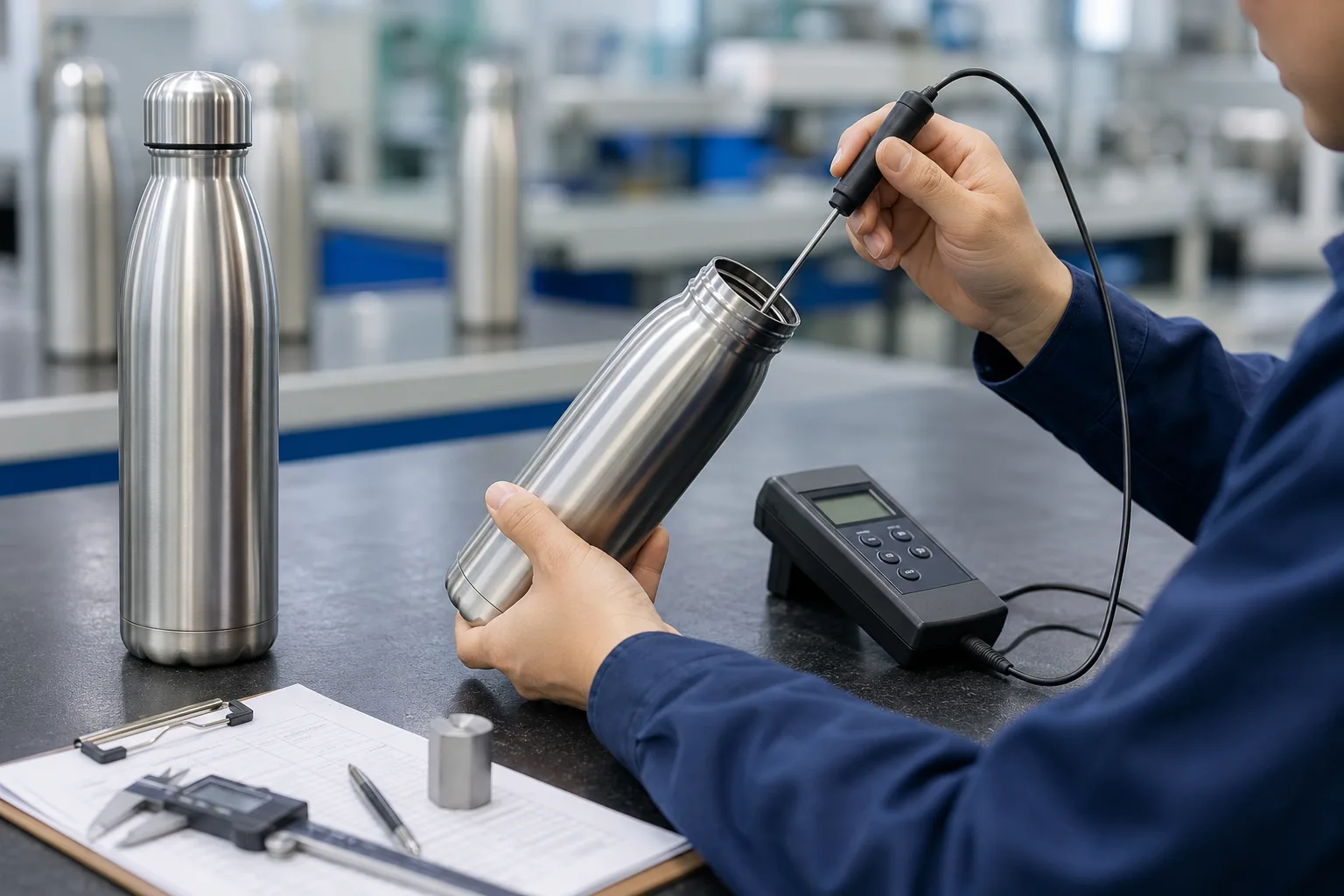
%An insulated water bottle being examined for quality
As someone who works on the factory floor, I see thousands of bottles every week. I also see the confusion from brand owners and distributors who are trying to source a reliable product. You are shown spec sheets filled with details about steel grades and wall thickness, but the one thing that truly determines performance is almost never mentioned. It's time to pull back the curtain and show you what actually matters, so you can protect your brand and deliver a product you can be proud of. Let's look at the questions you should be asking your supplier.
Is 'Double-Wall' the Same as 'Vacuum Insulated'?
Many suppliers use these terms as if they mean the same thing. This confusion can lead you to approve a product based on a false sense of quality, risking unhappy customers.
No, they are not the same. "Double-wall" simply means the bottle is constructed with two layers of steel. "Vacuum insulated" means the air has been pumped out from the space between those walls. A double-wall bottle with a failed or non-existent vacuum offers almost no insulation at all.3
%Cross-section of a double-wall vacuum insulated bottle
Think of it like this: heat needs a medium to travel, just like sound. In a water bottle, the main medium for heat transfer is the air trapped between the inner and outer walls. A vacuum removes that medium. This process is what stops the outside temperature from affecting your drink, and vice versa. A "double-wall" bottle that hasn't had the air properly removed is just a bottle with an air gap. That air will still conduct heat, causing cold drinks to warm up and hot drinks to cool down quickly. From our production data, a bottle with a failed vacuum can lose its insulating power by over 80%.4
Key Questions for Your Supplier
The only way to know the truth is to ask specific questions about their process. Vague answers are a major red flag.
| Question to Ask | Why It Matters | Red Flag Answer | Good Answer |
|---|---|---|---|
| "What is your vacuum pressure standard?" | This shows if they have a measurable quality target for insulation. | "We use a standard process." | "We maintain a vacuum level below 2.0 x 10⁻² Pa5 and have equipment to verify it." |
| "How do you test for vacuum seal integrity?" | This reveals their quality control process and commitment to consistency. | "We check a few from each order by hand." | "Every single bottle goes through a 100% temperature test after the vacuum process to ensure there are no leaks." |
Does a Copper Lining Actually Improve Insulation?
You've probably seen "extra copper layer" listed as a premium feature. It sounds impressive, but you need to know if it's a real performance booster or just a marketing buzzword.
Yes, a copper lining does improve insulation by reducing radiant heat transfer6, but it only works if the vacuum seal is strong and intact. Think of it as a turbocharger for a good engine. On a bottle with a poor vacuum, its effect is negligible.
%Diagram showing a copper lining inside a vacuum flask
Heat can also travel as invisible energy waves, a process called radiation. This can happen even across a vacuum. A thin layer of copper coated on the inner wall (inside the vacuum gap) is very effective at reflecting these heat waves. For a hot drink, it reflects heat back into the liquid. For a cold drink, it reflects external heat away from the liquid. From our internal tests, a copper layer can improve thermal retention by another 10-15% on an already well-made vacuum bottle.7
The Vacuum-First Principle
However, this feature is entirely dependent on the quality of the vacuum. I've had many conversations with buyers who are focused on adding copper but haven't asked a single question about our vacuum testing. This is like demanding high-performance tires for a car with a broken engine. A bottle with an excellent vacuum and no copper will always, without exception, outperform a bottle with a copper lining and a bad vacuum.8 When evaluating a bottle, here is the hierarchy of importance:
- Vacuum Seal Integrity: The non-negotiable foundation of all insulation.
- Copper Lining: A valuable and effective performance booster.
- Lid & Gasket Quality: Prevents heat from escaping or entering through the opening.
Will 316 Steel Keep Drinks Colder Than 304 Steel?
Some suppliers will offer an "upgrade" to 316 stainless steel, suggesting it offers superior performance. This often comes at a higher price, leaving you to wonder if it's a worthwhile investment.
No, 316 stainless steel provides no thermal advantage over 304 stainless steel.9 Both materials conduct heat at nearly identical rates.10 The choice between them is about corrosion resistance and the types of beverages the bottle will hold, not about insulation performance.
%Comparing 304 and 316 stainless steel samples
This is one of the most common misconceptions we have to clear up for buyers. The insulation magic comes from the vacuum, not the type of steel used to create the walls. Standard 18/8 food-grade stainless steel (Type 304) is the industry workhorse for a reason. It's safe, durable, and perfect for water, coffee, tea, and most everyday drinks. Type 316 steel, often called "marine-grade," contains an element called molybdenum. This gives it extra resistance against corrosion from salts and strong acids.
Choosing the Right Steel for Your Brand
So, when should you consider 316 steel? Only if you are specifically targeting a market that regularly consumes highly acidic or salty drinks. Paying more for 316 steel for a general-purpose water bottle is a waste of your budget that could be better spent on other customizations.
| If your customers will primarily use the bottle for... | Recommended Steel | Why? |
|---|---|---|
| Water, coffee, tea, daily use | 304 (18/8) Stainless Steel | Perfectly safe, durable, and cost-effective. The proven standard for the vast majority of uses. |
| Sports drinks, fruit juices, smoothies | 316 Stainless Steel | Offers superior long-term protection against pitting and corrosion caused by acids and electrolytes.11 |
| Maximum insulation performance | Both 304 and 316 perform identically. | Do not pay a premium for 316 steel expecting better insulation. Focus your questions on the vacuum quality instead. |
Conclusion
A great insulated bottle is defined by the invisible quality of its vacuum seal. To protect your brand, ask suppliers about their vacuum testing process, not just their material specs.
"Vacuum Flask - HyperPhysics", http://hyperphysics.phy-astr.gsu.edu/hbase/thermo/vacfla.html. A source on the physics of vacuum flasks can explain that the vacuum between the two walls is the primary feature that minimizes heat transfer by conduction and convection, making it the most critical component for insulation. Evidence role: mechanism; source type: encyclopedia. Supports: The principle that a vacuum is the primary insulator in a vacuum flask by preventing heat transfer via conduction and convection.. ↩
"Thermal insulation - Wikipedia", https://en.wikipedia.org/wiki/Thermal_insulation. Educational resources on thermodynamics explain that heat transfers through conduction, convection, and radiation. A vacuum acts as an excellent insulator by removing the air molecules needed for conduction and convection to occur. Evidence role: mechanism; source type: education. Supports: The mechanisms of heat transfer (conduction, convection, radiation) and how a vacuum effectively eliminates the first two.. Scope note: The source may also note that a vacuum does not stop heat transfer by thermal radiation, which is addressed by other features like reflective coatings. ↩
"List of thermal conductivities - Wikipedia", https://en.wikipedia.org/wiki/List_of_thermal_conductivities. A source comparing insulating materials can provide data on the thermal conductivity of air versus a vacuum, demonstrating that the presence of air in the gap allows for significant heat transfer via convection and conduction, drastically reducing insulation performance compared to a vacuum. Evidence role: statistic; source type: paper. Supports: The significant difference in insulating properties between an air-filled gap and a vacuum.. ↩
"Common Issues and Reasons Why Thermal Flasks Stop Working", https://relaxbottles.com/blogs/news/common-issues-and-reasons-why-thermal-flasks-stop-working. Independent testing or a research paper analyzing the performance of insulated containers could provide data on the rate of heat loss in a bottle with a compromised vacuum, supporting the claim of a substantial decrease in insulating power. Evidence role: case_reference; source type: research. Supports: The quantitative impact of a failed vacuum on the thermal retention of an insulated bottle.. Scope note: The exact percentage of performance loss will vary based on ambient temperature, liquid temperature, and bottle design, so a source may provide a range of values rather than a single figure. ↩
"Vacuum Flask - HyperPhysics", http://hyperphysics.phy-astr.gsu.edu/hbase/thermo/vacfla.html. A source from a vacuum technology institution or engineering standards body can provide context on the pressure levels (typically measured in Pascals or Torr) required to achieve effective thermal insulation, confirming that pressures in this range are indicative of a high-quality vacuum. Evidence role: general_support; source type: institution. Supports: The typical vacuum pressures used in manufacturing high-performance vacuum-insulated products.. Scope note: Specific manufacturing standards can be proprietary, so a source may discuss general ranges for 'high vacuum' rather than this exact number. ↩
"Development and Evaluation of Copper Based Transparent Heat ...", https://pmc.ncbi.nlm.nih.gov/articles/PMC9565434/. A paper on heat transfer or vacuum flask design can explain that a thin layer of a reflective material like copper has low thermal emissivity, meaning it reflects thermal radiation rather than absorbing or emitting it. This reduces heat transfer across the vacuum gap. Evidence role: mechanism; source type: paper. Supports: The mechanism by which a reflective layer like copper reduces heat transfer by radiation.. ↩
"[PDF] Nondestructive Assessment for Detection of Low-E Coatings on ...", https://docs.lib.purdue.edu/cgi/viewcontent.cgi?article=1820&context=cib-conferences. Research or independent product testing that compares vacuum flasks with and without a reflective inner coating can provide data on the percentage improvement in thermal retention time, supporting the claim that a copper layer offers a significant performance boost. Evidence role: statistic; source type: research. Supports: The measurable improvement in insulation performance provided by a copper lining in a vacuum flask.. Scope note: The exact percentage of improvement can vary depending on the test conditions and bottle design, so a source might provide a range of performance gains. ↩
"Types of Insulation | Department of Energy", https://www.energy.gov/energysaver/types-insulation. A source analyzing the physics of vacuum flasks can demonstrate that heat transfer from convection and conduction (stopped by the vacuum) is far more significant in this context than heat transfer from radiation (reduced by the copper), supporting the principle that a high-quality vacuum is the most critical factor for performance. Evidence role: general_support; source type: paper. Supports: The relative contributions of the vacuum and the reflective coating to overall insulation performance.. ↩
"Thermophysical Properties of Stainless Steels", https://www.osti.gov/servlets/purl/4152287. A materials engineering database or a specification sheet from a steel industry association can provide the thermal conductivity values for both 304 and 316 stainless steel, showing that the figures are nearly identical and thus would not result in any discernible difference in insulation performance. Evidence role: statistic; source type: government. Supports: The thermal conductivity values for 304 and 316 stainless steel are nearly identical.. ↩
"[PDF] Thermophysical Properties of Stainless Steels - OSTI", https://www.osti.gov/servlets/purl/4152287. A materials science handbook or research paper will list the thermal conductivity of 304 stainless steel at approximately 16.2 W/(m·K) and 316 stainless steel at approximately 16.3 W/(m·K) at room temperature, confirming they conduct heat at virtually the same rate. Evidence role: statistic; source type: research. Supports: The specific thermal conductivity values for both types of steel.. Scope note: Values may vary slightly depending on the exact composition and temperature, but the relative similarity remains constant. ↩
"Stainless Steel 316L and its Uses in Food and Beverage", https://scholarsjunction.msstate.edu/metallurgy/42/. A paper on metallurgy or food-grade materials can explain that the addition of molybdenum in 316 steel provides superior resistance to pitting and crevice corrosion from chlorides (salts) and non-oxidizing acids, making it a better choice for long-term exposure to beverages like sports drinks and fruit juices. Evidence role: mechanism; source type: paper. Supports: The superior corrosion resistance of 316 steel compared to 304, especially in acidic and chloride-rich environments.. ↩