
Struggling to design a flask that connects with your customers? You worry that picking the wrong features will lead to a product that flops and gets bad reviews.
Designing the perfect vacuum flask involves matching its features to your target user's lifestyle. It's about making smart choices on the lid, materials, structure, and finish to create a product that solves a real-world problem for them, not just looks good on a shelf.
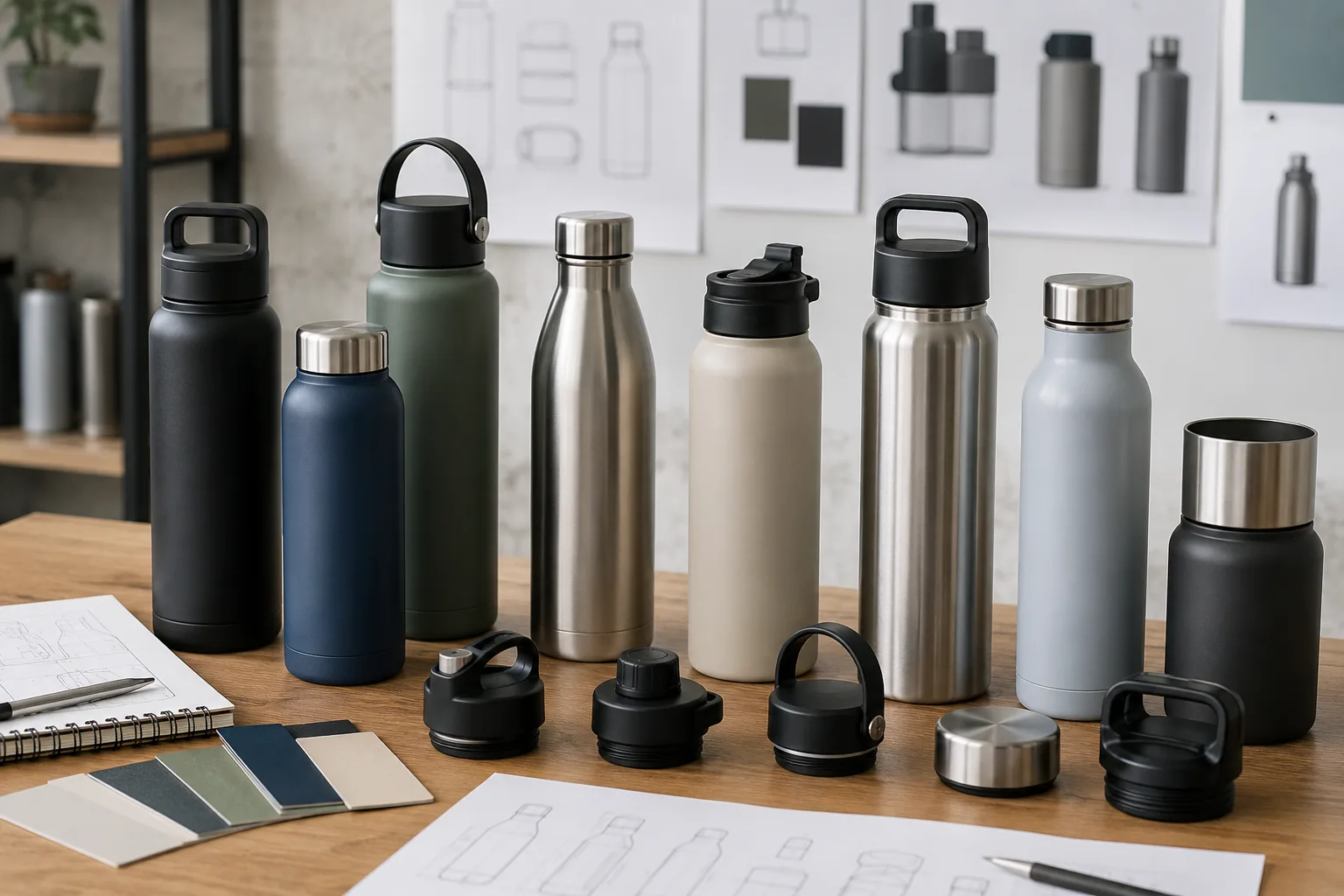
%A collection of custom-designed vacuum flasks with different lids and finishes
I’ve seen countless new brands come to us focusing only on getting their logo on a bottle. They pour all their energy into the color and the branding but overlook the small details that actually make a flask great. This often leads to a product that doesn't perform as their customers expect. But a few simple questions at the start of the process can guide you to a much better, more successful product. Let's walk through the key decisions you need to make.
Is the Lid Just a Style Choice?
Worried your flask's lid won't meet user expectations? A poorly chosen lid can lead to leaks and frustration, quickly undermining your brand's reputation with negative reviews.
The lid is a critical functional decision, not just a style choice. It defines the primary use case1, whether it's for a commuter needing a one-handed flip-top, an athlete wanting a straw lid, or a camper who needs a wide-mouth for easy pouring.
%Three different types of vacuum flask lids: a flip-top lid, a straw lid, and a wide-mouth screw lid
When a new client sends us a design, the lid is one of the first things I look at. It tells me if they've really thought about their end user. A beautiful bottle with the wrong lid is a recipe for failure. For example, a brand targeting gym-goers with a wide-mouth screw lid is creating a problem. It’s difficult to drink from while on a treadmill. They should be considering a straw lid or a flip-top for quick, easy sips. We see this all the time. The choice you make here positions your product in the market. Each lid type has a specific job.
Matching Lids to Lifestyles
| Lid Type | Ideal Use Case | Key Benefit | Potential Downside |
|---|---|---|---|
| Flip-Top Lid | Commuting, Desk Use | One-handed operation, spill-resistant | More complex cleaning2 |
| Straw Lid | Sports, Driving | Easy sipping without tilting | Can be less leak-proof |
| Wide-Mouth Lid | Camping, Sharing | Easy to fill, clean, and pour | Requires two hands to open |
| Handle Lid | Hiking, Outdoor | Easy to carry, clip to a bag | Can be bulky |
Thinking through these scenarios helps you build a product that fits seamlessly into your customer's daily routine, which is the key to creating a product they'll love and recommend.
Should You Always Choose 316 Stainless Steel for Your Flask?
Confused by material options like 304 and 316 stainless steel? Choosing the wrong one can inflate your manufacturing costs without adding any real value for your customer.
Not necessarily. While 316 steel offers superior corrosion resistance3, food-grade 304 steel is the industry standard4 and perfect for most uses like water or coffee. The upgrade to 316 is a cost-tradeoff, only truly necessary for acidic beverages5 or specific markets.
%A close-up shot showing the inside of a stainless steel vacuum flask
This is a conversation I have almost every week. A client will come to us and insist on using 316 stainless steel for both the inner and outer walls because they read online that it's "better." While it's true that 316 steel has added molybdenum for extra corrosion resistance6, it's often overkill. For 90% of the vacuum flasks we produce, a 304 stainless steel inner wall is perfectly safe, durable, and cost-effective. It's the standard for a reason.
When 316 Steel Makes Sense
The real question isn't "which is better?" but "what will your customer put in the bottle?" If you're designing a flask for a health brand whose customers drink lemon water, or for a coffee brand specializing in acidic cold brew, then upgrading the inner wall to 316 makes perfect sense. It protects the steel over the long term. But for a general-purpose water bottle, 304 steel provides all the performance and safety needed without the added cost. As a manufacturer, our job is to help you invest your budget where it matters most to your customer.
| Material | Best For | Main Advantage | Cost |
|---|---|---|---|
| 304 Stainless Steel | Water, coffee, tea, general use | Industry standard, cost-effective, excellent safety | $$ |
| 316 Stainless Steel | Acidic drinks (lemon water, kombucha), high-salinity liquids | Superior corrosion and acid resistance | $$$ |
Why Does My Simple Design Idea Have a High Production Cost?
Ever get a production quote that’s much higher than you expected? A seemingly simple design choice can hide manufacturing complexities that drive up costs and MOQ requirements.
Your design's structural details directly impact tooling and manufacturing complexity. Choices about the vacuum gap, neck diameter, or even the silicone seal's shape can make a product much harder or more expensive to produce at scale. Small changes can have big cost implications.
%A factory worker inspecting the structure and seams of a stainless steel bottle
A client once came to us with a beautiful 3D render of a bottle. It had a very sharp, angular base that looked incredibly modern. The problem wasn't the look; it was the physics of manufacturing it. Creating that sharp edge with stainless steel requires a more complex deep-drawing process7 and specialized tooling. This adds weeks to the setup time and increases the cost of every single bottle.
We worked with them to soften the angle just slightly. From a few feet away, you could barely tell the difference. But on the factory floor, that small change allowed us to use our existing tooling and a more efficient process. This kept over 90% of their desired look but cut the unit cost by a significant margin. These are the kinds of conversations that prevent budget surprises. Seemingly small details in a drawing can have huge consequences for production.
Hidden Cost Factors in Flask Design
- Vacuum Gap: A wider gap between the inner and outer walls is easier to manufacture8 and provides better insulation9. Making it ultra-slim for a sleeker look is possible, but it requires more precision and can increase the defect rate.
- Neck Diameter: Sticking to standard neck diameters means we can use existing, proven lid designs. A custom neck size means creating a whole new tool for the bottle's thread and a matching tool for the lid10, adding cost and complexity.
- Body Shape: Cylindrical bottles are the most straightforward to produce. Tapered shapes, square bodies, or complex curves all require more advanced tooling and slower production speeds.11
How Can I Give My Manufacturer a Perfect Design Brief?
Tired of endless back-and-forth revisions with your manufacturer? A vague design brief leads to wasted time, incorrect samples, and frustration for everyone involved in the project.
A perfect design brief goes far beyond aesthetics. It must clearly define the target user, the primary use case, and the key performance priority (e.g., heat retention vs. portability). This context allows your manufacturer to provide functional, production-ready feedback from day one.
%A person writing a design brief on a notepad with a vacuum flask and color swatches nearby
The best projects always start with the best briefs. When a client sends me a brief that just says "Make this bottle in Pantone blue with our logo," I know we have a lot of questions to ask. When they send a brief that explains who the bottle is for and why they need it, we can get to work immediately. This context is everything. It allows us to move from being just a supplier to being a true partner in developing their product. We can use our experience to spot potential problems and suggest improvements before the first sample is ever made.
The Anatomy of a Great Design Brief
Instead of just sending a picture, try to answer these four questions for us:
- Who is this product for? (The User Persona)
- Example: "Our target user is a construction worker who needs a durable bottle for their lunch pail."
- Where and how will they use it? (The Use Scenario)
- Example: "It will be used on-site, needs to withstand drops, and should be easy to open with gloves on."
- What is the single most important feature? (The Performance Priority)
- Example: "Durability is number one. Second is keeping soup hot for at least 6 hours12."
- How should it look and feel? (The Aesthetics and Finish)
- Example: "A textured powder coat to prevent scratches, in a safety yellow color, with a laser-engraved logo that won't peel off."
When we get this level of detail, we can instantly recommend a thick-walled body, a simple and robust screw-top lid, and the most durable coating available. It’s the difference between just making your product and helping you make it successful.
Conclusion
Designing a great vacuum flask means aligning function, materials, and structure with your user's needs. Start with 'why' and 'who' before deciding on the 'what' for a successful product.
"Human Factors in Product Design", https://productsofdesign.sva.edu/blog/human-factors-product-design. A source on industrial design principles could support this by explaining how the physical characteristics of a product feature, such as a lid, create 'affordances' that signal its intended function to the user. Evidence role: general_support; source type: education. Supports: The source should discuss the design principle of 'affordance,' where an object's properties imply its utility, and how different lid designs suggest different uses (e.g., sipping, pouring, carrying).. Scope note: The source would likely discuss general design principles rather than vacuum flasks specifically. ↩
"Daily Use Water Bottles as a Hub for Microbial Population - PMC", https://pmc.ncbi.nlm.nih.gov/articles/PMC11174293/. Studies on the hygiene of reusable beverage containers have found that complex lid mechanisms with multiple parts and seals can harbor more bacteria and be more difficult to clean effectively than simpler designs. Evidence role: case_reference; source type: research. Supports: The source should provide data or analysis on the difficulty of cleaning complex multi-part lids and the potential for bacteria to accumulate in hard-to-reach areas.. Scope note: The source may not specifically compare flip-top lids to the other types mentioned but can provide general support for the idea that complexity increases cleaning difficulty. ↩
"[PDF] Effect of Molybdenum Additions on the Microstructures and ... - OSTI", https://www.osti.gov/servlets/purl/1439854. A source from materials science can confirm that 316 stainless steel contains molybdenum, which enhances its resistance to pitting and crevice corrosion, especially in chloride-rich or acidic environments, making it superior to 304 steel in those applications. Evidence role: mechanism; source type: paper. Supports: The source should explain that the addition of molybdenum to 316 stainless steel significantly increases its resistance to corrosion, particularly from chlorides and acids, compared to 304 stainless steel.. ↩
"Food Packaging & Other Substances that Come in Contact with Food", https://www.fda.gov/food/food-ingredients-packaging/food-packaging-other-substances-come-contact-food-information-consumers. A document from a food safety or standards organization can support this by listing 304 stainless steel (often referred to as 18/8 or 18/10) as a common and acceptable material for food and beverage contact due to its durability and resistance to corrosion in typical conditions. Evidence role: general_support; source type: government. Supports: The source should confirm that 304 stainless steel (or its equivalent, 18/8 stainless steel) is widely recognized and approved for use as a food-contact surface by regulatory or standards bodies.. Scope note: The source may not use the exact phrase 'industry standard' but will establish its widespread acceptance and suitability for food-related applications. ↩
"Study of the Corrosion Behavior of Stainless Steel in Food Industry", https://pmc.ncbi.nlm.nih.gov/articles/PMC11012613/. Research on the interaction between acidic solutions and stainless steel alloys can support this, showing that while 304 steel is suitable for many foods, 316 steel provides superior long-term resistance to the corrosive effects of acidic beverages like citrus juices or some coffees. Evidence role: mechanism; source type: paper. Supports: The source should provide data or analysis showing that while 304 steel is generally resistant, prolonged contact with certain acids can lead to leaching or pitting, a risk that is mitigated by the molybdenum in 316 steel.. Scope note: The evidence may be from laboratory studies on specific acids rather than commercial beverages, but it would support the underlying chemical principle. ↩
"SAE 316L stainless steel - Wikipedia", https://en.wikipedia.org/wiki/SAE_316L_stainless_steel. A materials science handbook or metallurgical resource can confirm that the standard composition of 316 stainless steel includes molybdenum as a key alloying element, which is primarily responsible for its enhanced resistance to corrosion compared to 304 steel. Evidence role: definition; source type: encyclopedia. Supports: The source should define the composition of AISI 316 stainless steel and explicitly state that it contains 2-3% molybdenum, which is added to improve resistance to corrosion, particularly against chlorides.. ↩
"Rule-based DFM analysis for deep drawing - Wikipedia", https://en.wikipedia.org/wiki/Rule-based_DFM_analysis_for_deep_drawing. A source on metal forming or manufacturing engineering can support this by explaining that the deep-drawing process for sheet metal is most efficient with generous radii, as sharp corners concentrate stress, require more complex multi-stage tooling, and increase the risk of material failure. Evidence role: mechanism; source type: education. Supports: The source should explain that in the deep drawing process, material flows over a die radius, and a very small or 'sharp' radius can lead to high stress concentrations, thinning, and tearing of the metal sheet.. Scope note: The source will likely discuss general principles of deep drawing rather than the specific application of vacuum flasks. ↩
"Vacuum Insulation Panel Production with Ultralow Thermal ...", https://ui.adsabs.harvard.edu/abs/2024IJT....45..163J/abstract. A source detailing the manufacturing process for vacuum-insulated products can support this by explaining that maintaining a consistent, very narrow gap between the inner and outer walls requires higher precision in tooling and assembly, making a wider, more tolerant gap easier and more cost-effective to produce reliably. Evidence role: general_support; source type: institution. Supports: The source should describe the process of manufacturing a vacuum flask, including the welding of the inner and outer walls, and explain how tighter tolerances (a smaller gap) increase process difficulty and potential for defects.. Scope note: This information is often proprietary, so a general overview from a manufacturing association or engineering publication may be the most likely source. ↩
"[PDF] The Effective Thermal Performance of an Insulated Standard Stud ...", https://web.ornl.gov/sci/buildings/conf-archive/1979%20B1%20papers/068.pdf. A physics or engineering text explaining the principles of vacuum insulation can support this. Heat transfer via conduction and convection is minimized in a vacuum, and a wider gap can further reduce the impact of any residual gas molecules, while also affecting radiative heat transfer between the inner and outer walls. Evidence role: mechanism; source type: education. Supports: The source should explain that insulation in a vacuum flask works by minimizing heat transfer, and a wider gap can reduce the minimal conduction/convection through residual gas molecules and decrease radiative heat transfer between the walls.. Scope note: The source might note that beyond a certain point, increasing the gap size yields diminishing returns on insulation performance. ↩
"Understanding Injection Mold Cost for Parts and Tooling - Protolabs", https://www.protolabs.com/resources/design-tips/11-tips-to-reduce-injection-molding-costs/. A source on manufacturing economics or design for manufacturability can confirm that components like threads and closures are often standardized to allow for the reuse of expensive tooling. Introducing a custom dimension requires the creation of new, dedicated tools (e.g., molds, dies), which represents a substantial upfront cost and development time. Evidence role: general_support; source type: education. Supports: The source should explain that manufacturing processes like injection molding (for lids) and thread rolling (for bottles) rely on hardened steel tools (molds and dies) that are specific to a part's geometry, and creating new tools is a significant capital and time investment.. ↩
"Review on metal packaging: materials, forms, food applications ...", https://pmc.ncbi.nlm.nih.gov/articles/PMC7270472/. A source from manufacturing engineering can support this by explaining that producing non-cylindrical hollow shapes from metal often requires more advanced and costly processes, such as hydroforming, compared to the more straightforward drawing process used for cylindrical bodies. These advanced processes typically have slower production speeds and higher tooling costs. Evidence role: mechanism; source type: paper. Supports: The source should explain that while cylinders can be formed efficiently, non-uniform shapes like squares or tapers require more complex processes like hydroforming or multi-stage drawing, which involve more expensive tooling, slower cycle times, and higher defect rates.. Scope note: The source will likely focus on the engineering principles rather than the specific business implications for flask design. ↩
""Danger Zone" (40°F - 140°F) | Food Safety and Inspection Service", http://www.fsis.usda.gov/food-safety/safe-food-handling-and-preparation/food-safety-basics/danger-zone-40f-140f. Food safety guidelines from government bodies like the FDA or USDA state that hot food must be maintained at or above 140°F (60°C) to prevent bacterial growth. The 6-hour performance target for a flask reflects the need to keep its contents above this temperature for the duration of a typical work or school day. Evidence role: statistic; source type: government. Supports: The source should define the 'temperature danger zone' (typically 40°F to 140°F or 4°C to 60°C) where bacteria grow rapidly, and state the maximum time food can be held in this zone.. Scope note: The source will provide the food safety rule, not the 6-hour flask performance standard, but it provides the scientific justification for why such a standard is important. ↩