
Struggling to figure out the real cost of making a premium water bottle for your brand? The high retail prices are confusing. Understanding the factory cost breakdown is the key to creating a high-quality, profitable product.
A premium water bottle that retails for $35-$40, similar to an Owala, typically costs between $3 to $8 (FOB) to manufacture1. This price varies greatly based on order volume, material grades, lid complexity, and surface finish. The retail price is not an indicator of production cost alone.
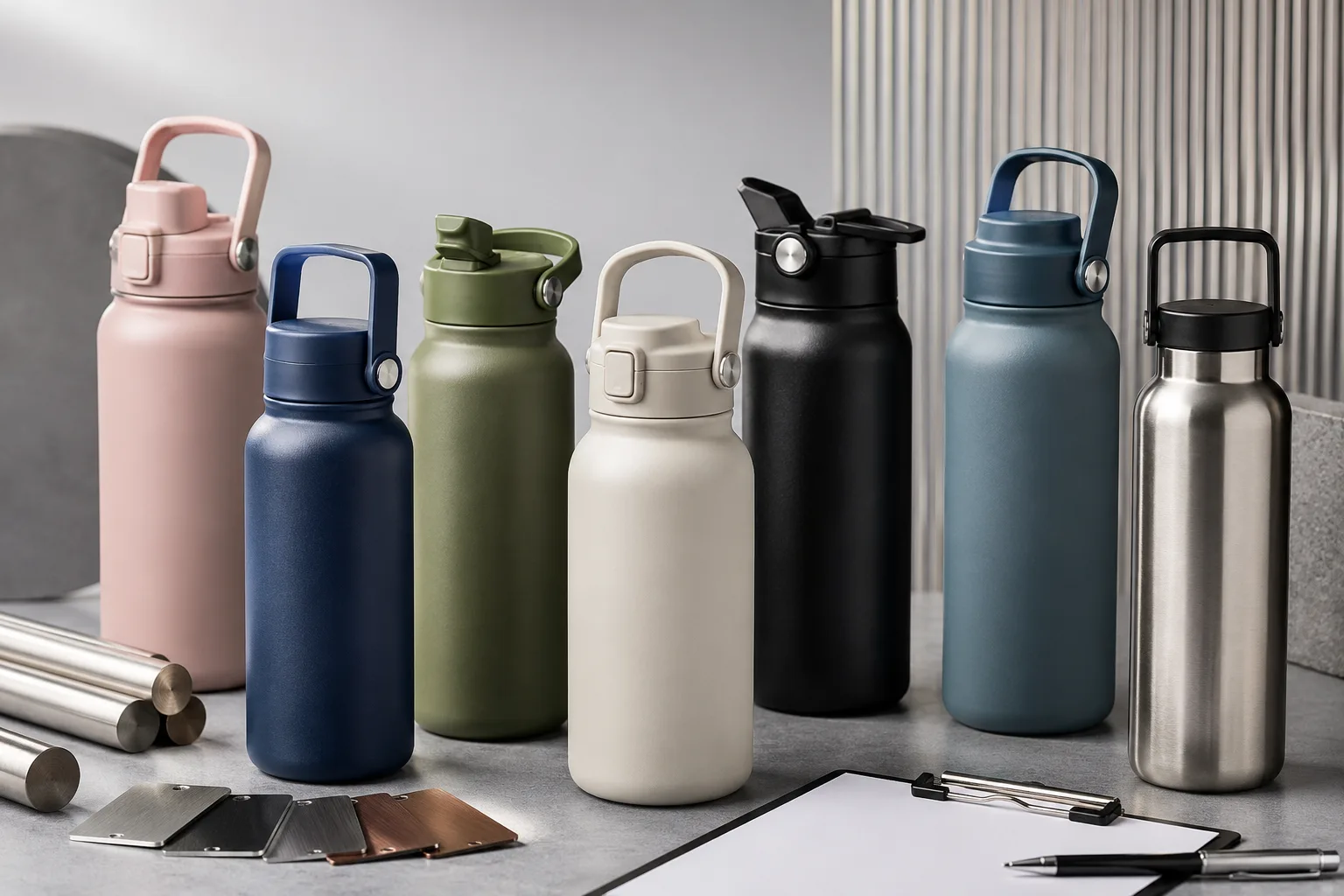
%A display of colorful water bottles similar to Owala
As a manufacturer, one of the first questions I get from new brand owners is about the cost of making a bottle like one from a famous brand. It's a natural starting point. But the truth is, the price you see on a store shelf has very little to do with the price we quote from the factory floor. The gap between those two numbers is where brands are built and profits are made. To succeed, you need to stop looking at the retail tag and start looking at the build sheet. This shift in perspective is the first step toward building your own successful water bottle brand. Let's dig into what really drives the cost.
Why Is a $40 Retail Bottle So Much Cheaper to Make?
Seeing high retail prices makes building your own brand feel impossibly expensive. You might assume the factory cost is a huge part of that price. The reality is that your factory cost is just one small, manageable piece of the puzzle.
A $40 retail price does not equal a $20 manufacturing cost. The factory price, or FOB cost, for a comparable premium bottle is often just $3 to $8. The large markup covers brand marketing, global shipping, warehousing, retailer profit margins, and intellectual property, not just production.2
%An infographic showing the cost breakdown of a retail product
When we talk about factory cost, we mean the FOB (Free On Board) price. This is the price per unit to manufacture your product and get it ready for shipping at the port. It’s the foundational number for all your other calculations. From there, you have to add all the other expenses that turn a factory product into a retail one. When a new client comes to us, they are often surprised by this. They anchor on the retail price they know. Our first conversation is always about shifting that focus from the shelf price to the specification sheet. That is where your brand’s profitability is truly decided. It’s not about what Owala spends; it’s about what you decide to spend on quality, materials, and features to build your own unique product.
Here is a simplified table to show how a bottle can go from the factory to the retail shelf.
| Cost Component | Typical Percentage of Retail Price | Example for a $40 Bottle |
|---|---|---|
| FOB Factory Cost | 10% - 20%3 | $4.00 - $8.00 |
| International Shipping & Duties | 5% - 10% | $2.00 - $4.00 |
| Domestic Warehousing & Logistics | 5% - 10% | $2.00 - $4.00 |
| Marketing & Brand Overhead | 15% - 25% | $6.00 - $10.00 |
| Retailer Margin / Marketplace Fees | 40% - 50%4 | $16.00 - $20.00 |
What Raw Materials Drive the Cost of a Premium Water Bottle?
You want Owala-level quality but do not know what materials to specify for your bottle. Choosing the wrong grade of steel or thickness can hurt your product or your budget. Knowing your key material options gives you direct control over cost and performance.
Stainless steel is the single biggest cost factor.5 The grade you choose (food-grade 304 vs. medical-grade 316) and the thickness of the inner and outer walls directly impact the final price. Thicker walls mean more material and higher cost, while 316 steel offers superior corrosion resistance for a premium.6
%Close-up of stainless steel sheets in a factory
In our production process, the first decision we discuss with a client is the material. For insulated bottles, you have two stainless steel shells: an inner one and an outer one. The most common material is 18/8 stainless steel, also known as food-grade 304.7 It is the industry standard because it is safe, durable, and cost-effective. It’s perfect for water, coffee, and most everyday drinks. For brands that want to offer a higher-end option, there is 18/10 or 316 stainless steel. This "marine-grade" steel provides superior resistance to corrosion from salts and acids, making it ideal for athletes who use electrolyte drinks. This upgrade, however, can increase your material cost by about 15-25%8. The thickness of the steel also matters. A thicker wall uses more raw material, making the bottle heavier, more durable, and more expensive. It is a direct trade-off between cost and that feeling of quality in your customer's hand.
| Feature | 304 (18/8) Stainless Steel | 316 (18/10) Stainless Steel |
|---|---|---|
| Cost | Standard Industry Price | ~15-25% Higher |
| Corrosion Resistance | Excellent | Superior (Best for acidic drinks) |
| Common Use | General purpose, water, coffee | Premium, sports drinks, marine use |
How Does Order Quantity Change Your Unit Price?
You want to start with a small test order of a few hundred bottles. But factories often quote a much higher unit price, making your initial run seem unprofitable. Understanding Minimum Order Quantity (MOQ) is essential for planning a successful launch budget.
Minimum Order Quantity (MOQ) is a massive cost multiplier. The unit cost for an order of 5,000 pieces can be 40-60% lower than for an order of 500 pieces9. This is because tooling setup, raw material purchasing, and labor efficiency are all optimized for larger production runs.10
%Stacks of boxes in a warehouse ready for shipping
Many brand owners assume they can test the market with 200 units at a price similar to a large order. This is a common misunderstanding of how manufacturing works. Every production run has fixed costs. Setting up the machinery, calibrating the tools, and preparing the production line costs the same whether we are making 500 bottles or 5,000. On a small order, that setup cost is spread across fewer units, making each one more expensive. Furthermore, we purchase our stainless steel in giant coils. Buying in bulk gives us better pricing from our suppliers, a saving we pass on to our clients. For a small order, we might have to buy materials at a higher price. Finally, a production line gains efficiency over time. The team gets faster with repetition. Because of these factors, a larger order is always significantly cheaper per unit.
| Order Quantity (Units) | Estimated FOB Price Range* | Key Reason |
|---|---|---|
| 500 | $7.00 - $9.00 | High setup costs per unit, low material discount |
| 3,000 | $4.50 - $6.00 | Standard MOQ, balanced efficiency and cost |
| 10,000+ | $3.00 - $4.50 | Maximum efficiency, best raw material price |
*Note: These are illustrative prices for a typical double-wall insulated bottle.
What Key Decisions Determine Your Bottle's Final Cost?
You want to create a unique water bottle but feel overwhelmed by all the customization options. Focusing only on copying another brand limits your potential and your control over the budget. Making a few key specification choices is how you build a great, profitable product.
Instead of trying to copy Owala, focus on the four key decisions that control your costs: 1) the material grade (304 vs. 316 steel), 2) the complexity of the lid, 3) the surface finish (powder coat vs. simple print), and 4) your packaging choice. Each is a lever you can pull.
%A person choosing between different color swatches and lid types
The most exciting part of this process is that you are in control. The right question is not "How much does an Owala cost to make?" but rather, "What kind of bottle do I want to build for my brand?" Let's break down the main cost levers you can pull, beyond the material and order quantity we already discussed. First is the lid mechanism. A simple, single-piece screw cap is very inexpensive. A complex, multi-part lid with a built-in straw, a handle, and a push-button lock requires multiple expensive molds and more time for assembly11. This is a major cost driver that is often underestimated. Second is the surface treatment. A simple, one-color logo printed on the bottle is the most affordable option. A durable powder coat finish, a full-wrap graphic, or a gradient color effect will increase the cost but also the perceived value. Third is packaging. Shipping your bottles in a basic polybag is cheapest. A custom-printed retail box or a gift tube adds cost but creates a better unboxing experience for your customer. As your manufacturing partner, our job is to help you navigate these choices to hit your target cost while creating a bottle you are proud of.
Conclusion
Manufacturing a premium bottle is cheaper than its retail price suggests. Your final factory cost depends on your choices in materials, order quantity, and custom features, not a secret formula.
"Manufacturing Costs: Full Breakdown & Cost Analysis", https://www.design2market.co.uk/academy/manufacturing-cost-considerations/. A source can provide an analysis of manufacturing costs for common consumer goods, showing that the factory price is often a small fraction of the final retail price, with figures for similar products falling within the stated range. Evidence role: statistic; source type: research. Supports: The typical Free On Board (FOB) cost for consumer hard goods like insulated drinkware, showing the ratio of manufacturing cost to retail price.. Scope note: The exact cost will vary based on the specific year, materials, and factory, so the source provides a general industry average rather than a precise quote for the product mentioned. ↩
"Pricing : r/manufacturing - Reddit", https://www.reddit.com/r/manufacturing/comments/rcnjih/pricing/. A business or economics resource can define the various costs included in a product's journey from factory to consumer, such as freight, insurance, duties, marketing, and retailer markup, which collectively account for the majority of the shelf price. Evidence role: definition; source type: education. Supports: The components that contribute to a product's final retail price beyond the initial manufacturing cost.. ↩
"Food Prices and Spending | Economic Research Service - USDA", http://www.ers.usda.gov/data-products/ag-and-food-statistics-charting-the-essentials/food-prices-and-spending. A market research report or business school case study on consumer product pricing can provide data showing that the factory cost (FOB) for many consumer goods often falls in the range of 10% to 20% of the final retail price, with the remainder covering logistics, marketing, and channel margins. Evidence role: statistic; source type: research. Supports: The typical ratio of factory cost (FOB) to the manufacturer's suggested retail price (MSRP) for consumer hard goods.. Scope note: This percentage is an average and can vary significantly based on the brand's strategy, product category, and distribution channels. ↩
"What is average markup % on retail products? : r/Entrepreneur", https://www.reddit.com/r/Entrepreneur/comments/6wl1ry/what_is_average_markup_on_retail_products/. Industry analysis or business research can show that retailer markups for consumer hard goods frequently range from 40% to 50% of the final selling price, a practice sometimes referred to as keystone pricing or higher. Evidence role: statistic; source type: research. Supports: The average margin that retailers or marketplaces add to the wholesale price of consumer goods.. Scope note: Margins can vary widely by product category, brand power, and retail channel (e.g., big-box store vs. independent boutique vs. online marketplace). ↩
"Stainless Steel Market Size & Share | Industry Report, 2033", https://www.grandviewresearch.com/industry-analysis/stainless-steel-market. A source on manufacturing cost analysis can confirm that for products like insulated drinkware, the cost of the primary raw material (stainless steel) typically constitutes the largest portion of the factory cost, before labor and finishing are added. Evidence role: general_support; source type: research. Supports: Raw materials, particularly metals like stainless steel, often represent the largest single component of the manufacturing cost for durable consumer goods.. Scope note: The source would support the general principle, but the exact cost balance can shift depending on the complexity of other components like the lid. ↩
"Deciding on the Best Material – 304 vs. 316 Stainless Steel - Polycase", https://www.polycase.com/techtalk/steel-enclosures/304-vs-316-stainless-steel.html. A metallurgical study or materials engineering guide can explain that the addition of molybdenum in 316 stainless steel provides enhanced resistance to corrosion, particularly from chlorides and acids, compared to 304 stainless steel. Evidence role: mechanism; source type: paper. Supports: The chemical and performance differences between 304 and 316 stainless steel, specifically regarding corrosion.. ↩
"SAE 304 stainless steel - Wikipedia", https://en.wikipedia.org/wiki/SAE_304_stainless_steel. A materials science or engineering resource can confirm that '18/8' stainless steel refers to its composition of approximately 18% chromium and 8% nickel, which is characteristic of Type 304 steel, and that this grade is widely used for food and beverage applications due to its corrosion resistance and durability. Evidence role: definition; source type: encyclopedia. Supports: The definition and common application of 304 (or 18/8) stainless steel.. ↩
"Metals and metal products : Mid–Atlantic Information Office", https://www.bls.gov/regions/mid-atlantic/data/producerpriceindexmetals_us_table.htm. A commodity market analysis or metal industry report can show the historical price difference between 304 and 316 stainless steel, confirming that 316 grade typically carries a price premium due to its molybdenum content and other alloying elements. Evidence role: statistic; source type: research. Supports: The typical price premium for 316 stainless steel over 304 stainless steel.. Scope note: The exact percentage can vary based on market conditions, so the source would support the existence and general range of the premium rather than a fixed 15-25% figure at all times. ↩
"Cost curve - Wikipedia", https://en.wikipedia.org/wiki/Cost_curve. A source from economics or operations management can illustrate the principle of economies of scale, explaining that large production runs dramatically lower per-unit costs by distributing fixed costs (like tooling and setup) over more units, with cost reduction curves often showing steep declines in the initial phases of scaling. Evidence role: general_support; source type: education. Supports: The principle of economies of scale in manufacturing, where unit costs decrease significantly as production volume increases.. Scope note: The source would provide a theoretical or generalized example of the principle, as the exact 40-60% figure is specific to this product and context. ↩
"The Effect of Learning Curve on Production - Purdue Business", https://business.purdue.edu/news/features/Learning-Curve.php. An economics or business textbook can explain that economies of scale arise from several sources, including technical economies (spreading fixed setup and tooling costs), purchasing economies (discounts for buying raw materials in bulk), and the learning curve effect (increased labor efficiency with repetition). Evidence role: mechanism; source type: education. Supports: The underlying factors that create economies of scale in a manufacturing context.. ↩
"Cost modeling and design for manufacturing guidelines for ...", https://dspace.mit.edu/handle/1721.1/8138. A source on industrial design or manufacturing engineering can confirm that components with high part counts, complex geometries, and moving mechanisms significantly increase costs due to the need for multiple, intricate injection molds and increased manual assembly time, both of which are major cost drivers. Evidence role: mechanism; source type: research. Supports: The relationship between part complexity, tooling costs, and assembly labor in determining final product cost.. ↩