
Choosing the right material for your water bottle seems complicated. You worry about safety and durability, but the technical terms are confusing, leaving your brand’s reputation at risk.
For a water bottle, 304 stainless steel is the safe, industry-standard choice1. It is food-grade, highly resistant to rust, and durable. 201 stainless steel is cheaper and prone to corrosion2, making it an unsuitable and risky option for products that hold beverages.
As a product specialist at a custom water bottle manufacturer, I've seen this question come up countless times. Clients want to understand the difference between 304 and 201 stainless steel, and it's a critical question. The choice isn't just about a product specification; it's about the safety of the end-user and the reputation of your brand. Getting this decision right is fundamental, and it's simpler than you might think. Let's break down what you actually need to know to make a smart, safe choice for your custom water bottles.
What Exactly Makes 304 Steel Different from 201?
Struggling to see the real difference between steel types? You know one is better, but explaining why to your team or customers feels impossible, leaving you looking unprepared.
The key difference lies in their chemical makeup3, specifically the elements that prevent rust. 304 steel uses a higher percentage of nickel for superior corrosion resistance, making it food-grade. 201 steel substitutes cheaper manganese for nickel, making it more prone to rust and corrosion.
%A simple diagram comparing the chemical composition of 304 and 201 stainless steel.
When we talk about stainless steel, we're talking about a family of iron-based alloys. What makes them "stainless" is the addition of other elements, primarily chromium, which creates a passive, protective layer on the surface4. The real story, however, is in the other ingredients. In my experience, the most important distinction for a water bottle comes down to nickel content. 304 stainless steel is part of the "300 series," which is known for its high nickel content. This nickel significantly boosts its ability to fight off rust and corrosion. 201 stainless steel, on the other hand, is from the "200 series." To cut costs, manufacturers replace much of the expensive nickel with cheaper manganese. While this makes the steel strong, it severely weakens its defenses against rust, especially when it's constantly exposed to moisture.
| Feature | 304 Stainless Steel (Food-Grade) | 201 Stainless Steel (Non-Food-Grade) |
|---|---|---|
| Key Alloy | Higher Nickel (8-10%) | Higher Manganese (5-7%) |
| Corrosion Resistance | Excellent | Poor to Fair |
| Food Safety | Yes, industry standard | No, not for beverage containers |
| Cost | Higher | Lower |
| Best Use Case | Water bottles, kitchenware | Structural components, decorative trim |
Why Does Corrosion Resistance Matter So Much for a Water Bottle?
You hear "corrosion resistance" and might think it's a minor detail. But you fear that overlooking it could lead to product returns, bad reviews, and safety complaints down the line.
Corrosion resistance is a non-negotiable safety feature. When less-resistant steel like 201 rusts, it can taint the taste of the water and potentially leach harmful elements into the liquid you drink5. This poses a health risk and damages your brand's credibility.
A water bottle is a uniquely challenging environment for any metal. It's designed to be wet, often for hours or days at a time. It holds various liquids, from plain water to acidic juices or sports drinks, which can accelerate corrosion6. This is why the choice of material is so critical. In our manufacturing process, we only use 304 stainless steel for any part that touches liquid. Why? Because 304 steel's high nickel content forms a stable, robust barrier against rust. Even if the surface gets scratched, it "heals" itself by forming a new protective layer7. 201 steel doesn't have this reliable defense. Its reliance on manganese makes it vulnerable. The first sign is often a metallic taste. The worst-case scenario is visible rust spots and the potential for metal ions, including manganese, to leach into the water8. For a product intended for daily consumption, that's a risk no reputable brand should ever take. It's not just a quality issue; it's a fundamental safety and liability issue.
Can an Unusually Low Price Signal the Use of 201 Steel?
You've found a supplier with an amazing price, but it seems too good to be true. You're tempted to save costs, but a nagging feeling warns you of hidden compromises.
Yes, an unusually low price is a major red flag. 201 stainless steel is significantly cheaper than 3049, and some factories use it to cut costs, hoping buyers won't notice. This is a direct trade-off between price and safety that can put your brand at risk.
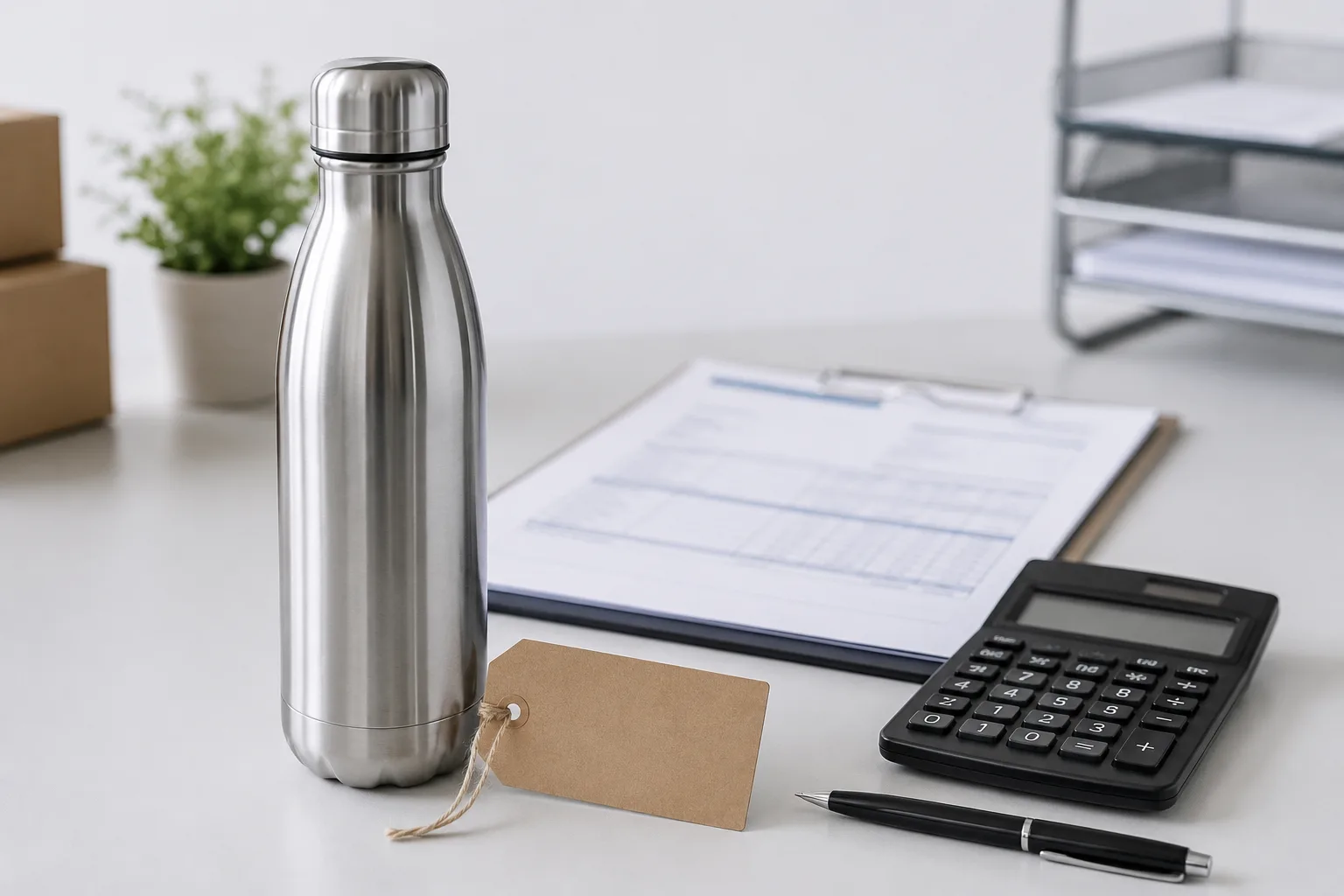
%An image of a price tag with a question mark on it, next to a stainless steel water bottle.
From a manufacturer's standpoint, material costs are a huge part of the final price. Nickel is a traded commodity, and its price can be volatile and expensive. Manganese is much cheaper. This cost difference creates a powerful temptation for some suppliers to substitute 201 steel for 304, especially when quoting a new client who is focused on getting the lowest possible price. A common question we get from clients is how a competitor could offer such a low quote. Often, the answer lies in the materials. A factory that willingly uses 201 steel for a water bottle is signaling that its priority is cost, not quality or safety. As a brand owner, partnering with such a supplier is risky. If your product fails—if it rusts, taints the water, or causes a health concern—it's your brand name on the bottle.10 The initial savings are not worth the potential damage to your reputation, customer trust, and the possibility of a product recall.
How Can You Verify You’re Getting Food-Grade 304 Steel?
You don't have a science lab to test metals. You feel powerless, relying only on a supplier's promise, and worry about being misled into buying a subpar, unsafe product.
The most reliable way is to demand documentation. Ask your supplier for a material specification sheet11 for the 304 stainless steel they use. Reputable manufacturers will provide this readily. A refusal or hesitation to provide documentation is a clear warning sign.
%An image of a person reviewing a technical specification document with a magnifying glass.
While you can't perform a chemical analysis, you are not powerless. You need to be a smart buyer. The first step is to be direct. Ask the supplier, "Is the inner wall of this bottle made from food-grade 304 stainless steel?" Get their answer in writing. Next, request the material specification sheet or a test report from their steel supplier. This document confirms the grade and chemical composition. As a professional manufacturer, we have these documents on file for every batch of steel we purchase and are happy to share them with clients. Some people mention the "magnet test," as 304 steel is generally non-magnetic while 201 can be slightly magnetic. However, this is not a foolproof method12, as processing can sometimes make 304 steel slightly magnetic. Don't rely on it. Your best tools are clear communication and a demand for transparency. A supplier who values quality and safety will understand and respect your due diligence. A supplier who pushes back is telling you everything you need to know.
Conclusion
Choose 304 stainless steel for safety, durability, and brand integrity. It is the only responsible choice for water bottles, while 201 steel is a risk you should not take.
"Regulatory Status of Components of a Food Contact Material - FDA", https://www.fda.gov/food/packaging-food-contact-substances-fcs/determining-regulatory-status-components-food-contact-material. Sources such as the NSF (National Sanitation Foundation) and other food safety organizations recognize austenitic stainless steels like type 304 as safe and appropriate for food contact surfaces due to their corrosion resistance and durability. Evidence role: general_support; source type: government. Supports: The claim that 304 stainless steel is considered a standard, safe material for food and beverage contact.. ↩
"Manganese biofouling and the corrosion behavior of stainless steel", https://pubmed.ncbi.nlm.nih.gov/22115104/. Metallurgical studies show that the substitution of manganese for nickel in 200-series stainless steels, such as type 201, reduces its resistance to pitting and crevice corrosion, particularly in chloride-containing environments, compared to 300-series steels like type 304. Evidence role: mechanism; source type: paper. Supports: The claim that 201 stainless steel is more susceptible to corrosion than 304.. ↩
"SAE 304 stainless steel - Wikipedia", https://en.wikipedia.org/wiki/SAE_304_stainless_steel. According to industry standards (e.g., ASTM A240), type 304 stainless steel typically contains 18-20% chromium and 8-10.5% nickel, while type 201 contains 16-18% chromium, 3.5-5.5% nickel, and a higher percentage of manganese (5.5-7.5%). Evidence role: definition; source type: encyclopedia. Supports: The specific chemical compositions that differentiate 304 and 201 stainless steel.. ↩
"Case Study: How Chromium Protects Steel", https://mse.engin.umich.edu/internal/demos/case-study-how-chromium-protects-steel. The corrosion resistance of stainless steel is due to a phenomenon called passivation, where the chromium in the alloy reacts with oxygen in the environment to form a thin, stable, and non-reactive film of chromium oxide on the surface, protecting the iron underneath from oxidation (rust). Evidence role: mechanism; source type: education. Supports: The mechanism by which chromium protects stainless steel from rust.. ↩
"Scale-dependent manganese leaching from stainless steel ...", https://pubmed.ncbi.nlm.nih.gov/29885096/. Research on metal migration from food contact materials indicates that under corrosive conditions (such as with acidic beverages), stainless steels with lower corrosion resistance can leach metal ions, including iron, chromium, and manganese, into the liquid. Evidence role: case_reference; source type: paper. Supports: The potential for corroded, lower-grade stainless steel to leach metals into liquids.. Scope note: The amount and health significance of leached elements can vary widely based on the alloy, liquid, temperature, and contact time. ↩
"Study of the Corrosion Behavior of Stainless Steel in Food Industry", https://pmc.ncbi.nlm.nih.gov/articles/PMC11012613/. Chemical studies demonstrate that acidic environments can compromise the passive chromium oxide layer on stainless steel. The presence of chlorides, found in many sports drinks, can further accelerate this process, leading to localized pitting corrosion, especially in less-resistant steel grades. Evidence role: mechanism; source type: research. Supports: The claim that acidic solutions can speed up corrosion in stainless steel.. ↩
"Preventing rust on scratched stainless steel? - Facebook", https://www.facebook.com/groups/2883325456/posts/10174510169650457/. This property is known as re-passivation. When the surface of stainless steel is mechanically damaged (e.g., scratched) in the presence of oxygen, the exposed chromium rapidly reacts with oxygen to spontaneously reform the protective passive chromium oxide film. Evidence role: mechanism; source type: paper. Supports: The scientific process behind the 'self-healing' property of stainless steel.. ↩
"Manganese | Public Health Statement | ATSDR - cdc.gov.", https://wwwn.cdc.gov/tsp/PHS/PHS.aspx?phsid=100&toxid=23. Public health organizations like the World Health Organization (WHO) note that while manganese is an essential nutrient, chronic exposure to high levels in drinking water can be associated with neurological effects. Therefore, controlling its migration from contact materials is a safety consideration. Evidence role: expert_consensus; source type: institution. Supports: The idea that leaching manganese is a health concern.. ↩
"Historical Statistics on Mineral Commodities in the United States", https://www.usgs.gov/centers/national-minerals-information-center/historical-statistics-mineral-commodities-united. Market data from commodity exchanges shows that nickel, a key alloying element in 304 steel, is historically significantly more expensive and volatile in price than manganese, which is used in higher proportions in 201 steel as a lower-cost substitute. Evidence role: statistic; source type: other. Supports: The claim that the materials for 201 steel are cheaper than for 304.. ↩
"Consumers blame both manufacturer and retailer when products fail ...", https://mendoza.nd.edu/news/consumers-blame-when-products-fail/. Business and legal case studies demonstrate that product failures due to poor material choices can lead to costly product recalls, loss of consumer trust, and long-term damage to a brand's reputation. For example, recalls in the automotive and consumer electronics industries often stem from material defects. Evidence role: case_reference; source type: other. Supports: The idea that using substandard materials can lead to significant brand and financial damage.. Scope note: While the source may not specifically mention water bottles, it supports the general principle of brand liability for product quality. ↩
"Mill test report - Wikipedia", https://en.wikipedia.org/wiki/Mill_test_report. A material test report or mill test certificate (MTC) is a quality assurance document provided by the metal producer that certifies a material's chemical and physical properties. It details the exact chemical composition by percentage, confirming that the batch meets the required standard for a specific grade, such as 304 stainless steel. Evidence role: definition; source type: institution. Supports: The role and content of a material specification sheet in verifying material quality.. ↩
"[PDF] Quantitative measurement of deformation-induced martensite in 304 ...", http://wpfiles.mines.edu/wp-content/uploads/aspprc/ResearchMaterials/Publications/235-De.pdf. While type 304 stainless steel is austenitic and typically non-magnetic in its annealed state, manufacturing processes like forming or drawing (cold working) can cause a phase transformation in its crystal structure, creating small amounts of ferromagnetic martensite. This can render the final product slightly magnetic. Evidence role: mechanism; source type: paper. Supports: The scientific reason why the magnet test for 304 steel is unreliable.. ↩