
A stainless steel water bottle may look like a simple cylindrical product, but forming its metal body involves much more than cutting a piece of stainless steel tube to length.
For most deep-drawn stainless steel drinkware, the inner liner and outer shell begin as flat stainless steel sheet or coil. The metal is progressively formed through blanking, deep drawing, redrawing, annealing, trimming, necking, expanding, and mouth-forming operations until the required bottle shape is achieved.
 For standard cylindrical bottles, the process can be relatively straightforward.
For a custom bottle with a narrow neck, curved shoulder, enlarged base, sculpted body, or proprietary silhouette, however, the forming process can become considerably more complex.
Understanding how the bottle body is made is important for brands developing custom stainless steel drinkware because body geometry directly affects:
- Tooling requirements
- Mold cost
- Minimum order quantity
- Production feasibility
- Surface quality
- Dimensional tolerances
- Lid compatibility
- Production lead time
- Overall product cost
This guide explains how a flat piece of stainless steel becomes the finished metal body of a water bottle.
What Raw Material Is Used to Make a Stainless Steel Bottle Body?
The process normally begins with stainless steel sheet or coil.
Depending on the product specification, different stainless steel grades may be used, including:
- 304 stainless steel
- 316 stainless steel
- 201 stainless steel
The appropriate grade depends on the bottle structure, application, corrosion-resistance requirements, target cost, and which part of the bottle is being manufactured.
The sheet itself can be surprisingly thin.
Depending on the bottle design and manufacturing requirement, stainless steel used for drinkware bodies may be around:
- 0.4 mm
- 0.5 mm
- 0.6 mm
or another engineered thickness.
The important point is that the manufacturer starts with a relatively thin, flat piece of metal.
So how does that flat sheet become a bottle that may be more than 200 mm tall?
The answer is primarily:
Deep drawing.
What Is Deep Drawing in Stainless Steel Bottle Manufacturing?
Deep drawing is a metal-forming process that converts a flat stainless steel blank into a hollow three-dimensional shape using a punch and die.
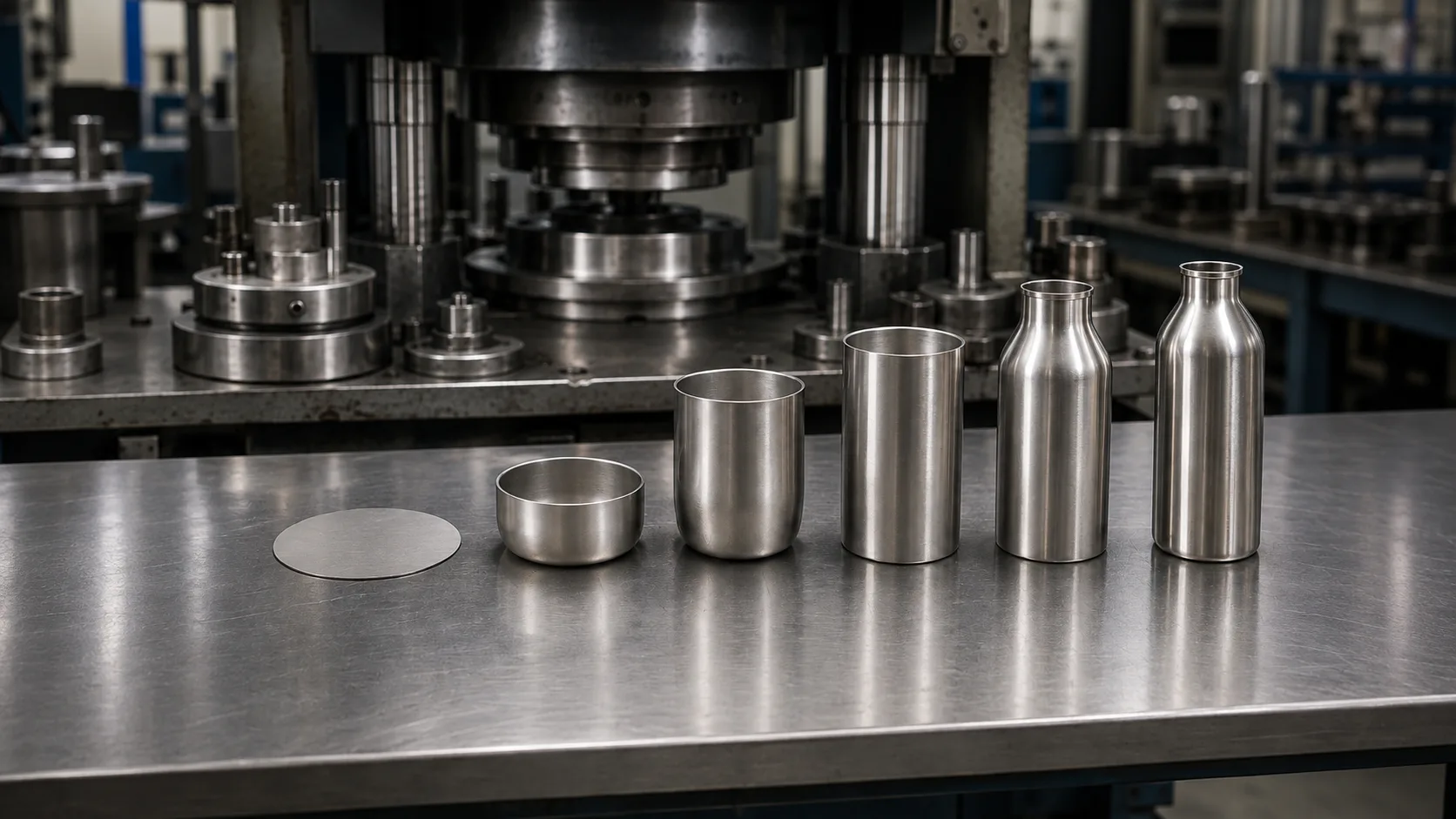
A simplified transformation looks like this:
Flat stainless steel disc
→ shallow cup
→ deeper cup
→ elongated cylindrical body
→ final bottle body
The material is not simply removed to create the height.
Instead, the stainless steel is progressively redistributed as it is drawn into the forming die.
As the diameter changes and the material flows into the die cavity, a taller wall is created.
This is one of the fundamental manufacturing processes behind stainless steel water bottles, tumblers, travel mugs, and many other metal containers.
Stainless Steel Bottle Body Manufacturing Process
A simplified process flow can be represented as:
Stainless Steel Sheet / Coil
→ Blanking
→ First Drawing
→ Redrawing
→ Intermediate Annealing if Required
→ Further Drawing
→ Trimming
→ Necking / Expanding / Shaping
→ Mouth Forming
→ Finished Metal Body
Each step has a different purpose.
1. Blanking: Cutting the Initial Stainless Steel Disc
Before the bottle can be drawn, the required amount of material must first be cut from the stainless steel sheet or coil.
This process is called:
Blanking
The resulting piece is called a:
Blank
For many round stainless steel bottle bodies, the starting blank is circular.
The diameter and thickness of this blank are calculated according to factors such as:
- Final bottle diameter
- Bottle height
- Wall thickness
- Bottom geometry
- Drawing ratio
- Material grade
- Expected material flow during forming
The manufacturer cannot simply choose an arbitrary disc size.
If insufficient material is provided, the required bottle height may not be achievable.
If excessive material is used, unnecessary trimming, wrinkles, instability, or material waste may result.
This means that even the first blanking step already depends on the final product geometry.
2. First Drawing: Turning a Flat Disc Into a Shallow Cup
The circular blank is positioned in a drawing die.
A punch then pushes the metal into the die cavity.
Instead of remaining flat, the blank begins to form a shallow hollow shape.
After the first drawing operation, the component may look more like a shallow stainless steel bowl than a water bottle.
This is known as the:
First Draw
At this stage, the product is still far from its final height.
The goal is to begin controlling material flow without overstressing the stainless steel.
3. Redrawing: Increasing the Depth Step by Step
One of the most important concepts in stainless steel bottle manufacturing is that a tall bottle usually cannot be drawn to its full depth in a single operation.
For example, imagine developing a bottle approximately:
220 mm high
Attempting to form the entire depth in one aggressive drawing operation may significantly increase the risk of defects such as:
- Cracking
- Tearing
- Wrinkling
- Excessive wall thinning
- Uneven wall thickness
- Bottom failure
- Distortion around the opening
Instead, the body is normally formed progressively.
A simplified example might look like:
First draw: shallow cup
Second draw: deeper cup
Third draw: elongated body
Fourth draw: near-final bottle height
The actual number of drawing operations varies from product to product.
It depends on:
- Bottle height
- Bottle diameter
- Height-to-diameter ratio
- Stainless steel grade
- Material thickness
- Shoulder geometry
- Bottom geometry
- Required dimensional tolerances
- Tool design
- Forming method
This repeated drawing process is commonly called:
Redrawing
Therefore, when a manufacturer says:
“This bottle body requires three or four drawing operations.”
they are referring to the progressive forming stages required to safely achieve the final depth.
Why Can't a Stainless Steel Bottle Be Drawn in One Step?
Stainless steel has good formability, but it is not infinitely stretchable.
During deep drawing, the metal experiences substantial plastic deformation.
If too much deformation is attempted at once, stress may become concentrated in certain areas.
Possible problems include:
Cracking
The material exceeds its forming limit and splits.
Wrinkling
Excess material flow causes folds to develop, particularly around areas under compressive stress.
Excessive Wall Thinning
Certain sections become thinner than intended, potentially reducing strength or causing later manufacturing problems.
Uneven Height
Material may not flow uniformly around the circumference.
Bottom Failure
Excessive stress near the bottom radius can cause tearing.
Dimensional Instability
The finished shape may fail to meet required diameter, height, or roundness tolerances.
For this reason, controlled progressive forming is normally preferred to one extremely aggressive forming operation.
Why Is Annealing Used During Deep Drawing?
Another important concept is:
Work hardening.
When stainless steel is repeatedly plastically deformed, its mechanical properties change.
As forming continues, the material can become harder and less accommodating to further deformation.
If the manufacturer continues drawing a heavily work-hardened part without sufficient process control, the risk of cracking can increase.
One possible solution is:
Annealing
Annealing is a heat-treatment process used during manufacturing when the material requires additional formability before subsequent forming operations.
A simplified production sequence might therefore be:
Drawing
→ Annealing
→ Redrawing
→ Annealing
→ Further Drawing
However, this does not mean every bottle requires annealing after every drawing operation.
Whether intermediate annealing is necessary depends on factors including:
- Stainless steel grade
- Total drawing depth
- Drawing ratio
- Wall thickness
- Number of forming operations
- Bottle geometry
- Degree of work hardening
- Tooling and process design
For purchasing and product-development teams, the key point is:
Annealing during bottle-body forming is primarily a manufacturing and formability requirement—not a decorative process.
4. Trimming: Creating a Consistent Bottle Height
After deep drawing, the upper edge of the formed body is not always perfectly even.
The drawn shell may contain:
- Uneven edge height
- Excess material
- Irregular edges
- Variation around the circumference
The manufacturer therefore performs:
Trimming
This operation removes excess material and brings the body to a controlled height.
You can think of deep drawing as creating the basic body, while trimming brings that body closer to its specified dimensions.
Accurate trimming becomes particularly important when later processes depend on the position and geometry of the bottle opening.
5. Necking: Making the Bottle Opening Smaller
Many stainless steel bottles do not have the same diameter from bottom to top.
For example:
- Main body diameter: approximately 75 mm
- Neck or opening diameter: approximately 50 mm
The upper part of the bottle therefore has to become narrower.
This process is generally referred to as:
Necking
In simple terms:
Necking reduces the diameter of a selected portion of the metal body.
It is commonly used for:
- Sports bottles
- Narrow-mouth bottles
- Vacuum flasks
- Thermos-style bottles
- Bottles with curved shoulders
The more dramatic the transition between the main body and the neck, the more carefully the forming process must be designed.
A simple straight cylindrical shell is generally easier to manufacture than a bottle with a highly sculpted shoulder and narrow neck.
6. Expanding and Bulging: Making Part of the Bottle Wider
Some bottle designs require the opposite effect.
Instead of reducing a diameter, part of the body needs to become larger.
This can involve processes described as:
- Expanding
- Bulging
- Body shaping
For example, a designer may want:
- A wider base
- A rounded lower section
- A slightly enlarged center body
- A curved silhouette
- A distinctive grip area
Additional forming operations may therefore be required after the initial deep drawing process.
The terminology used by different factories can vary, but the engineering objective is similar:
Change the geometry of a previously drawn shell to achieve the required final profile.
7. Mouth Forming: Creating the Functional Bottle Opening
Cutting the upper edge to the correct height does not mean the bottle mouth is finished.
The mouth is one of the most critical dimensional areas of a reusable water bottle because it interfaces directly with the lid.
Different products may require:
- Straight mouth
- Rolled edge
- Curled edge
- Reduced neck
- Expanded opening
- Threaded structure
- Welded neck component
- Special sealing geometry
Processes may include:
Curling
Necking
Expanding
Thread Forming
Edge Forming
Bottle-mouth tolerances are particularly important.
If the metal body is out of specification, problems may appear during final assembly.
For example, a customer may report:
“The lid does not fit properly.”
It may be tempting to immediately assume that the plastic lid is defective.
But lid-fit problems can also originate from the stainless steel body.
Possible causes include:
- Incorrect mouth diameter
- Poor roundness
- Incorrect thread dimensions
- Incorrect neck height
- Mouth deformation
- Excessive dimensional variation
This is why experienced manufacturers evaluate the bottle body and lid as an integrated sealing system rather than as two unrelated components.
How Are Special-Shaped Stainless Steel Bottles Made?
This is where custom water bottle development becomes more interesting.
A standard straight cylindrical bottle may be relatively easy to produce using established deep-drawing and forming processes.
A custom bottle might instead require:
- Concave center sections
- Convex lower sections
- Curved shoulders
- Narrow necks
- Larger bases
- Non-standard proportions
- Ergonomic grip areas
- Proprietary silhouettes
In these cases, normal deep drawing alone may not be sufficient.
Additional manufacturing methods can include:
- Custom forming dies
- Multiple necking operations
- Multiple expanding operations
- Secondary stamping
- Specialized shaping
- Hydroforming
- Dedicated body-forming tooling
This is why one of the most important questions in a custom bottle project is not simply:
“Can you make this shape?”
A more useful engineering question is:
Can this geometry be produced from an existing bottle body, or does it require new body-forming tooling?
That distinction can significantly affect:
- Tooling investment
- MOQ
- Development time
- Sample cost
- Production risk
- Unit cost
Does Every Custom Bottle Shape Require a New Mold?
No.
There are several possible customization levels in stainless steel drinkware manufacturing.
Level 1: Existing Bottle Body
The manufacturer uses an existing bottle structure.
Customization may include:
- Color
- Powder coating
- Printing
- Logo
- Packaging
- Accessories
This normally requires the least product-development investment.
Level 2: Modified Existing Structure
An existing bottle body may be adapted with changes such as:
- Different lid
- Modified neck
- New accessory
- Different bottom component
- Surface pattern
- Decoration changes
Whether this is possible depends on dimensional compatibility.
Level 3: Custom Body Forming
If the customer requires a substantially different:
- Diameter
- Height
- Shoulder
- Neck
- Bottom
- Body curve
- Overall silhouette
new forming tooling may be required.
This is one reason why an experienced OEM/ODM manufacturer should review the product drawing before confirming tooling cost.
A design that looks visually simple on a rendering may be significantly more complicated from a metal-forming perspective.
What Is Hydroforming, and When Might It Be Used?
For some complex bottle geometries, manufacturers may consider:
Hydroforming
Hydroforming uses controlled fluid pressure together with tooling to form metal into a desired shape.
It can be useful when the design requires shapes that are difficult to achieve efficiently through conventional drawing or mechanical expansion alone.
However, hydroforming is not automatically necessary for every custom bottle.
The appropriate forming method depends on:
- Geometry
- Production volume
- Material
- Wall thickness
- Surface requirements
- Tooling cost
- Dimensional requirements
The correct production method should therefore be determined after reviewing the design rather than selected simply because a process sounds more advanced.
How Are the Inner and Outer Walls of a Vacuum Bottle Made?
A double-wall vacuum insulated bottle should be understood as two separate metal bodies.
These are commonly described as:
Inner Liner / Inner Wall
and
Outer Shell / Outer Wall
They are formed separately.
Conceptually, the structure looks like:
**Inner stainless steel body
-
Outer stainless steel body
-
Space between the two walls**
The two formed components are later assembled and joined during subsequent manufacturing processes.
The space between them is then used to create the thermal-insulation structure of the vacuum bottle.
This is important because the dimensions of the inner and outer components must be engineered to work together.
The manufacturer must consider:
- Clearance between the walls
- Assembly position
- Neck connection
- Welding location
- Bottom structure
- Overall wall thickness
- Finished external dimensions
Bottle-body forming is therefore only the first major stage of vacuum bottle production.
How Does Bottle Shape Affect Tooling Cost?
Bottle geometry is one of the biggest factors influencing tooling requirements.
Consider two products.
Bottle A
- Straight cylindrical body
- Standard diameter
- Standard opening
- Existing production structure
Bottle B
- Concave center
- Wide lower body
- Narrow upper body
- Custom shoulder curve
- Proprietary neck
- Unique overall silhouette
Bottle B may require considerably more engineering work and tooling.
Possible additional tooling can include:
- Drawing dies
- Redrawing dies
- Necking dies
- Expanding dies
- Trimming fixtures
- Shaping tools
- Mouth-forming tools
- Inspection gauges
Therefore, when evaluating a custom bottle project, tooling should not be viewed as one generic "mold."
A fully custom stainless steel bottle can involve multiple tooling sets for different manufacturing operations.
How Does Body Forming Affect MOQ?
Tooling and process complexity also influence minimum order quantity.
An existing bottle with custom printing may support relatively small production quantities because the basic metal-forming tooling already exists.
A proprietary bottle shape is different.
New tooling may require:
- Engineering
- Tool manufacturing
- Machine setup
- Trial production
- Process adjustment
- Sample testing
- Dimensional validation
The development cost must then be spread across the production quantity.
For this reason, a true custom-mold stainless steel bottle normally requires a higher commercial commitment than simply applying a logo to an existing bottle.
What Quality Problems Can Occur During Bottle Body Forming?
Professional bottle manufacturing requires more than simply achieving the approximate shape.
Several potential defects need to be controlled.
1. Cracking
Usually associated with excessive deformation, poor material flow, inappropriate process parameters, or unsuitable forming conditions.
2. Wrinkling
Can occur when material flow is not adequately controlled during drawing.
3. Uneven Wall Thickness
Excessive thinning in certain areas can affect strength and downstream processes.
4. Poor Roundness
Especially important around the bottle opening because it can affect lid fit and sealing.
5. Height Variation
Can affect assembly and overall product consistency.
6. Surface Scratches
Tool condition, lubrication, handling, and material movement can affect the cosmetic surface.
7. Neck Distortion
Improper neck forming may affect both appearance and cap compatibility.
8. Mouth Dimensional Variation
A critical issue for threads, seals, caps, and leak resistance.
These are some of the reasons why drinkware manufacturing depends heavily on process control and tooling condition.
What Should a Buyer Ask When Developing a Custom Stainless Steel Bottle?
When sending a new bottle design to a manufacturer, asking only:
“Can you make it?”
usually does not reveal enough.
For a genuinely customized body, consider asking:
1. Is this body made by normal deep drawing, or does it require special forming?
This helps determine whether the design fits an existing manufacturing process.
2. How many drawing operations are required?
A deeper or more complex body may require multiple redraw stages.
3. Does the body require intermediate annealing?
This can provide insight into the forming complexity.
4. Is new body-forming tooling required?
This directly affects development cost.
5. Can an existing bottle body be modified instead?
Sometimes a new product can be developed more economically by adapting an existing platform.
6. Which dimensions are the most difficult to control?
This helps identify technical risk before tooling begins.
7. What tolerances are required around the bottle mouth?
This is especially important when developing a custom lid.
8. Does the shape require necking, expanding, bulging, or hydroforming?
The answer helps clarify exactly where the tooling investment will be used.
What Information Should You Give the Manufacturer?
The quality of the manufacturer's technical assessment depends heavily on the information provided.
For serious OEM or ODM development, it is useful to provide:
- 2D dimensional drawing
- 3D CAD file if available
- Target capacity
- Overall height
- Maximum body diameter
- Mouth diameter
- Neck geometry
- Bottom geometry
- Required stainless steel grade
- Required wall structure
- Lid concept
- Target finish
- Target order quantity
- Intended use
- Reference sample if available
A rendering alone can communicate appearance, but it may not provide enough information for reliable tooling evaluation.
Existing Bottle vs. Custom-Mold Bottle: What Is the Difference?
Understanding bottle-body forming also helps explain the difference between two very different OEM projects.
| Project Type | Existing Bottle | Custom Bottle Body |
|---|---|---|
| Body geometry | Existing | Newly developed |
| Tooling | Usually minimal | May require multiple new tools |
| Development time | Shorter | Longer |
| MOQ | Usually lower | Usually higher |
| Engineering involvement | Limited | Significant |
| Shape exclusivity | Low | High |
| Initial investment | Lower | Higher |
| Product differentiation | Moderate | Potentially very high |
For brands entering drinkware for the first time, starting with an existing platform can reduce development risk.
For established brands seeking a recognizable and defensible product identity, a custom bottle body can provide much stronger differentiation.
Why Bottle-Body Engineering Matters for Brand Owners
When consumers see a stainless steel bottle, they mainly notice:
- Shape
- Color
- Finish
- Logo
- Lid
- Overall design
But underneath that simple appearance is a series of engineering decisions.
The final bottle geometry determines:
- How the steel flows during forming
- How many forming stages are required
- Whether annealing may be needed
- What tooling must be created
- How easily dimensions can be controlled
- Whether the lid can seal consistently
- Whether mass production is stable
This is why custom drinkware development should involve manufacturing engineering early in the design process.
A good-looking 3D concept is only the beginning.
The next question is:
Can the design be manufactured consistently, efficiently, and at the required quality level?
Frequently Asked Questions
Are stainless steel water bottles made from stainless steel tubes?
Some metal products and specific constructions may use tubular material, but most conventional deep-drawn stainless steel drinkware bodies are formed from stainless steel sheet or coil through drawing and subsequent forming operations.
What is deep drawing in bottle manufacturing?
Deep drawing is a metal-forming process in which a flat stainless steel blank is progressively pushed and drawn into a die to create a hollow cup or bottle-shaped body.
Why are multiple drawing operations required?
A tall bottle often requires several controlled forming stages because attempting too much deformation in one operation can increase the risk of cracking, wrinkling, wall thinning, and dimensional problems.
What is annealing used for?
Annealing may be used between forming operations when the stainless steel has work-hardened and additional formability is required for subsequent drawing or shaping.
What does necking mean?
Necking reduces the diameter of part of the bottle, commonly around the shoulder and opening.
What does expanding mean?
Expanding increases the diameter of a selected section of the bottle body to create a wider or more sculpted profile.
Does a unique bottle shape always require new tooling?
Not necessarily. Some designs can be created by modifying an existing bottle platform. However, substantial changes to the diameter, shoulder, neck, bottom, or overall silhouette often require dedicated forming tooling.
Why is the bottle mouth so important?
The bottle mouth interfaces directly with the lid and sealing system. Poor roundness, diameter variation, incorrect thread dimensions, or deformation can result in difficult assembly or leakage.
Final Thoughts
A stainless steel water bottle starts with something remarkably simple:
a flat piece of stainless steel.
Through a carefully controlled sequence of:
Blanking
→ Deep Drawing
→ Redrawing
→ Annealing when required
→ Trimming
→ Necking / Expanding
→ Shaping
→ Mouth Forming
that flat material gradually becomes a functional bottle body.
For standard products, manufacturers can rely on proven tooling and established production parameters.
For exclusive custom designs, the engineering challenge becomes much more significant.
The key question is not simply:
“Can this shape be made?”
It is:
“What is the most stable, scalable, and cost-effective manufacturing method for producing this shape consistently?”
That is where an experienced OEM/ODM stainless steel drinkware manufacturer adds value.
Developing a Custom Stainless Steel Water Bottle?
If you are developing a new stainless steel water bottle rather than simply adding a logo to an existing product, we can evaluate your design from a manufacturing perspective.
Depending on your project, we can support:
- Existing bottle customization
- Custom colors and finishes
- Complex printing
- Custom lids
- Custom bottle structures
- Body-forming evaluation
- Custom mold development
- Prototype and sample development
- OEM/ODM production
You can start with a proven bottle design for lower-volume customization, or develop a proprietary bottle structure when product differentiation is the priority.
Send us your drawing, reference image, target capacity, estimated quantity, and design requirements for an initial manufacturability review.