
You ordered premium 304 steel, but how can you be sure that's what you received? Using a cheaper material risks your brand’s reputation. Here's how you can verify it.
The most reliable way to test for 304 stainless steel is a multi-step process. Start with a magnet as a quick screen, then use an XRF analyzer to confirm the chemical composition (approx. 18% chromium, 8% nickel1), and finally, cross-reference with batch-specific material certificates.
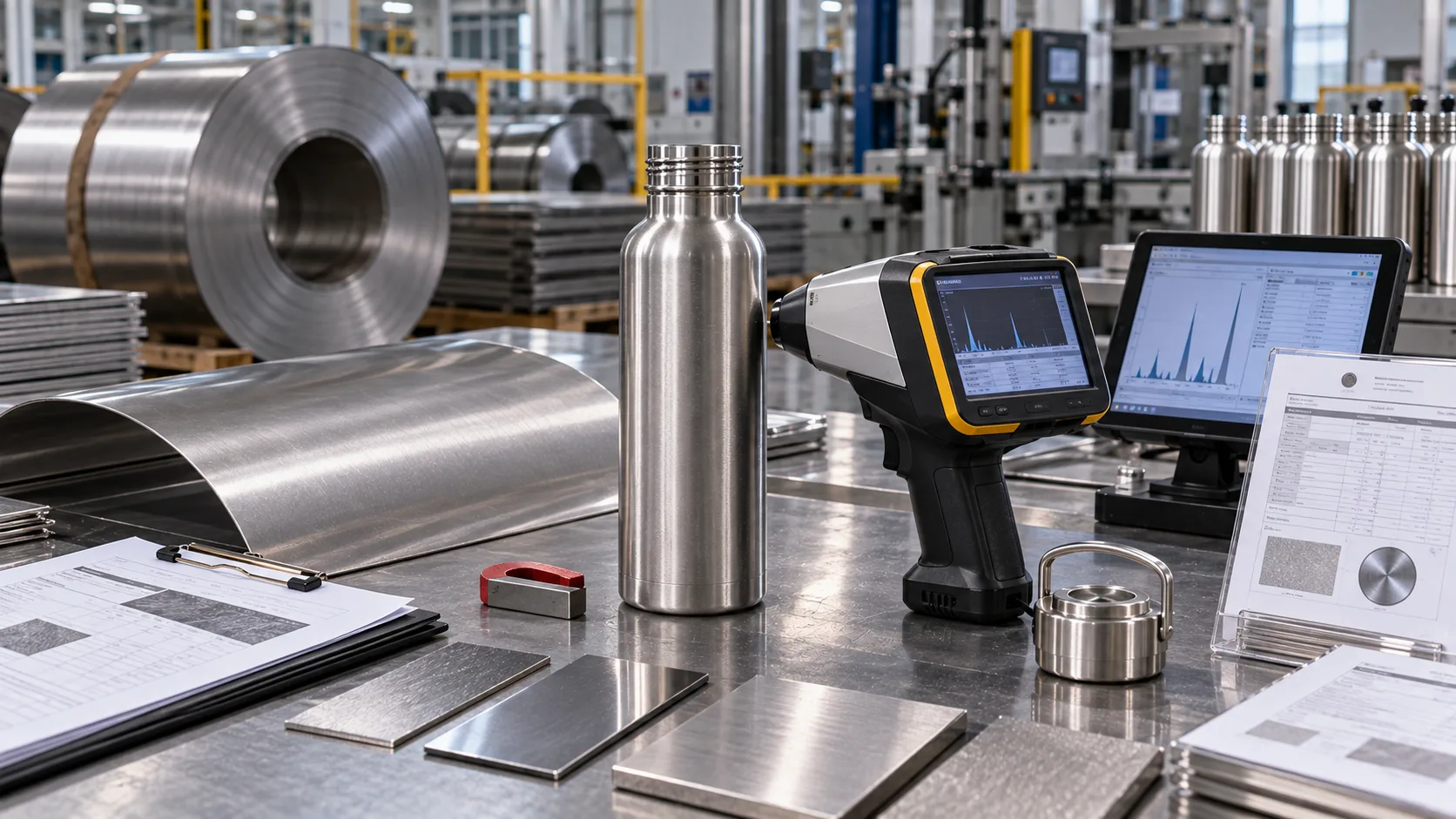
Verifying the materials you source can feel overwhelming, especially with something as specific as stainless steel grades. As a manufacturer, I've stood on the factory floor and seen firsthand what happens when a batch of raw material doesn't meet the standard. It's not about being a scientist; it's about having a practical process. I want to walk you through the exact steps we use in our incoming quality control, so you can apply the same rigor to protect your own business.
Is the Magnet Test a Reliable Way to Identify 304 Stainless Steel?
You’ve heard a magnet can spot lower-quality stainless steel. But relying on this simple trick alone could cause you to approve a subpar shipment, putting your product quality at risk.
The magnet test is only a preliminary screening tool, not a final verdict. While true 304 steel is generally non-magnetic2, some lower-grade alloys like 201 can be too. It only flags obvious problems and cannot confirm the grade.
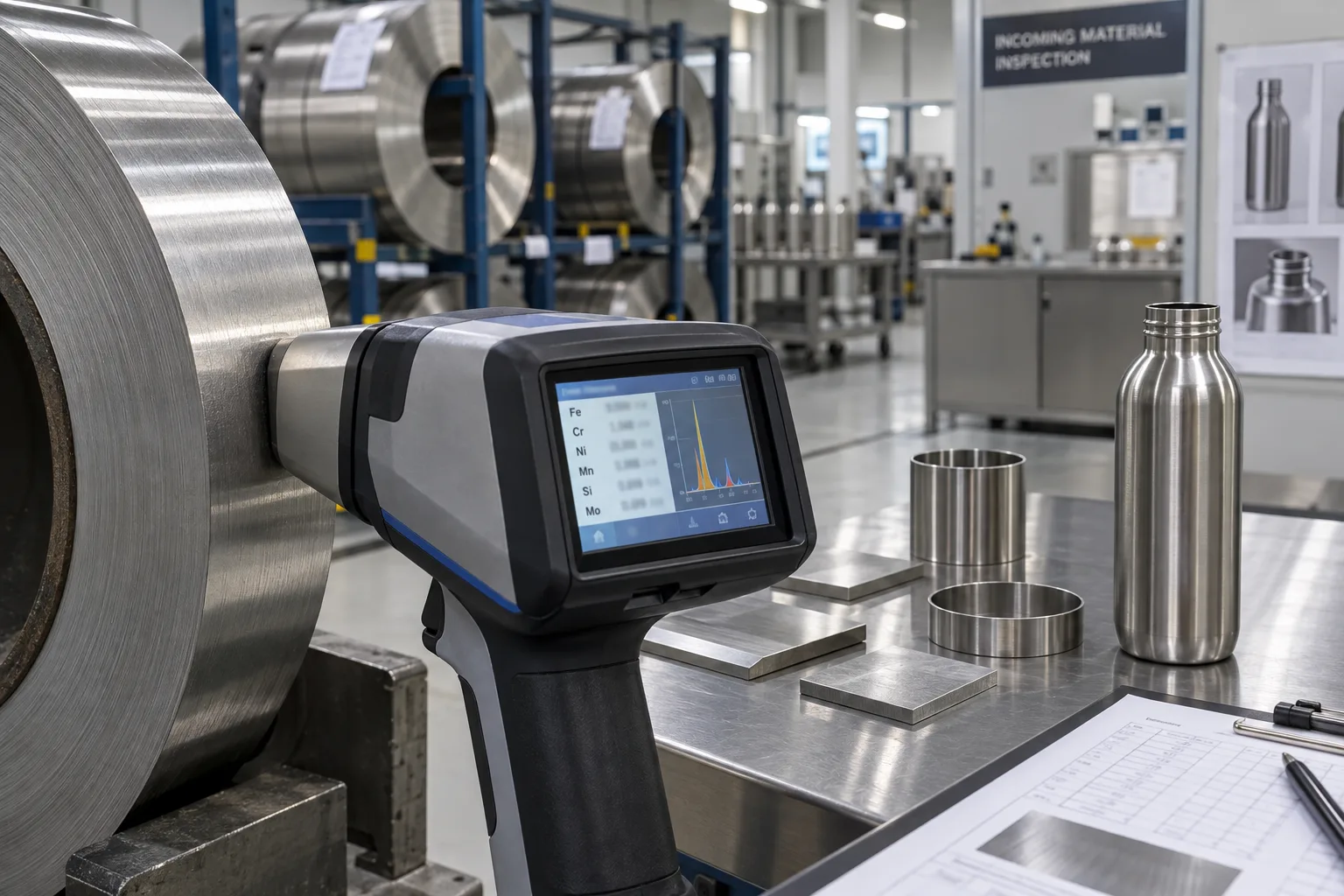
In my years on the production side, the magnet test is always the first thing we do when a new coil of steel arrives. It’s fast and easy. The reason 304 stainless steel is typically non-magnetic is due to its austenitic crystalline structure3. However, this isn't a perfect test for a few key reasons.
First, the manufacturing process itself can change the properties of the steel. Processes like deep drawing or hydroforming, which we use to shape water bottles, are types of "cold working." This can slightly alter the steel's structure, making true 304 grade steel weakly magnetic4. So, a slight pull from a magnet doesn't automatically mean it's not 304.
Second, other grades of steel, like grade 201, can also be non-magnetic5. Grade 201 is a cheaper alternative with much lower nickel content, making it more prone to rust6. If you rely only on a magnet, you could easily mistake 201 for 304.
| Test Scenario | Grade 304 (Annealed) | Grade 304 (Cold-Worked) | Grade 201 |
|---|---|---|---|
| Magnet Reaction | No attraction | Slight attraction | No attraction |
| Conclusion | Inconclusive on its own | Inconclusive on its own | Inconclusive on its own |
Think of the magnet test as a bouncer at a club. It can spot someone obviously breaking the rules, but it can't check everyone's ID. If a steel sheet shows strong magnetism, it's a huge red flag and we investigate immediately. But if it passes, it just moves on to the next, more definitive test.
How Can XRF Analysis Confirm Your Steel Is Truly 304 Grade?
The magnet test was inconclusive, and now you need a real answer. You are worried about the hidden chemical makeup of your products. An XRF analysis provides that definitive answer quickly.
XRF (X-ray fluorescence)7 is the practical gold standard for on-site material verification8. A handheld analyzer reads the elemental composition. For 304 grade, it must show approximately 18% chromium and 8% nickel. It’s the fast, reliable confirmation we use for every single batch.
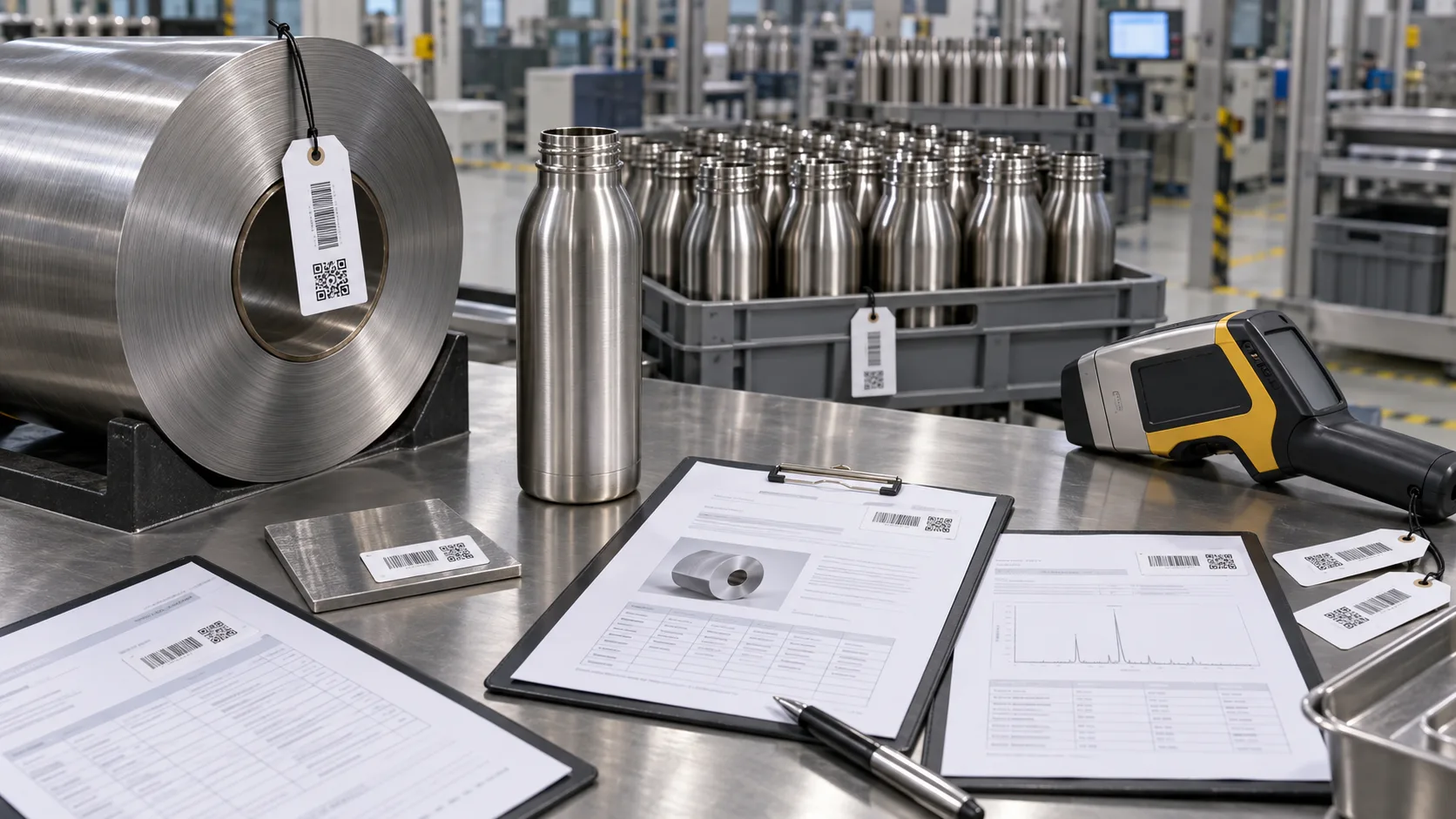
After the initial magnet screen, the XRF analyzer is our most important tool for incoming material QC. It looks like a futuristic scanner gun, and it's incredibly effective. We simply point the device at the raw steel coil or even a finished water bottle, pull the trigger, and within seconds, the screen displays a precise breakdown of the elements inside. It's a completely non-destructive test9.
What we are looking for is very specific. For a material to be classified as food-grade 304 stainless steel10, two numbers are critical:
- Chromium (Cr): Must be around 18%.
- Nickel (Ni): Must be around 8%.
If we see a reading with nickel content down at 1% or 4%, we know immediately that it’s not 304. It's most likely a 200-series steel that a supplier is trying to pass off as a premium grade. I've personally had to reject entire shipments because the XRF reading showed nickel at half the required level, even when the paperwork looked perfect. This is why we never, ever skip this step.
As a buyer, you can leverage this technology to protect yourself. You can either ask your supplier for the XRF test report from your specific production run or, for ultimate peace of mind, hire a third-party inspection agency to perform a portable XRF test on-site at the factory before your goods are shipped.
Are Supplier Mill Certificates and SGS Reports Enough Proof?
Your supplier sent a professional SGS report certifying their 304 steel. But does that piece of paper guarantee the bottles in your specific order are made from that exact, tested batch?
A Mill Test Certificate (MTC)11 or a third-party report from a lab like SGS12 is a critical document, but it is not sufficient on its own. These reports certify a specific batch of material at one point in time. You must ensure the certificate's lot number matches the material used for your specific production run.
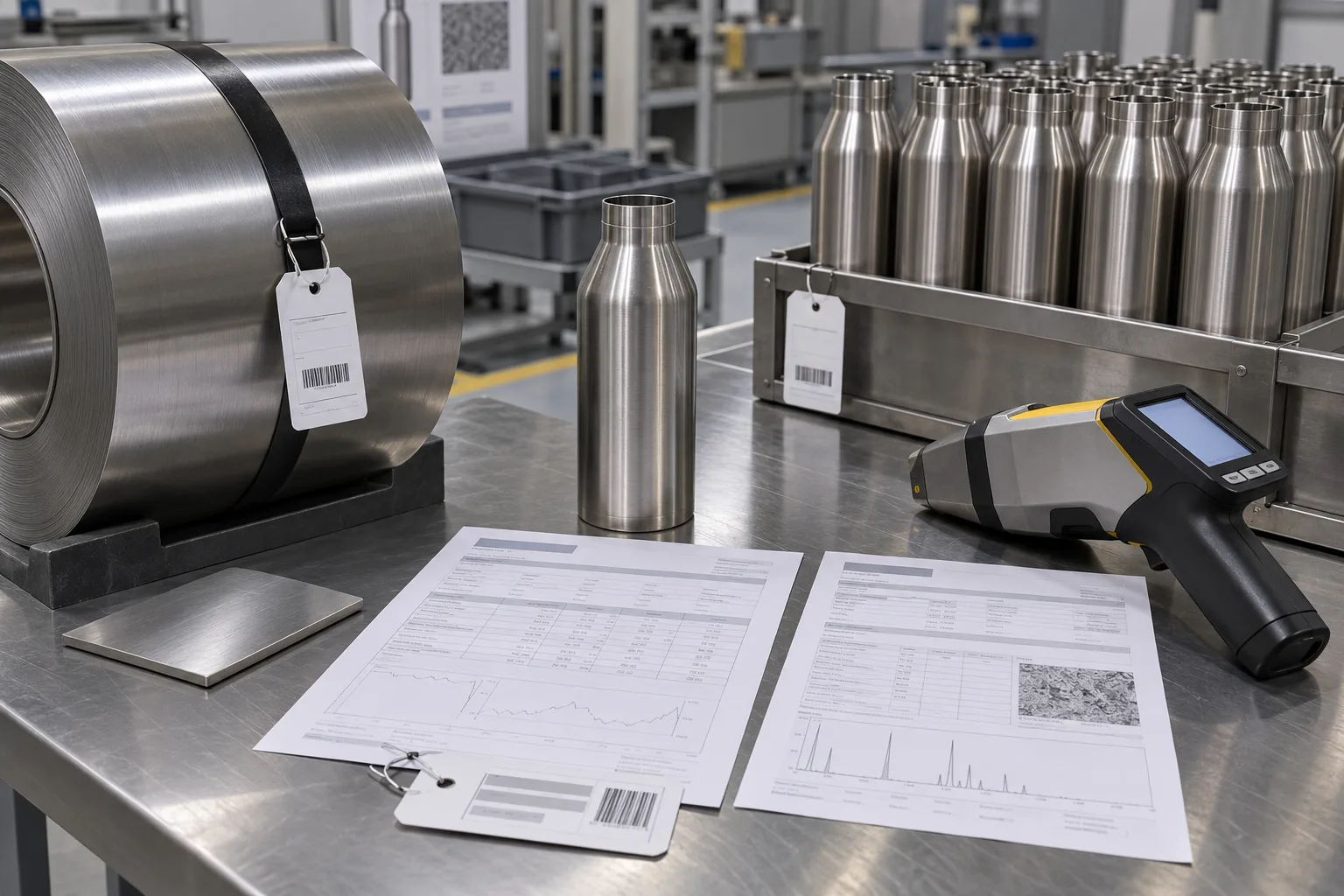
Paperwork is a huge part of the verification process, but you have to know how to read between the lines. An MTC is a document from the original steel mill that details the exact chemical and physical properties of the steel coil it was produced with. An SGS report is similar but done by an independent third-party lab, often commissioned by the factory to prove quality. Both are important.
The problem is the potential gap between the certified material and the material used for your order. A factory might buy hundreds of tons of steel. It's possible for them to show you a great certificate from a high-quality batch, but then use a cheaper, different batch for your production. Sometimes this is intentional to cut costs; other times it's simply due to poor inventory management and traceability.
To close this gap, here is what you should do:
- Request the MTC: Always ask your supplier for the Mill Test Certificate for the exact steel coils being used for your order.
- Trace the Lot Number: A good factory has a traceability system. Insist they can show you how the lot number on the MTC links directly to your production run.
- Question the Reports: When you receive an SGS report, ask if it was for a random sample the factory had on hand or for a sample taken directly from the material allocated to your order. The difference is huge.
The best strategy is to combine paperwork with physical verification. Use the MTC and SGS reports to confirm what should be, and use XRF analysis to confirm what is. This creates a closed-loop system that leaves no room for doubt.
Conclusion
Verifying 304 stainless steel requires a layered approach. Use a magnet for a quick check, demand XRF data for chemical proof, and review batch-specific certificates to ensure you get what you ordered.
"SAE 304 stainless steel - Wikipedia", https://en.wikipedia.org/wiki/SAE_304_stainless_steel. A source from a materials science database or standards organization can confirm that Grade 304 stainless steel is defined by its chemical composition, which typically includes 18-20% chromium and 8-10.5% nickel. Evidence role: definition; source type: encyclopedia. Supports: The standard chemical composition for Type 304 stainless steel.. ↩
"Magnetic stainless 304 / 316 : r/metallurgy - Reddit", https://www.reddit.com/r/metallurgy/comments/1936z3u/magnetic_stainless_304_316/. A materials science or engineering resource can explain that 304 stainless steel, in its fully annealed (softened) state, is non-magnetic due to its austenitic crystal structure. Evidence role: mechanism; source type: education. Supports: The magnetic properties of 304 stainless steel in its annealed state.. ↩
"Austenitic stainless steel - Wikipedia", https://en.wikipedia.org/wiki/Austenitic_stainless_steel. An encyclopedia or materials science text can define the austenitic (face-centered cubic) crystal structure and explain why this atomic arrangement in stainless steels like grade 304 does not exhibit ferromagnetism. Evidence role: definition; source type: encyclopedia. Supports: The definition of an austenitic crystalline structure and its relation to non-magnetic properties in steel.. ↩
""Deformation Induced Martensitic Transformation In 304 Stainless ...", https://scholarcommons.sc.edu/etd/3804/. A research paper or metallurgical resource can describe how cold working processes (like bending or drawing) can cause a partial transformation of the non-magnetic austenite phase into the magnetic martensite phase in 304 stainless steel. Evidence role: mechanism; source type: paper. Supports: The mechanism by which cold working induces magnetism in 304 stainless steel.. ↩
"201 VS 304 Stainless Steel:How To Distinguish - Grand Metal", https://www.grandstainless.com/blog/201-vs-304-stainless-steelhow-to-distinguish.html. A materials supplier datasheet or engineering guide can confirm that Grade 201 stainless steel, like Grade 304, is an austenitic alloy and is also non-magnetic in its annealed condition, supporting the claim that a magnet test cannot distinguish between the two. Evidence role: general_support; source type: education. Supports: The magnetic properties of 201 stainless steel.. ↩
"Deciding between types of Stainless Steel: 304 v 201 : r/AskEngineers", https://www.reddit.com/r/AskEngineers/comments/6l1o6q/deciding_between_types_of_stainless_steel_304_v/. A source from a steel industry association or materials database can provide a comparison, showing that Grade 201 has significantly lower nickel and higher manganese content than Grade 304, resulting in lower cost and reduced corrosion resistance. Evidence role: statistic; source type: institution. Supports: The comparative properties of 201 and 304 stainless steel, including nickel content and corrosion resistance.. ↩
"X-Ray Fluorescence Introduction - MSU chemistry", https://www2.chemistry.msu.edu/facilities/crystallography/xrfi.html. A university physics page or scientific instrument guide can explain that X-ray fluorescence works by bombarding a material with high-energy X-rays, causing its atoms to emit secondary, 'fluorescent' X-rays at energies characteristic of each element present. Evidence role: mechanism; source type: education. Supports: The basic principle of X-ray fluorescence.. ↩
"PMI Technologies: What's the Difference Between XRF, LIBS, and ...", https://www.thermofisher.com/blog/metals/pmi-technologies-whats-the-difference-between-xrf-libs-and-oes/. A publication from a materials testing or quality assurance organization can support the claim that portable X-ray Fluorescence (XRF) is a widely accepted and standard method for on-site Positive Material Identification (PMI) due to its speed, accuracy, and non-destructive nature. Evidence role: expert_consensus; source type: research. Supports: The widespread use and acceptance of portable XRF for Positive Material Identification (PMI) in industrial quality control.. ↩
"Understanding Non Destructive Testing (NDT) Basics and Benefits", https://www.uti.edu/blog/ndt/what-is-non-destructive-testing. A source from a scientific instrument manufacturer or an encyclopedia of testing methods can confirm that X-ray fluorescence is considered a non-destructive testing (NDT) technique, as it analyzes the material's surface chemistry without altering its physical properties or integrity. Evidence role: definition; source type: encyclopedia. Supports: The classification of XRF as a non-destructive testing (NDT) method.. ↩
"Regulatory Status of Components of a Food Contact Material - FDA", https://www.fda.gov/food/packaging-food-contact-substances-fcs/determining-regulatory-status-components-food-contact-material. A source from a food safety authority, such as the U.S. Food and Drug Administration (FDA) or NSF International, can define the requirements for food contact surfaces and confirm that austenitic stainless steels like Type 304 are generally recognized as safe and suitable for this use. Evidence role: definition; source type: government. Supports: The criteria for a material to be considered "food-grade" and the suitability of 304 stainless steel for this purpose.. ↩
"What is a mill test certificate? - Wermac.org", https://www.wermac.org/documents/mtc.html. A source from a manufacturing or engineering standards organization can define a Mill Test Certificate (MTC) as a quality assurance document that certifies a material's chemical and physical properties, providing traceability back to the original heat of the metal. Evidence role: definition; source type: institution. Supports: The definition and function of a Mill Test Certificate (MTC) in manufacturing and quality control.. ↩
"SGS S.A. - Wikipedia", https://en.wikipedia.org/wiki/SGS_S.A.. A neutral business profile or encyclopedia entry can confirm that SGS S.A. is a multinational company that provides inspection, verification, testing, and certification services across various industries, including materials testing. Evidence role: case_reference; source type: encyclopedia. Supports: The role of SGS as a provider of third-party inspection and certification services.. Scope note: This source confirms the nature of SGS's business but does not endorse or evaluate the quality of their specific reports. ↩