
Choosing a water bottle for your brand seems simple. But in the extreme heat of a sauna, the wrong choice can lead to customer complaints, safety risks, and brand damage.
The best sauna water bottle prioritizes heat-resistant materials like 316 stainless steel and high-temperature-rated lids over maximum insulation. Safety and structural integrity in high heat are far more important than keeping water ice-cold, a common mistake for brands sourcing these products.
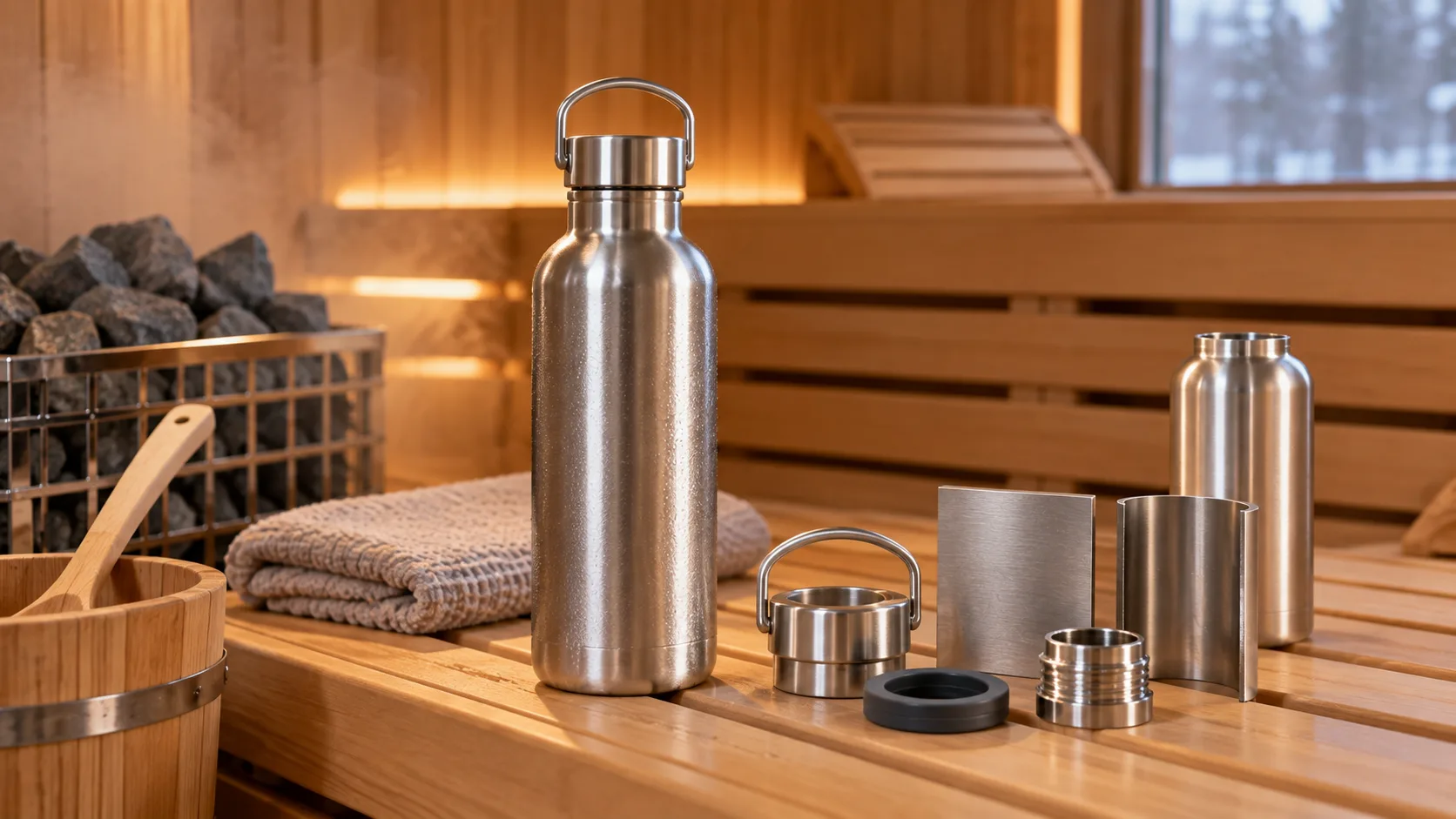
This might sound backward. We're all taught that better insulation is the mark of a quality bottle. However, based on years of manufacturing water bottles specifically for wellness brands, I've learned that the sauna changes all the rules. The logic you use for a sports bottle doesn't just fail here—it can be dangerous. Let’s break down what truly matters when you're sourcing a bottle that will live in a 90°C (195°F) environment1, so you can make a choice that protects your customers and your brand.
Why Is Maximum Insulation a Bad Thing for a Sauna Bottle?
You assume a bottle that keeps water cold for 24 hours is the best. But in a 90°C sauna, this feature becomes a liability, creating an unexpected burn risk for your customers.
A highly insulated, double-wall vacuum bottle traps heat very differently in a sauna. The intense ambient heat warms the outer wall, and the vacuum layer prevents that heat from escaping, making the bottle's surface dangerously hot to touch. A single-wall bottle is often a safer choice here.
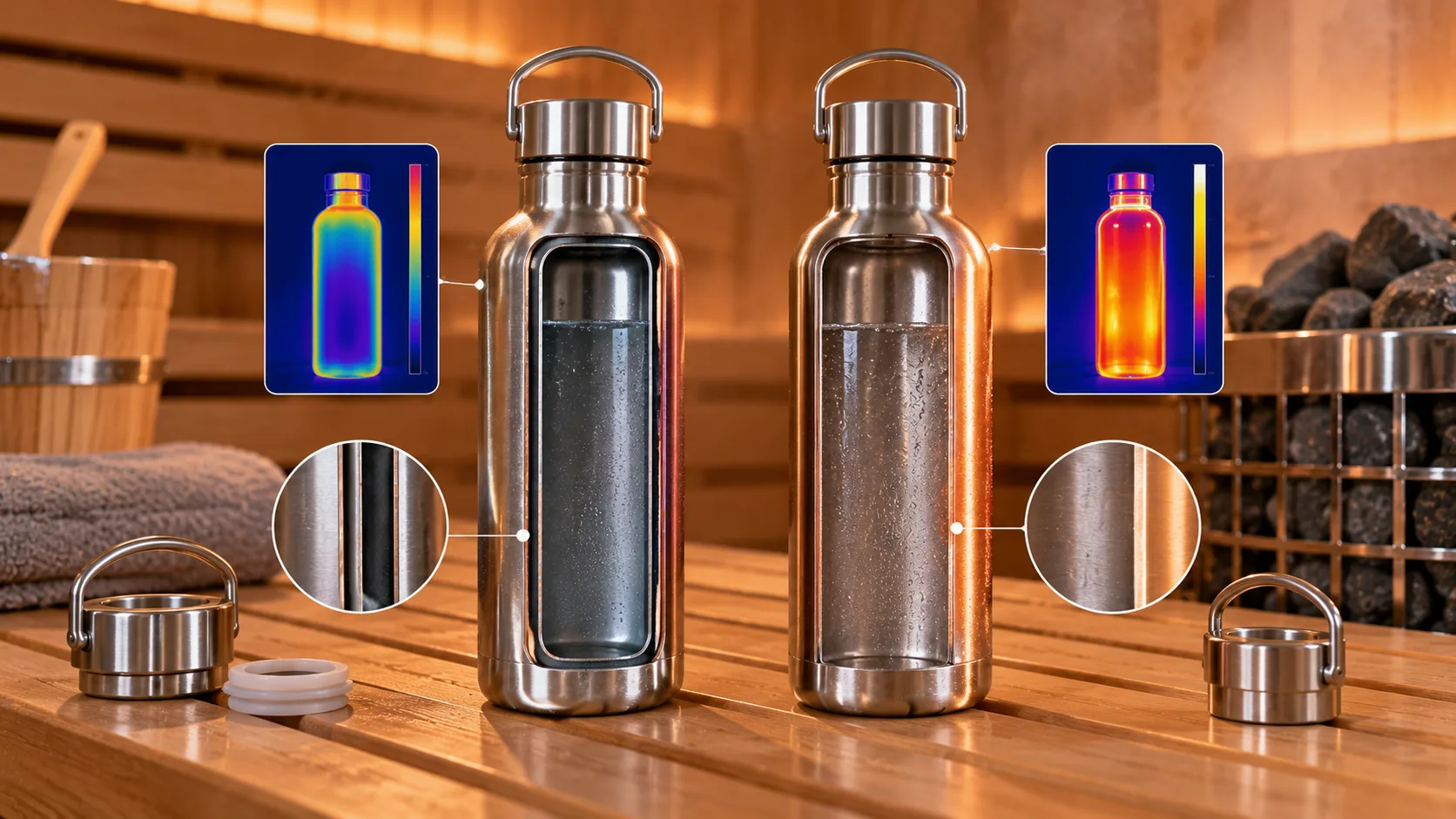
Based on our direct manufacturing experience, the entire goal of bottle selection shifts in a high-heat environment. For a sports bottle, the goal is to prevent heat transfer from the outside in. For a sauna bottle, the goal must also include managing the temperature of the bottle's outer surface for safe handling. A standard double-wall vacuum bottle, the kind celebrated for keeping ice frozen for days, is designed to be the ultimate barrier. In a sauna, that barrier works too well. The outer steel wall absorbs the room's intense heat, but the vacuum prevents it from transferring to the cooler liquid inside. As a result, the surface temperature of the bottle can climb to unsafe levels, creating a serious burn risk2. We've seen this in our own high-temperature cycle tests. A single-wall bottle, by contrast, allows for some heat exchange, so its surface temperature stays much closer to the temperature of the water inside3—which is significantly cooler and safer to handle than the sauna air.
| Bottle Type | Performance at Room Temp | Performance in Sauna (90°C / 195°F) | Sourcing Recommendation |
|---|---|---|---|
| Max-Insulation Double-Wall | Keeps cold 24+ hours | Outer wall can become dangerously hot. | Not Recommended |
| Single-Wall Stainless Steel | Poor insulation | Surface stays cooler, safer to handle. | Good Choice for Safety & Value |
| Custom Double-Wall | Moderate insulation | Balanced; keeps water cool, surface safe. | Best for Premium Brands |
Is Standard 304 Stainless Steel Safe Enough for a Sauna?
You see "food-grade 304 stainless steel" on a spec sheet and assume it's perfect. But repeated exposure to high heat and humidity can stress the material in ways you don't expect.
While 304 stainless steel is food-safe for normal use, 316 stainless steel offers superior resistance to corrosion and heat stress4. For a product used repeatedly in a hot, humid sauna, this added durability is a critical long-term safety and quality feature for your brand.
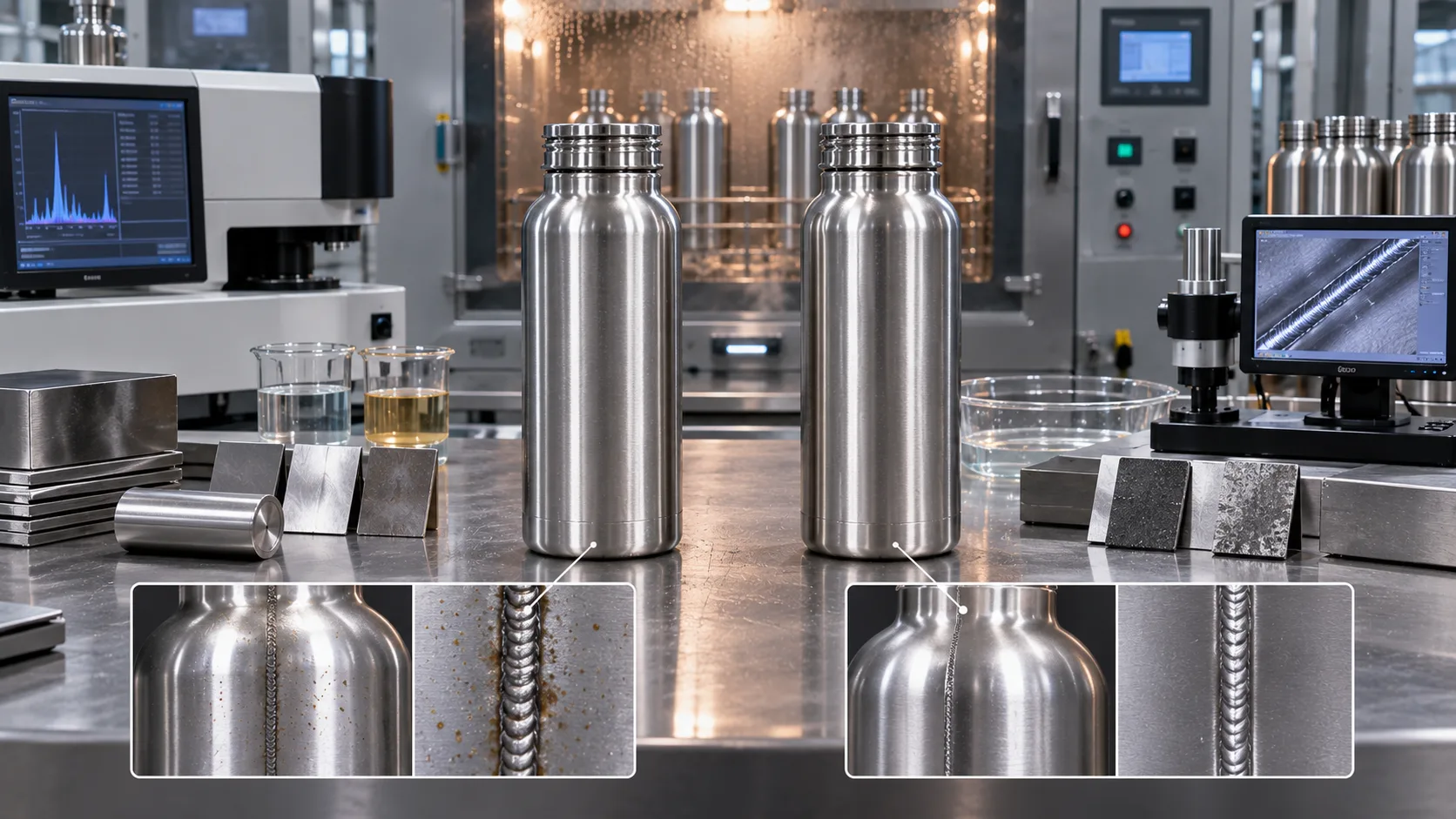
In our factory, we advise clients to think beyond baseline certifications. Passing an FDA or LFGB test is a starting point, not the finish line for a specialty product. The real test is long-term performance. The key difference between 304 and 316 stainless steel is the addition of molybdenum in 3165. This element significantly boosts its resistance to corrosion, particularly from chlorides (found in sweat)6 and high temperatures. From a manufacturing perspective, this is most visible at the weld points. A bottle's weld seam is its most vulnerable area. Based on orders we've produced for sauna and wellness brands, we've observed that bottles made from 316 steel hold up better to the repeated stress of high-temperature cycling. Choosing 316 steel is about ensuring the bottle remains structurally sound and safe after months or years of use, not just when it's new. This is a crucial detail that protects a brand's reputation for quality and durability.
What's the Most Overlooked Failure Point in a Sauna Bottle?
You've specified the perfect steel body for your bottle. But if the lid fails, the whole product is useless. Standard lids can warp, leak, or even release odors in a sauna.
The lid and its silicone gasket are the most common points of failure in a high-heat environment.7 Standard plastics and seals can warp, lose their integrity, or off-gas. It is essential to specify heat-resistant materials like BPA-free polypropylene (PP)8 and high-temperature-rated silicone gaskets.
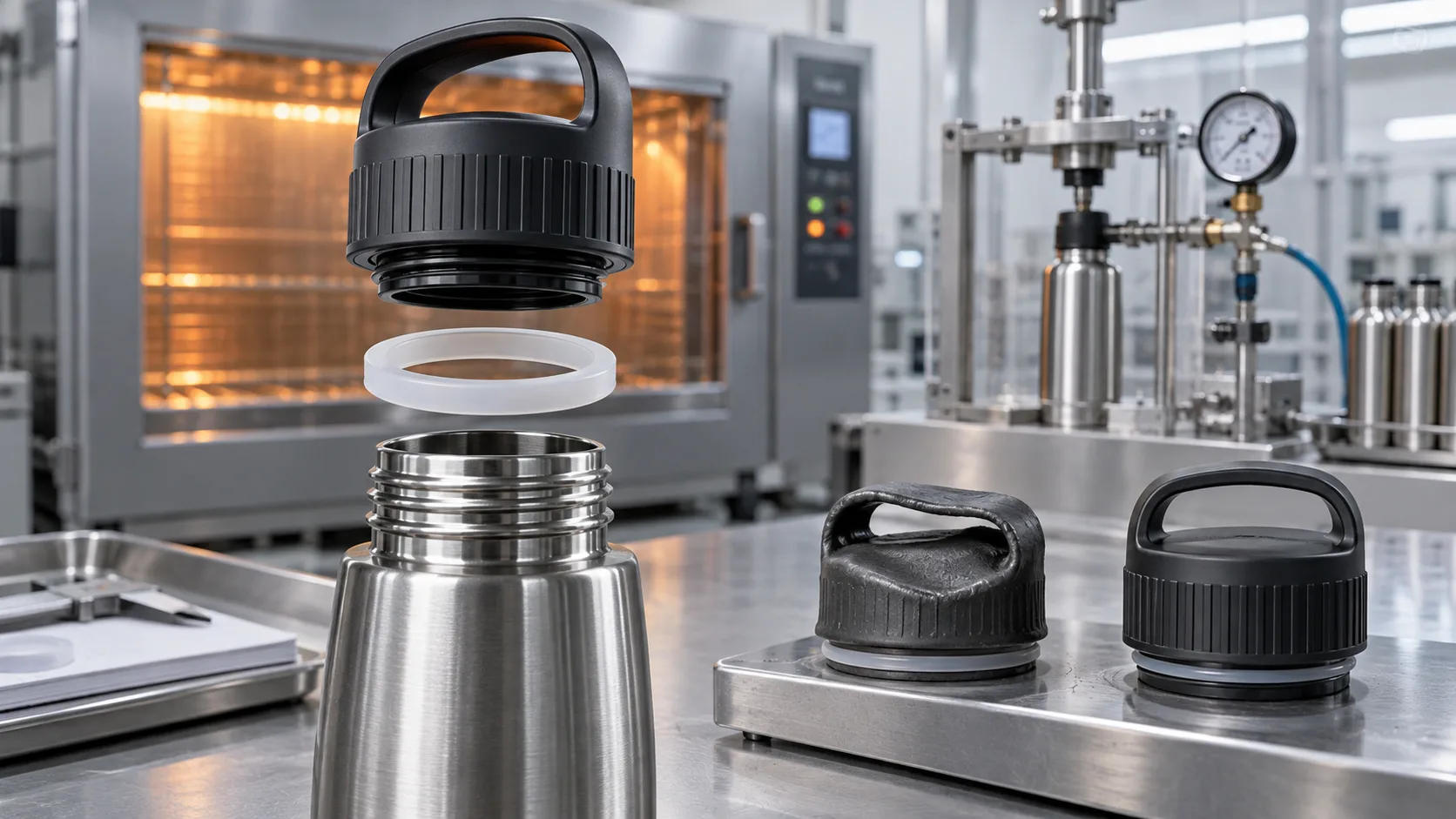
I've seen this issue firsthand more times than I can count. A potential client will send us a sample they sourced elsewhere, and it looks great at room temperature. But after just a few cycles in our high-temperature test chamber, the lid won't screw on correctly, or it starts to leak. This is because the plastic has warped. Low-quality lids and gaskets are the hidden weak link in most water bottles when they are pushed outside their normal operating range. In a sauna, three things can go wrong: the plastic lid structure can change shape, causing a bad fit; the silicone gasket can become brittle or too soft, destroying the seal; or the materials can off-gas, releasing a chemical smell or taste into the water9. For the orders we produce, we proactively consult with brands on upgrading these components. We recommend using a thicker, reinforced BPA-free PP and specifying a silicone gasket that is certified to withstand higher temperatures. This small detail in the product specification makes a massive difference in performance, safety, and customer satisfaction.
How Much Water Should a Sauna Bottle Actually Hold?
It's tempting to offer a large, 1-liter bottle, just like for the gym. But sauna hydration is different, and the wrong size can be inconvenient and impractical for your customers.
The ideal capacity for a sauna water bottle is between 500ml (17 oz) and 750ml (25 oz).10 This size supports the typical use case of sipping small amounts of water over a single session, without being too large or heavy to handle in a confined space.
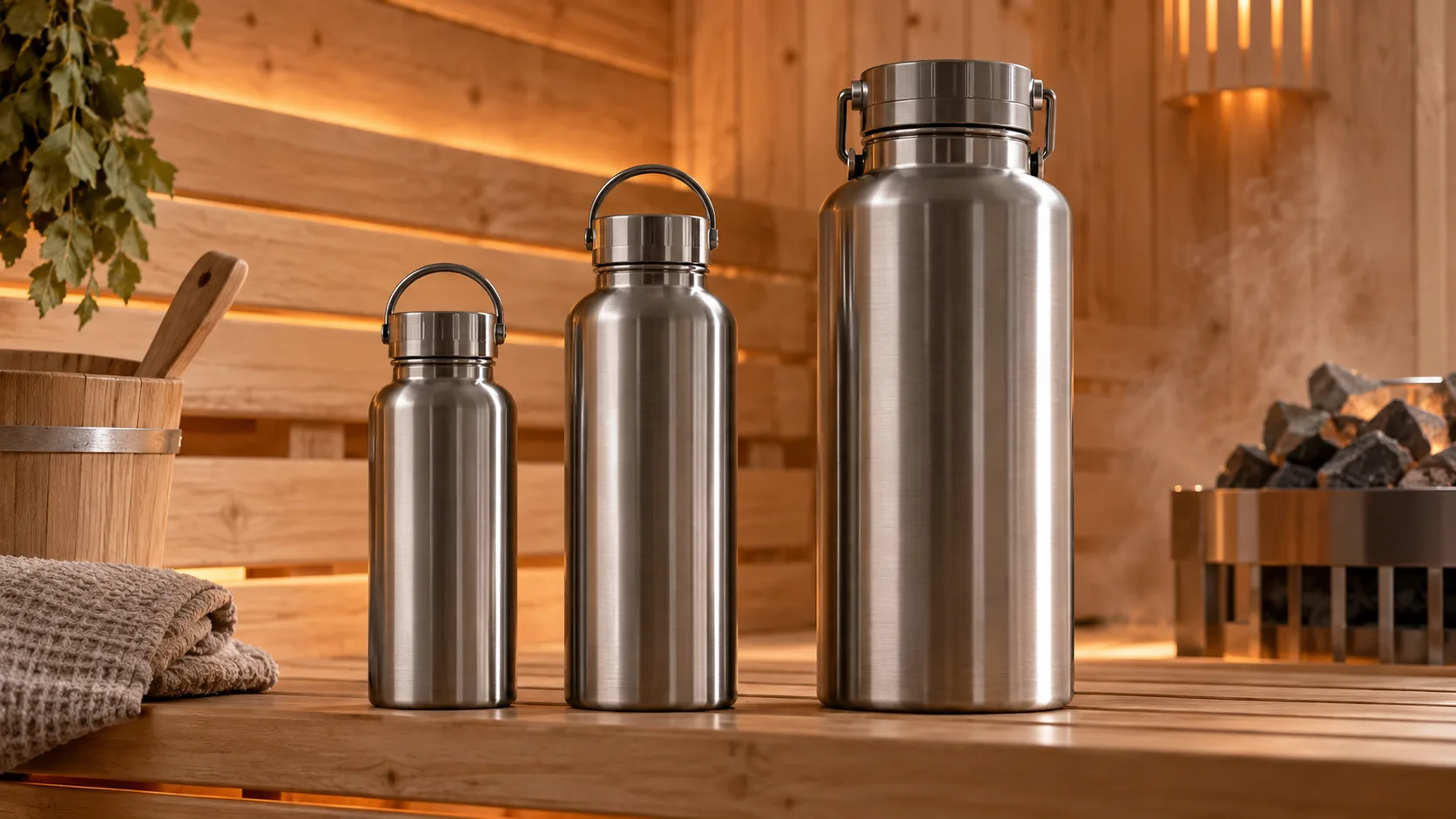
The way people hydrate in a sauna is fundamentally different from how they hydrate during a workout. Sauna use is about maintaining equilibrium with small, consistent sips, not chugging large volumes of water11 to replace rapid fluid loss. A large 1L or 1.5L bottle is simply overkill. It's heavy, takes up too much space on a narrow bench, and the large volume of water will inevitably warm up over a 60-minute session anyway. The 500ml to 750ml range is the sweet spot. It provides ample water for a full session, remains lightweight and easy to manage, and encourages the correct sipping behavior. Beyond capacity, a few simple features become critical. A simple, leak-proof screw cap with a good grip is far more reliable than a complex push-button or straw lid12, whose small parts can fail or become difficult to clean. A sturdy carrying loop is another practical feature that users appreciate.
| Feature | Importance for Sauna | Rationale |
|---|---|---|
| Capacity (500-750ml) | High | Matches sipping behavior; easy to handle. |
| Leak-Proof Seal | Critical | Safety first. Prevents spills on hot surfaces. |
| Simple Screw Cap | High | Reliable and easy to operate with sweaty hands. |
| Carrying Loop/Handle | Medium | Adds convenience for transport. |
| Complex Lids (Straw/Spout) | Low | More failure points in high heat; harder to clean. |
Conclusion
Choosing a sauna bottle means prioritizing safety and material stability in high heat over insulation. Focus on steel grade, heat-resistant lids, and correct capacity for a truly reliable product.
"Clinical Effects of Regular Dry Sauna Bathing: A Systematic Review", https://pmc.ncbi.nlm.nih.gov/articles/PMC5941775/. Sources on traditional Finnish saunas confirm that temperatures commonly range from 80°C to 100°C (176°F to 212°F), placing the article's figure of 90°C (195°F) squarely within the typical operating range. Evidence role: historical_context; source type: encyclopedia. Supports: The article's reference to 90°C (195°F) is a typical temperature for a traditional Finnish sauna.. ↩
"[PDF] CPSC Publication 3200: Playground Burn Fact Sheet", https://www.cpsc.gov/s3fs-public/3200.pdf. Educational resources on thermodynamics explain that a vacuum layer in an insulated flask minimizes heat transfer via conduction and convection. In a hot environment, this prevents the ambient heat absorbed by the outer wall from transferring to the cooler liquid inside, causing the outer surface temperature to rise significantly. Evidence role: mechanism; source type: education. Supports: The physics of vacuum insulation explain why the outer wall of a bottle would get hot in a sauna.. ↩
"Double wall versus single wall incubator for reducing heat loss in ...", https://pmc.ncbi.nlm.nih.gov/articles/PMC8767785/. Physics principles of thermal conduction state that heat will transfer from a hotter body to a cooler one. For a single-wall container, heat from the ambient air is conducted through the metal to the cooler liquid inside, meaning the outer surface temperature will be closer to that of the liquid rather than the surrounding air. Evidence role: mechanism; source type: education. Supports: The principle of thermal conduction supports the claim that a single-wall bottle's surface will be cooler than the ambient air.. ↩
"Deciding on the Best Material – 304 vs. 316 Stainless Steel - Polycase", https://www.polycase.com/techtalk/steel-enclosures/304-vs-316-stainless-steel.html. Materials science literature confirms that 316 stainless steel exhibits superior corrosion resistance, particularly against chlorides and in acidic environments, compared to 304 stainless steel, due to the addition of molybdenum. Evidence role: general_support; source type: paper. Supports: 316 stainless steel has documented superior properties compared to 304 grade, especially regarding corrosion.. ↩
"SAE 316L stainless steel - Wikipedia", https://en.wikipedia.org/wiki/SAE_316L_stainless_steel. Technical specifications and encyclopedic entries for stainless steel grades confirm that the primary compositional difference between 304 and 316 alloys is the inclusion of approximately 2-3% molybdenum in 316, which is not present in 304. Evidence role: definition; source type: encyclopedia. Supports: The chemical composition of 316 steel includes molybdenum, which is absent in 304 steel.. ↩
"Physiology of sweat gland function: The roles of sweating and ... - PMC", https://pmc.ncbi.nlm.nih.gov/articles/PMC6773238/. Physiological studies show that human sweat is composed primarily of water and electrolytes, with sodium and chloride being the most abundant ions. Evidence role: statistic; source type: paper. Supports: Human sweat contains chlorides, which can be corrosive.. ↩
"Degradation Behavior of Polypropylene during Reprocessing and Its ...", https://pmc.ncbi.nlm.nih.gov/articles/PMC7464851/. Material property data shows that common polymers like polypropylene and elastomers like silicone have significantly lower heat deflection temperatures and operating ranges compared to stainless steel, making them more susceptible to warping, degradation, and failure under high-heat conditions. Evidence role: mechanism; source type: education. Supports: Plastics and silicones have lower thermal limits than steel, making them more likely points of failure in high heat.. ↩
"Polypropylene - Wikipedia", https://en.wikipedia.org/wiki/Polypropylene. According to plastics industry resources, polypropylene (PP) is a thermoplastic polymer that does not use Bisphenol A (BPA) in its production process. It is widely used for food containers due to its good chemical resistance and a melting point typically above 160°C (320°F). Evidence role: definition; source type: institution. Supports: Polypropylene (PP) is inherently BPA-free and has a relatively high heat tolerance suitable for this application.. ↩
"Is Polypropylene Heat Resistant? Max Temp Rating & Tolerance ...", https://www.palmetto-industries.com/is-polypropylene-heat-resistant/?srsltid=AfmBOopFf-D8orHbARhItVuiACnlPucgIkBGyJGH7H7ZdGjnb62CJr36. Research on food contact materials indicates that polymers, including polypropylene and silicone, can release volatile organic compounds (VOCs) when heated, which may impart an odor or taste. Evidence role: mechanism; source type: research. Supports: Plastics and silicones can release volatile compounds at elevated temperatures.. Scope note: The presence and safety of such compounds depend on the specific material grade, quality, and temperature. ↩
"Correlations between Repeated Use of Dry Sauna for 4 x 10 ... - PMC", https://pmc.ncbi.nlm.nih.gov/articles/PMC6360547/. Physiological studies on sauna use have measured average sweat loss to be approximately 0.5 kg (about 500 ml) per session, which aligns with the lower end of the recommended bottle capacity. Evidence role: statistic; source type: paper. Supports: The recommended bottle size aligns with typical fluid loss in a sauna.. Scope note: Actual sweat loss can vary significantly based on individual physiology, sauna temperature, and duration. ↩
"Rethink your Drink Post-Sauna - SweatHouz", https://sweathouz.com/rethink-your-drink-post-sauna/. Health organizations and sauna societies often recommend drinking several glasses of water after a sauna session and sipping water during the session as needed to stay hydrated, rather than consuming large quantities at once. Evidence role: expert_consensus; source type: government. Supports: Health experts recommend sipping water during sauna use rather than drinking large amounts at once.. Scope note: Specific recommendations may vary, but the principle of gradual hydration is consistent. ↩
"Draft paper for Topic: Mechanical Reliability", https://users.ece.cmu.edu/~koopman/des_s99/mechanical/. Principles of reliability engineering support the concept that products with fewer components, particularly moving parts, generally have fewer potential failure points and thus tend to exhibit higher reliability over their lifespan. Evidence role: general_support; source type: education. Supports: Simpler designs with fewer components are generally more reliable.. ↩