
Trying to budget for a new custom drinkware line can feel like navigating a maze in the dark. You know there's a final price, but getting a straight answer on manufacturing costs seems impossible. This uncertainty is more than just frustrating; vague quotes and surprise fees can derail your project, damage your brand's reputation, and destroy your profit margins. The solution is to understand that the cost to manufacture a stainless steel water bottle isn't a single number, but a dynamic equation you control through your design, quality, and supplier choices.
The cost to manufacture a stainless steel water bottle is not a fixed price but a comprehensive sum of multiple variables. It is determined by the grade of stainless steel, the bottle's structural complexity (e.g., single vs. double-wall), the order volume, and the layers of customization—including surface finishes, printing methods, lid mechanisms, and packaging. One-time costs for custom molds and tooling are also a significant factor for unique designs.
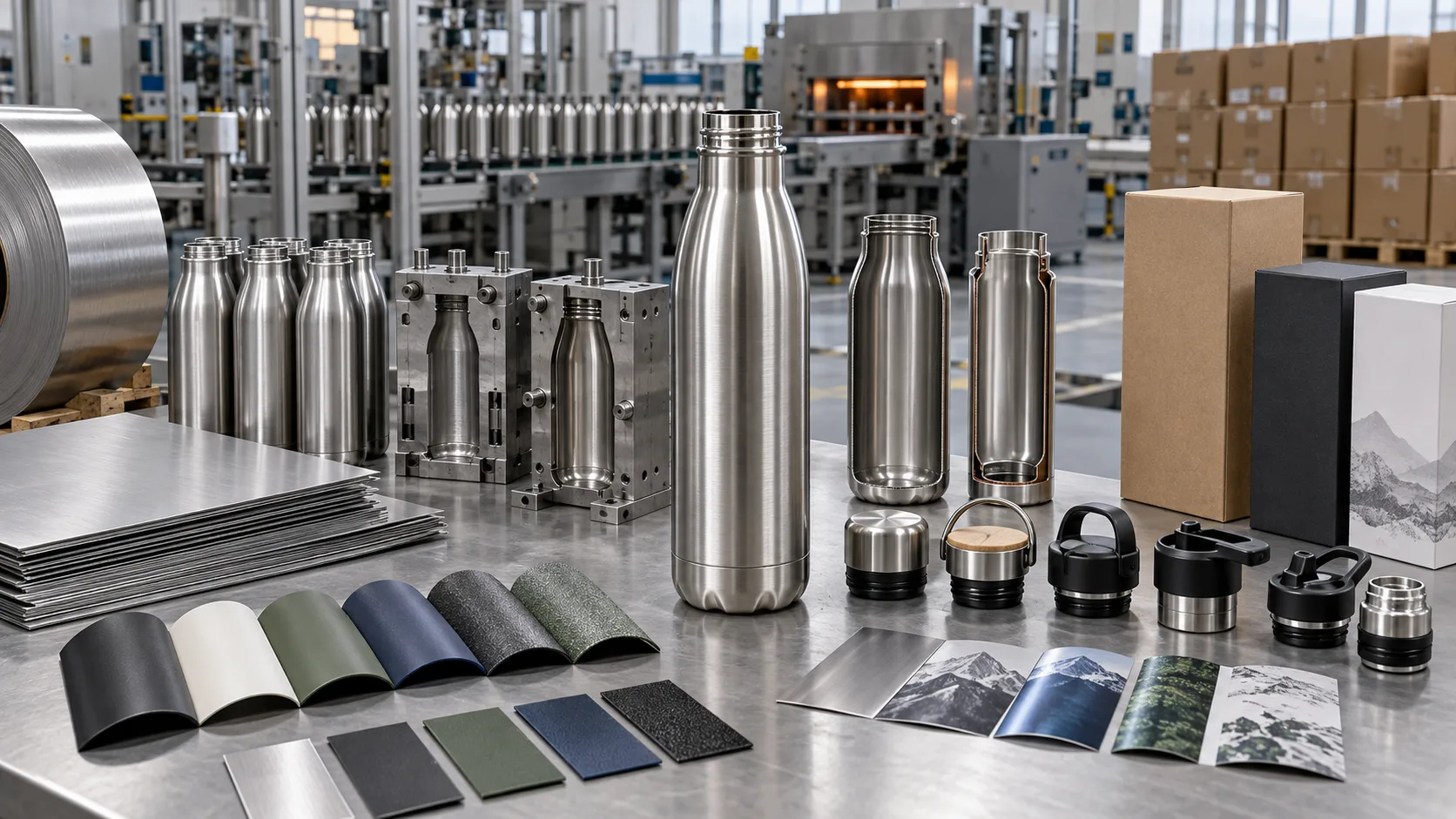
Now that you have the high-level answer, it's clear that a simple "price per unit" question misses the mark. To build an accurate budget and choose the right manufacturing partner, you need to understand how each of these components contributes to your final, landed cost. Let's break them down one by one.
What Are the Core Components of the Base Production Cost?
You might assume the base cost is just raw materials plus a bit for labor. But this oversimplification is where budgets first begin to fail. Which grade of steel are you using? How complex is the bottle's structure? Overlooking these fundamental details leads to inaccurate forecasts and can put you in a difficult negotiating position later on.
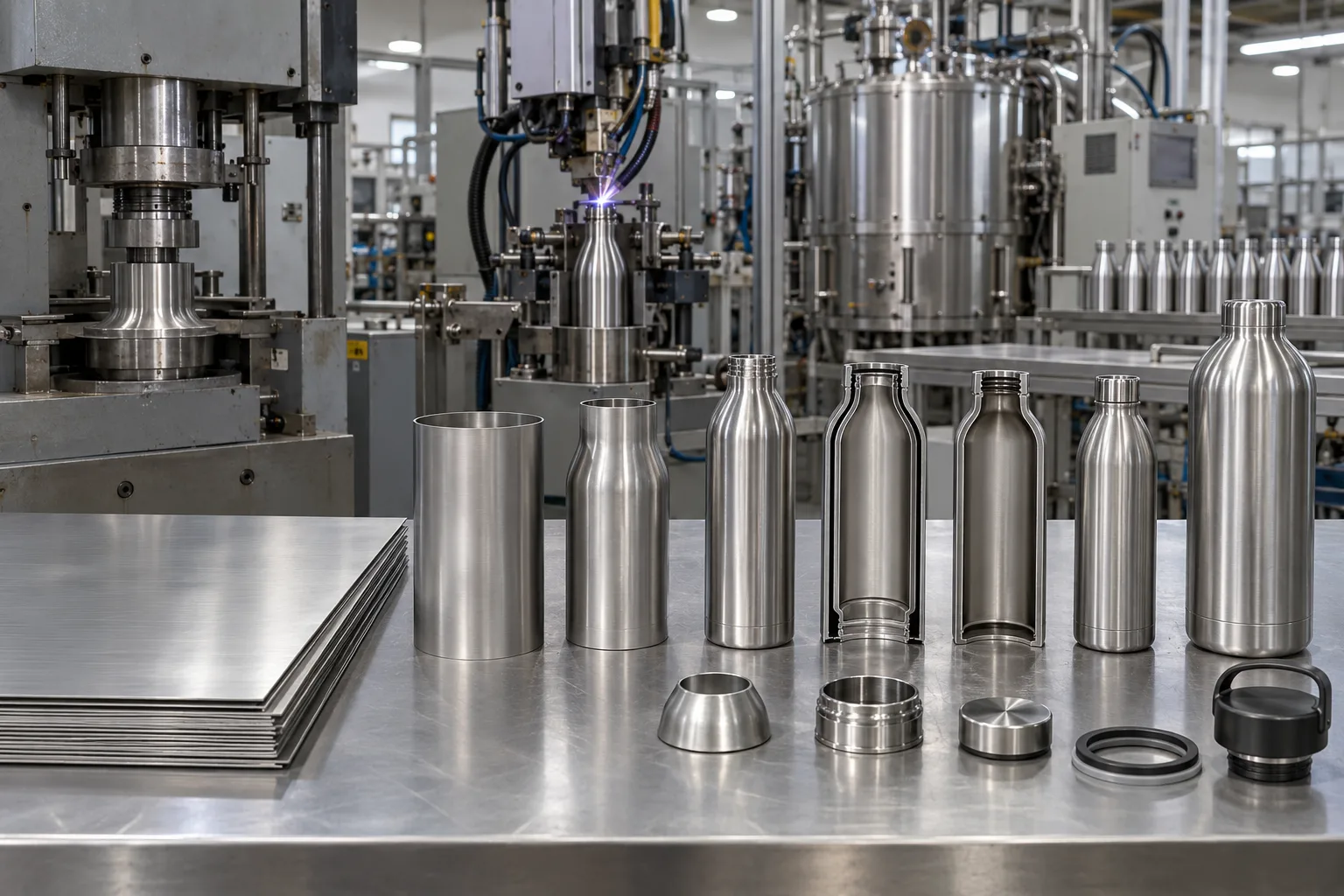
The base production cost is primarily driven by three things: the grade and amount of stainless steel used, the bottle's fundamental structure (like single-wall versus double-wall vacuum insulated), and the core manufacturing processes required to form, weld, and prepare the vessel for finishing.
As a market analyst in this industry, I've seen countless project proposals. The most successful ones are always those that have a firm grasp of these foundational cost drivers from the very beginning.
Material Grade and Consumption
The "stainless steel" in your water bottle isn't a generic term. The specific grade has a direct impact on performance and cost.
- 304 (18/8) Stainless Steel: This is the industry standard for high-quality drinkware1. The "18/8" refers to its composition of 18% chromium and 8% nickel, which gives it excellent rust and corrosion resistance. For most lifestyle, outdoor, and retail brands, 304 stainless steel provides the perfect balance of quality, safety, and cost-effectiveness. It is considered food-grade and is the material we use for the vast majority of our client projects.
- 316 Stainless Steel: This is a premium, "marine-grade" steel with added molybdenum. This gives it superior corrosion resistance, especially against chlorides2 and other industrial chemicals. While technically superior, it's also more expensive and is typically overkill for a standard water bottle. Its use is reserved for specific applications where maximum corrosion resistance is a non-negotiable requirement.
The amount of material also matters. A tall, wide 40 oz bottle will naturally cost more in raw materials than a slim 12 oz bottle.
Structural Complexity
How the bottle is constructed is a major cost factor because it dictates the number of manufacturing steps.
- Single-Wall: These bottles are made from a single layer of stainless steel. They are lighter, simpler, and less expensive to produce. This structure is common for sports water bottles or bike cages where light weight is a priority and insulation is not needed.
- Double-Wall Vacuum Insulated: This is the structure used in most modern tumblers and insulated bottles. It involves an inner and an outer wall. During manufacturing, these two layers are welded together at the top, and the air is pumped out from the space between them through a small port (usually at the bottom) which is then permanently sealed. This vacuum is what stops heat transfer3, keeping drinks hot or cold. This multi-step process—involving more material, precise welding, and a dedicated vacuuming procedure—makes these bottles significantly more expensive to produce.
Core Manufacturing Processes
Even a "simple" bottle goes through a dozen or more stages, each adding to the labor and machine time costs. These steps include:
- Pipe Cutting: Raw steel pipes are cut to length.
- Shaping: The pipes are shaped using processes like water expansion, where high-pressure water forces the steel into a mold4.
- Joining: For multi-part bottles, pieces are joined together with precision laser welding.
- Vacuuming: For insulated models, the vacuum process is performed in a specialized chamber.
- Polishing: The bottle is mechanically polished to create a smooth surface, ready for coating or printing.
How Do Customization and Design Affect the Cost to Manufacture a Stainless Steel Water Bottle?
A unique bottle design is your brand's signature, helping you stand out on a crowded shelf. But are you prepared for the associated costs? Failing to budget for tooling, finishes, and complex printing can quickly inflate your per-unit price and turn a profitable idea into a financial burden. Customization is a major factor in the cost to manufacture a stainless steel water bottle.
The cost impact of customization can be broken into two categories: significant one-time fees for mold and tooling development (for truly unique shapes) and recurring per-unit costs for special surface finishes, printing methods, and accessory components like lids.
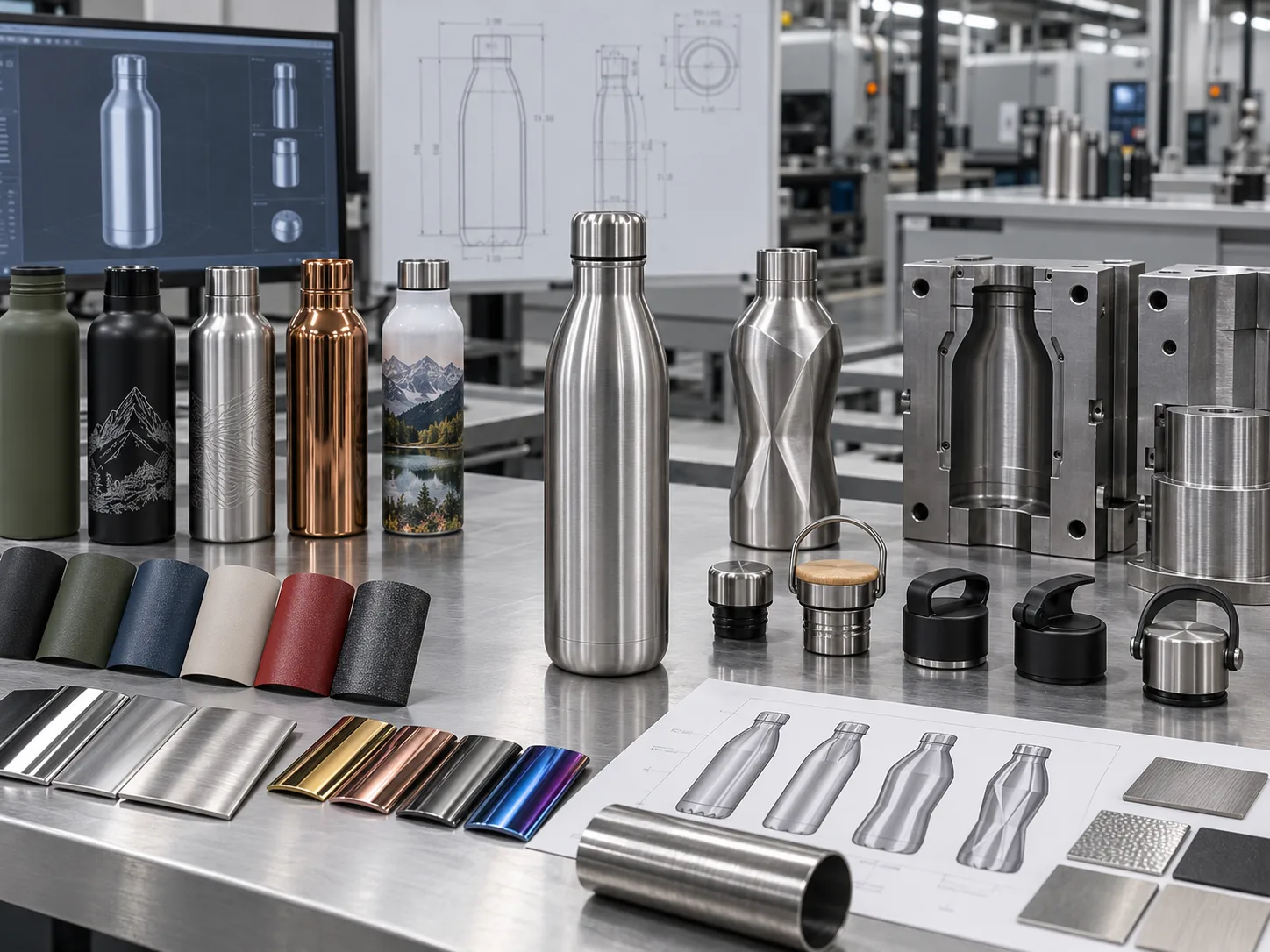
When brands approach us, their first decision point is often between using an existing design or creating a completely new one. This choice has the single largest impact on upfront investment.
Tooling & Mold Development (OEM vs. ODM)
- ODM (Original Design Manufacturer): In this model, you select a bottle shape from our existing catalog of mature designs. The molds and tooling already exist. This is the fastest and most cost-effective way to launch a product. The primary benefit is a very low (or zero) upfront tooling investment and a lower Minimum Order Quantity (MOQ), often starting around 100–500 units. You can still customize the color, finish, and logo.
- OEM (Original Equipment Manufacturer): In this model, we work with you to create a completely unique bottle shape, lid, or feature. This requires designing and fabricating new molds and production tooling. This is a significant upfront investment, often running into thousands of dollars5, and is treated as a separate project cost. Because of the dedicated resources required, OEM projects typically have a higher MOQ, starting around 1,500 units or more. While it requires more capital, this is the path to true brand differentiation.
Surface Finishes and Their Cost Impact
The finish on your bottle is what your customer sees and touches first. It defines the aesthetic and has a direct, per-unit cost. Here’s a comparison of common options:
| Finish Type | Description | Relative Cost Impact | Best For |
|---|---|---|---|
| Powder Coating | A durable, slightly textured finish applied as a dry powder and cured with heat. | Moderate | Outdoor, sports, and lifestyle brands needing durability. |
| Spray Painting | A liquid paint application that can achieve a smooth, high-gloss, or matte look. | Low to Moderate | Retail and corporate brands requiring precise Pantone color matching. |
| Electroplating | A process that deposits a thin layer of metal (e.g., copper, chrome) onto the bottle. | High | High-end or luxury brands looking for a premium, metallic finish. |
| Raw Finish | The bottle is simply brushed or polished, leaving the raw stainless steel visible. | Low | Minimalist or industrial-style brands. |
Printing, Branding, and Accessories
How you apply your logo and branding adds another layer to the per-unit cost.
- Silk Screen Printing: Very cost-effective for simple logos with 1–2 solid colors.
- Laser Engraving: Uses a laser to etch your design into the surface. It’s permanent and has a premium feel, but is slower and more expensive than printing.
- Full-Wrap Heat Transfer: A pre-printed design on a special film is applied to the bottle with heat. This is ideal for complex, multi-color patterns that cover the entire surface.
- Custom Lids & Accessories: A unique, leak-proof straw lid or a handle integrated into the cap requires its own design and tooling process, adding to the overall project cost.
What "Hidden" Expenses Impact the Total Landed Cost?
Your quote from the factory looks great and fits the budget. But what about all the costs involved in getting that product from the factory floor to your warehouse shelf? Ignoring these "hidden" expenses is a classic and costly procurement mistake that can erase your entire profit margin.
The total landed cost goes far beyond the ex-factory price. To get a true picture, you must account for quality assurance inspections, compliance testing and certification, custom retail packaging, international shipping, insurance, customs duties, and local taxes.
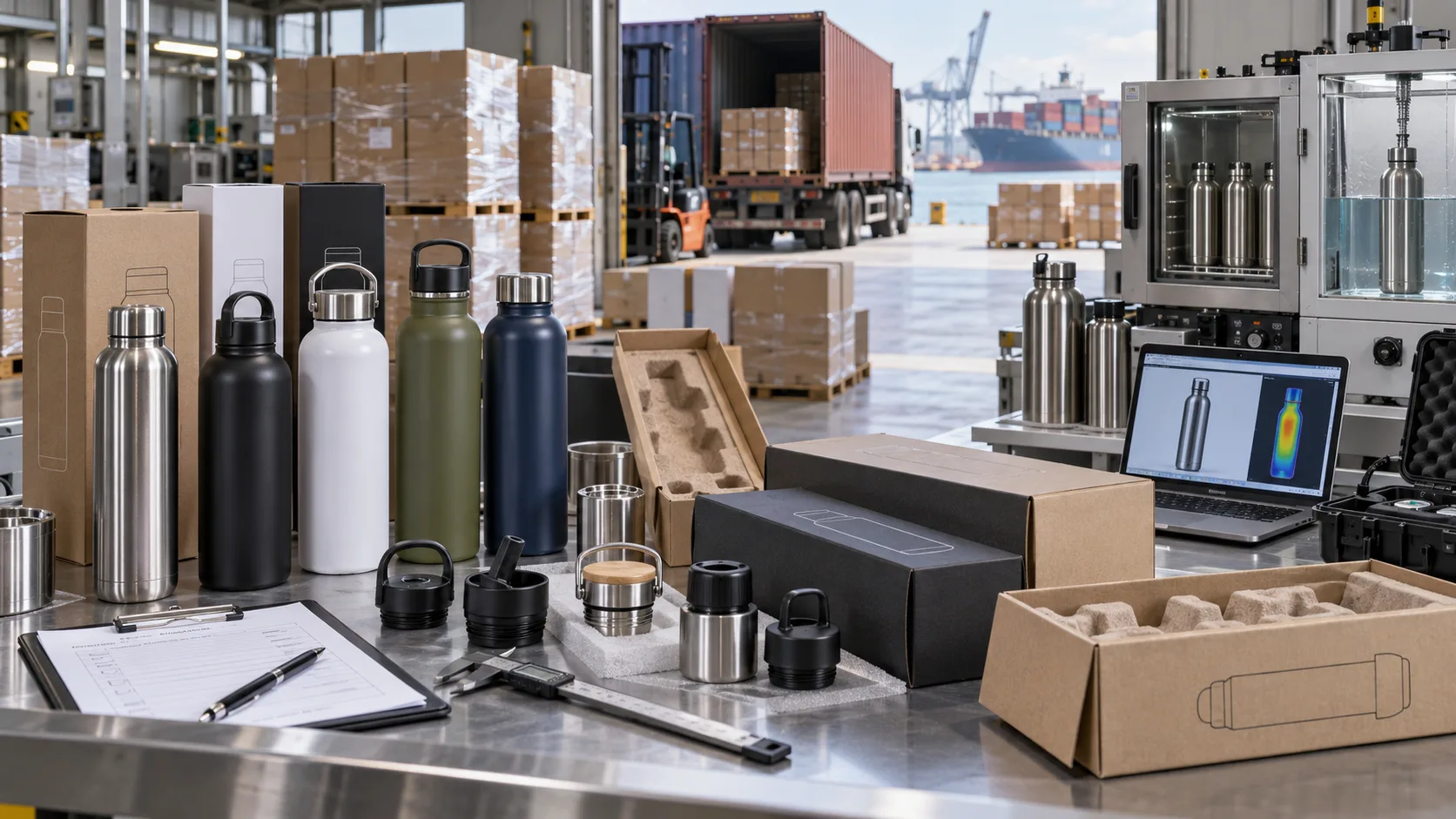
From my experience working with brands entering the drinkware market for the first time, this is the area most prone to budget overruns. A good manufacturing partner will be transparent about these factors, but ultimately, they are your responsibility to manage.
Quality Assurance & Compliance
Quality isn't free. While we have our own rigorous internal QC processes, many clients choose to add further layers of verification.
- Third-Party Inspection: You can hire an independent inspection agency to check your products before they leave the factory. They can verify specs, check for defects, and ensure everything matches your order. This is an added cost but provides crucial peace of mind.
- Compliance & Certification: Your product must be safe for consumers. This means complying with standards like FDA (in the U.S.), LFGB (in Germany/EU), and California Prop 656. While reputable manufacturers use materials that comply, you may need to pay for specific batch testing or certification documents in your company's name for your target market. It's vital to request and verify a supplier's existing certifications.
Custom Packaging
How your bottle is packaged directly impacts both cost and retail appeal.
- Bulk/Standard Packaging: The default is often a simple polybag and a plain white or brown box per unit, packed into a master carton. This is the cheapest option.
- Custom Retail Packaging: A full-color printed box with a die-cut window, internal inserts to hold the bottle securely, and a branded hang-tag all contribute to a premium unboxing experience. This is essential for retail success, but it can add a surprising amount to your per-unit cost. We often work with clients to design packaging that is both protective and brand-aligned.
Logistics, Duties, and Tariffs
The price you are quoted is often based on an Incoterm, which defines who pays for what.
- FOB (Free On Board)7: This is a common term. The factory's price includes getting the goods to the nearest port (e.g., FOB Shanghai). From that point on, you are responsible for paying for ocean freight, insurance, customs clearance, duties, and inland transportation in your country.
- DDP (Delivered Duty Paid): This is a more all-inclusive option where the supplier arranges and pays for everything to get the goods to your final destination. It's simpler for you but the cost is, of course, built into your price.
Customs duties and tariffs8 are taxes imposed by your country's government on imported goods. These vary wildly by country and product classification and can significantly increase your total landed cost. You must work with a customs broker to determine the exact rate for your product.
How Does Order Quantity Influence the Cost to Manufacture a Stainless Steel Water Bottle?
You want to start with a small test batch to gauge the market, but the per-unit price you're quoted is shockingly high. Why can't the factory just produce a few hundred units for you at the same price as a 10,000-unit order? It's a question rooted in the realities of factory production.
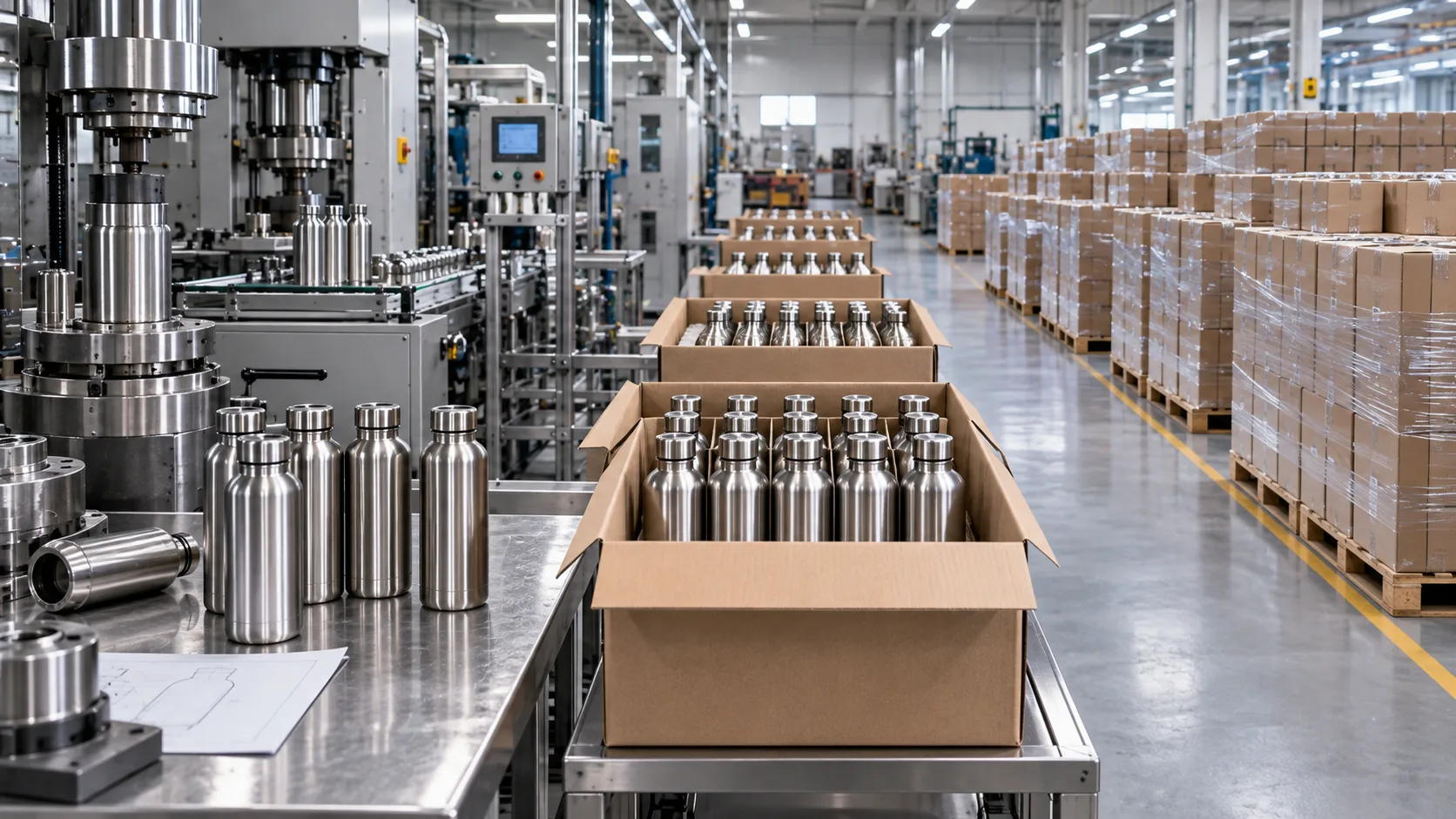
Order quantity, or volume, is one of the most significant levers on your per-unit price. The fundamental principle of economies of scale9 means that higher volumes spread fixed production costs over more units, lowering the price for each one. However, these savings have diminishing returns beyond a certain point. The key is to find the optimal batch size for your business.
In every negotiation I've been a part of, the conversation eventually turns to volume and price tiers. Understanding the "why" behind these numbers empowers you to make more strategic sourcing decisions.
Understanding Minimum Order Quantity (MOQ)
Factories don't just arbitrarily set MOQs. They are a direct reflection of the economics of production.
- Material Sourcing: Steel mills and coating suppliers have their own minimums. A factory can't just buy materials for 50 bottles; they have to purchase raw materials in large coils or tons.
- Machine Setup: It can take several hours to set up, calibrate, and test a production line10 for a specific bottle model. This setup cost is the same whether you're making 500 units or 50,000. On a small run, that fixed cost makes each unit prohibitively expensive.
- Efficiency and Labor: Production lines operate most efficiently when running continuously. Constant starting and stopping for small, different jobs is highly inefficient and drives up labor costs.
This is why, for our mature models (ODM), we can support MOQs around 100–500 units, as the tooling is ready and processes are established. For a fully custom OEM project, the MOQ starts around 1,500 units to justify the investment in new molds and process development.
Economies of Scale in Action
Let's imagine a hypothetical fixed setup cost of $1,000 for a production run.
- On an order of 500 units, that setup cost adds $2.00 to each bottle.
- On an order of 5,000 units, that same cost adds only $0.20 to each bottle.
- On an order of 50,000 units, it adds a mere $0.02.
This same logic applies to tooling amortization, administrative overhead, and other fixed costs. The steepest price drops occur in the lower volume ranges (e.g., moving from 500 to 2,000 units). The price difference between an order of 20,000 and 30,000 units will be much less dramatic.
Finding Your Optimal Batch Size
The goal shouldn't be to chase the absolute lowest per-unit price. For many brands, ordering a massive quantity ties up too much cash, incurs high warehousing costs, and carries the risk of being stuck with unsold inventory if the market shifts. It's about finding a strategic balance. A slightly higher per-unit cost on a smaller, faster-selling order can often be more profitable and agile for your business than a massive order with a rock-bottom price.
Frequently Asked Questions
Why is 304 stainless steel the standard for water bottles?
304 (or 18/8) stainless steel is the industry standard because it offers the best balance of performance, safety, and cost. Its high chromium and nickel content make it highly resistant to rust and corrosion, it imparts no flavor to the contents, and it is universally recognized as a food-grade material11.
What's the difference between OEM and ODM manufacturing?
ODM (Original Design Manufacturer) is when you choose a pre-existing design from a manufacturer's catalog and customize it with your color and logo. OEM (Original Equipment Manufacturer) is when you partner with a manufacturer to build a completely new product based on your unique design, which requires creating new molds and tooling.
How long does it take to develop a custom water bottle?
The timeline varies greatly depending on complexity. For a fully custom (OEM) project, a timeframe of 4 to 6 months is a realistic estimate12. This includes initial design, 3D modeling, mold creation, sample testing and refinement, and finally, the first mass production run. ODM projects are much faster.
Can I get a sample before placing a large order?
Absolutely. Obtaining samples is a critical step. We typically provide pre-production samples (PPS) for approval before starting mass production. For ODM projects, we can often send existing stock samples quickly. For custom OEM projects, creating a one-off sample requires significant setup and has an associated cost.
Conclusion
As you can see, asking "how much does it cost?" is only the first step. The real answer lies in the choices you make. The final cost to manufacture a stainless steel water bottle is a dynamic value equation, not a static price tag. It's a reflection of your brand's commitment to quality, your desire for differentiation, and your strategy for bringing a product to market. From the grade of steel and the complexity of the vacuum insulation to the texture of the powder coat and the design of the retail box, every decision has a cost implication. Understanding these levers empowers you to have more intelligent conversations with potential suppliers and build a realistic, profitable business plan.
Choosing a partner who can transparently guide you through these variables is just as important as the product itself. If you are a brand that prioritizes design, quality, and a collaborative development process, we can help you navigate these complexities. Contact us to discuss your project and learn how we can help you build the perfect drinkware for your market.
"Food Grade Stainless Steel: 304 vs 316", https://www.azom.com/article.aspx?ArticleID=24472. Sources from materials science or food-grade equipment suppliers confirm that 304 stainless steel, also known as 18/8, is widely used for kitchen and beverage containers due to its strong corrosion resistance and lack of flavor leaching. Evidence role: general_support; source type: institution. Supports: The claim that 304 stainless steel is a standard material for food and beverage applications.. ↩
"Marine grade stainless", https://en.wikipedia.org/wiki/Marine_grade_stainless. Metallurgical studies show that the addition of molybdenum to stainless steel alloys, as in grade 316, significantly improves its resistance to pitting and crevice corrosion, particularly in environments containing chlorides. Evidence role: mechanism; source type: research. Supports: The claim that molybdenum in 316 steel enhances its resistance to corrosion from chlorides.. ↩
"Vacuum flask - Wikipedia", https://en.wikipedia.org/wiki/Vacuum_flask. A vacuum layer minimizes heat transfer via conduction and convection because it contains very few particles to transfer thermal energy between the inner and outer walls of the container. Heat transfer by thermal radiation can still occur but is often reduced by reflective coatings. Evidence role: mechanism; source type: encyclopedia. Supports: The claim that a vacuum acts as an insulator against heat transfer.. ↩
"Hydroforming", https://en.wikipedia.org/wiki/Hydroforming. Hydroforming is a metal forming process that uses high-pressure hydraulic fluid to press room temperature material into a die. For tubular products like water bottles, it allows for the creation of complex shapes with strong structural integrity. Evidence role: definition; source type: education. Supports: The description of the water expansion (hydroforming) process.. ↩
"How to Estimate Injection Molding Cost?", https://formlabs.com/blog/injection-molding-cost/. Industry reports on manufacturing indicate that the cost for creating custom molds and tooling can range from a few thousand to tens of thousands of dollars, depending on the part's complexity, size, material, and the country of manufacture. Evidence role: general_support; source type: research. Supports: The claim that custom tooling for manufacturing represents a significant cost, often in the thousands of dollars.. Scope note: The source provides a general cost range for tooling, not a specific price for water bottle molds. ↩
"Food Packaging & Other Substances that Come in Contact ...", https://www.fda.gov/food/food-ingredients-packaging/food-packaging-other-substances-come-contact-food-information-consumers. The U.S. Food and Drug Administration (FDA) regulates food contact materials, Germany's LFGB sets standards for food and feed articles, and California's Proposition 65 requires warnings for products containing certain chemicals. These regulations are critical for ensuring the safety of drinkware sold in these markets. Evidence role: definition; source type: government. Supports: The existence and relevance of FDA, LFGB, and Prop 65 regulations for consumer products.. ↩
"Know Your Incoterms", https://www.trade.gov/know-your-incoterms. According to the International Chamber of Commerce's Incoterms® rules, 'Free On Board' (FOB) means the seller delivers the goods on board the vessel nominated by the buyer at the named port of shipment. Risk transfers to the buyer once the goods are on board. Evidence role: definition; source type: institution. Supports: The definition of the shipping term FOB (Free On Board).. ↩
"Customs Duty Information - U.S. Customs and Border Protection", https://www.cbp.gov/travel/international-visitors/know-before-you-visit/customs-duty-information. As defined by bodies like the World Trade Organization (WTO) and national customs agencies, customs duties or tariffs are taxes levied on goods imported into a country. The rates are typically determined by the product's classification, value, and country of origin. Evidence role: definition; source type: government. Supports: The definition and function of customs duties and tariffs.. ↩
"Economies of scale", https://en.wikipedia.org/wiki/Economies_of_scale. Economies of scale are cost advantages reaped by companies when production becomes efficient. They are achieved by increasing production and lowering costs, as costs are spread over a larger number of goods. This is primarily because fixed costs, such as machine setup, are shared across more units. Evidence role: definition; source type: encyclopedia. Supports: The definition of the economic principle of economies of scale.. ↩
"Efficient scheduling to reduce setup times and increase ...", https://dspace.mit.edu/entities/publication/76066a30-586f-4948-9df9-9c7499a3e196. Studies in operations management and lean manufacturing identify setup or changeover time as a major source of production downtime and cost. The process involves retooling, calibration, and test runs, which can take several hours and directly impacts the economic viability of small production batches. Evidence role: general_support; source type: research. Supports: The claim that machine setup (changeover) is a time-consuming process in manufacturing.. ↩
"Code of Federal Regulations - Title 21 - Food and Drugs", https://www.fda.gov/medical-devices/medical-device-databases/code-federal-regulations-title-21-food-and-drugs. Food safety standards bodies, such as NSF International, and regulations like the U.S. FDA's Code of Federal Regulations, recognize austenitic stainless steels, including type 304, as safe materials for food contact surfaces when properly formulated and finished. Evidence role: expert_consensus; source type: government. Supports: The claim that 304 stainless steel is recognized as a food-grade material.. ↩
"Hardware Product Development Process: 10-Stage Guide", https://www.analogydesign.co/blog/hardware-product-development-process. Analyses of new product development cycles for consumer hardware show that the process from concept to mass production typically spans multiple months. This includes phases for design, engineering, prototyping, tooling creation (which can take 1-2 months alone), and pilot production runs, making a 4-6 month timeline a common estimate. Evidence role: general_support; source type: research. Supports: The estimated 4-6 month timeline for a custom product development project.. ↩