Worried your custom bottle's finish will chip and fade, hurting your brand? Vacuum coating isn't paint. It's a durable, safe solution that elevates your product's perceived value1.
Vacuum coating, also known as PVD, is a process that bonds a thin, durable film of metal to the bottle's exterior at an atomic level2. It creates a highly scratch-resistant finish3 and is completely food-safe4 because it is only applied to the outside, never touching the liquid inside.
When brand owners first approach us about customizing their stainless steel bottles, one of the most common topics is the finish. They often ask, "What's the difference between this and just painting it?" It's a great question, because the answer gets to the heart of what makes a premium bottle feel premium. The finish is the first thing your customer touches and sees, and its durability directly reflects on your brand's quality. In this post, I want to walk you through what we do on our factory floor and explain why this technology is so much more than just a coat of paint.
How Does Vacuum Coating Actually Work on a Bottle?
You're told a coating is "durable," but what does that really mean? Without understanding the process, it's hard to trust a supplier's claim. Let's look at how it works.
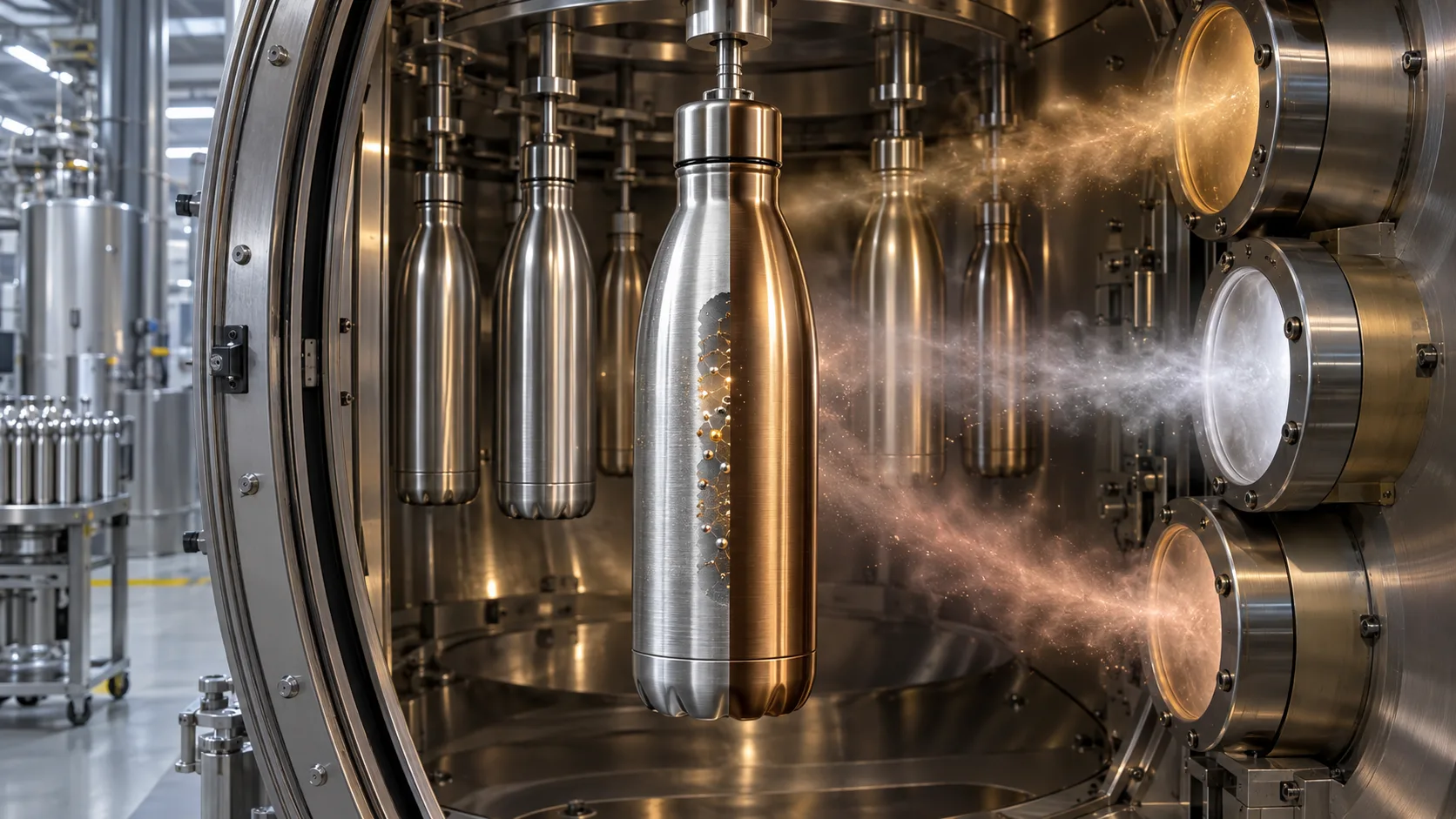
In a vacuum chamber, we vaporize solid metal into a plasma5. This plasma then deposits onto the bottle's exterior, forming a permanent, atomic bond with the stainless steel surface. This process creates a hard, dense film that becomes part of the bottle itself, not just a layer on top.
The term we use in the industry is Physical Vapor Deposition, or PVD. Unlike spray painting, where liquid paint is applied and dries on the surface, PVD is a structural change. Think of it this way: paint sits on the steel, while a PVD coating becomes one with the steel. In our process, we place the bottles inside a high-vacuum chamber. We then introduce a target material—often a durable metal like titanium or zirconium6—and use an electric arc to vaporize it. These vaporized metal ions then bond directly to the bottle's surface, creating an incredibly thin but tough finish. This physical bond is the secret to its durability7. It doesn't chip or flake off like paint because it's not a separate layer; it's an integrated part of the product.
PVD Coating vs. Traditional Paint
| Feature | Vacuum (PVD) Coating | Spray Painting |
|---|---|---|
| Application | Atomic bonding in a vacuum | Sprayed liquid dries on surface |
| Durability | High scratch & abrasion resistance8 | Prone to chipping and scratching |
| Bonding | Becomes part of the metal surface | Sits on top of the metal surface |
| Feel | Premium, metallic texture | Can feel like plastic or cheap |
| Consistency | Uniform, even coating | Risk of drips, unevenness |
Is Vacuum Coating Safe for a Drink Bottle?
Your biggest fear is a customer safety issue. Is the bottle's coating toxic? A product recall could be catastrophic for your brand. The answer is simple and structural, ensuring total peace of mind.
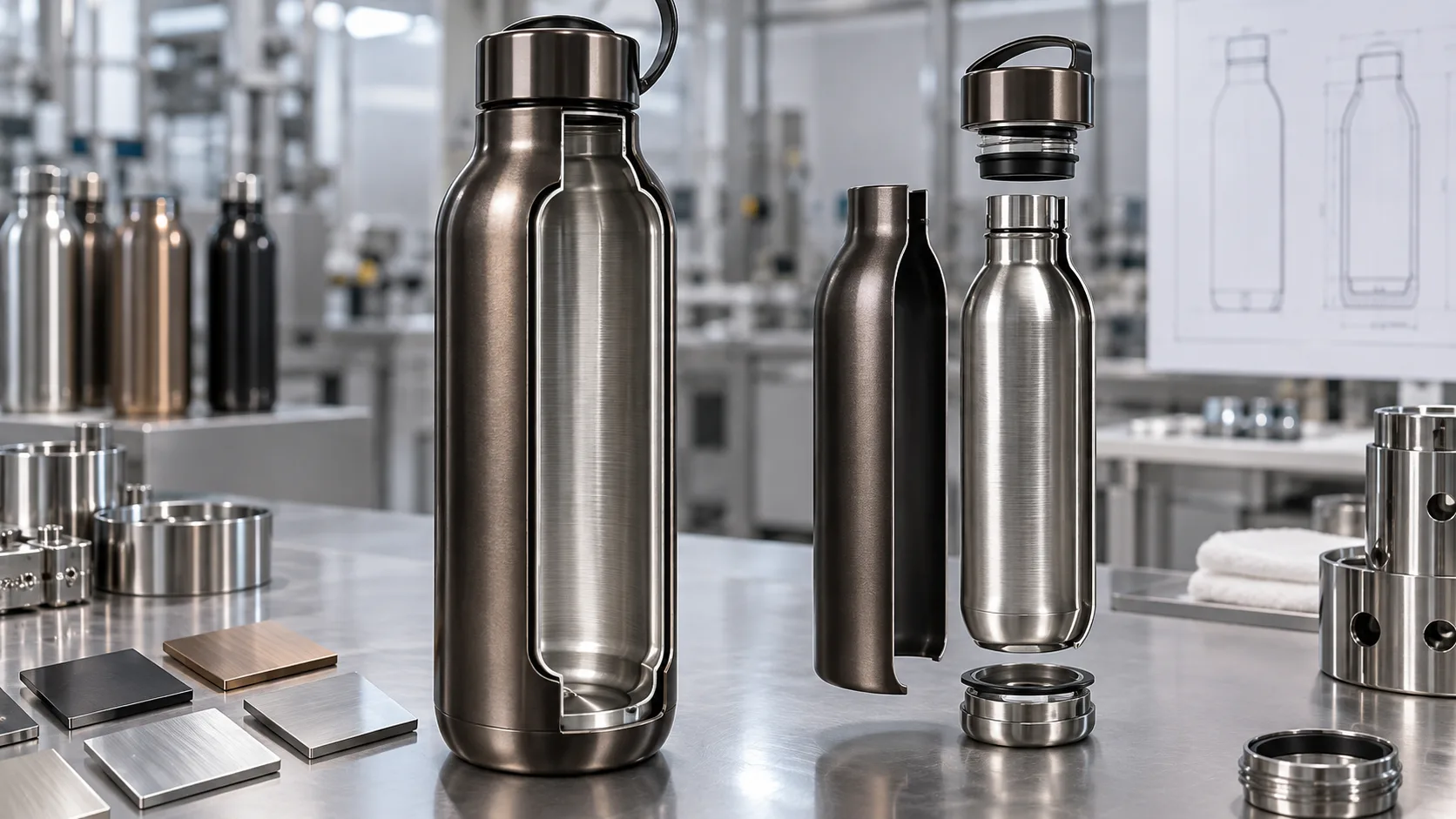
Absolutely. The vacuum coating is applied only to the exterior surface of the water bottle. The interior, which holds your drink, remains pure, uncoated 304 or 316 food-grade stainless steel9. There is zero contact between the coating and the liquid, making it completely safe.
This is one of the first things we clarify for new brand owners, and it immediately resolves one of their biggest concerns. The safety of vacuum-coated bottles isn't based on a chemical formula or a special "food-safe" coating material. It’s based on simple, reliable mechanics.
The Exterior-Only Application
During the manufacturing process, the bottles are positioned so that only the exterior wall is exposed inside the PVD chamber. The interior surface is never in the path of the vaporized metal ions. This means we are not creating a barrier between a chemical and your drink; we are ensuring the "chemical"—in this case, a thin layer of inert metal—never gets near your drink in the first place.
The Untouched Interior
The inside of every bottle we produce is made from food-grade stainless steel, typically type 304 or 316. This material is chosen for its stability, corrosion resistance, and proven safety10 in food and beverage applications. It imparts no flavors and does not react with liquids11. By leaving the interior uncoated, we guarantee that the part of the bottle in contact with your beverage is as pure and safe as possible. This structural separation is the most straightforward and dependable guarantee of safety.
What Customization Options Does Vacuum Coating Offer?
You want a unique look for your brand, but aren't sure what's possible. Choosing the wrong finish can lead to a generic product that doesn't stand out. Let's explore the real customization options.
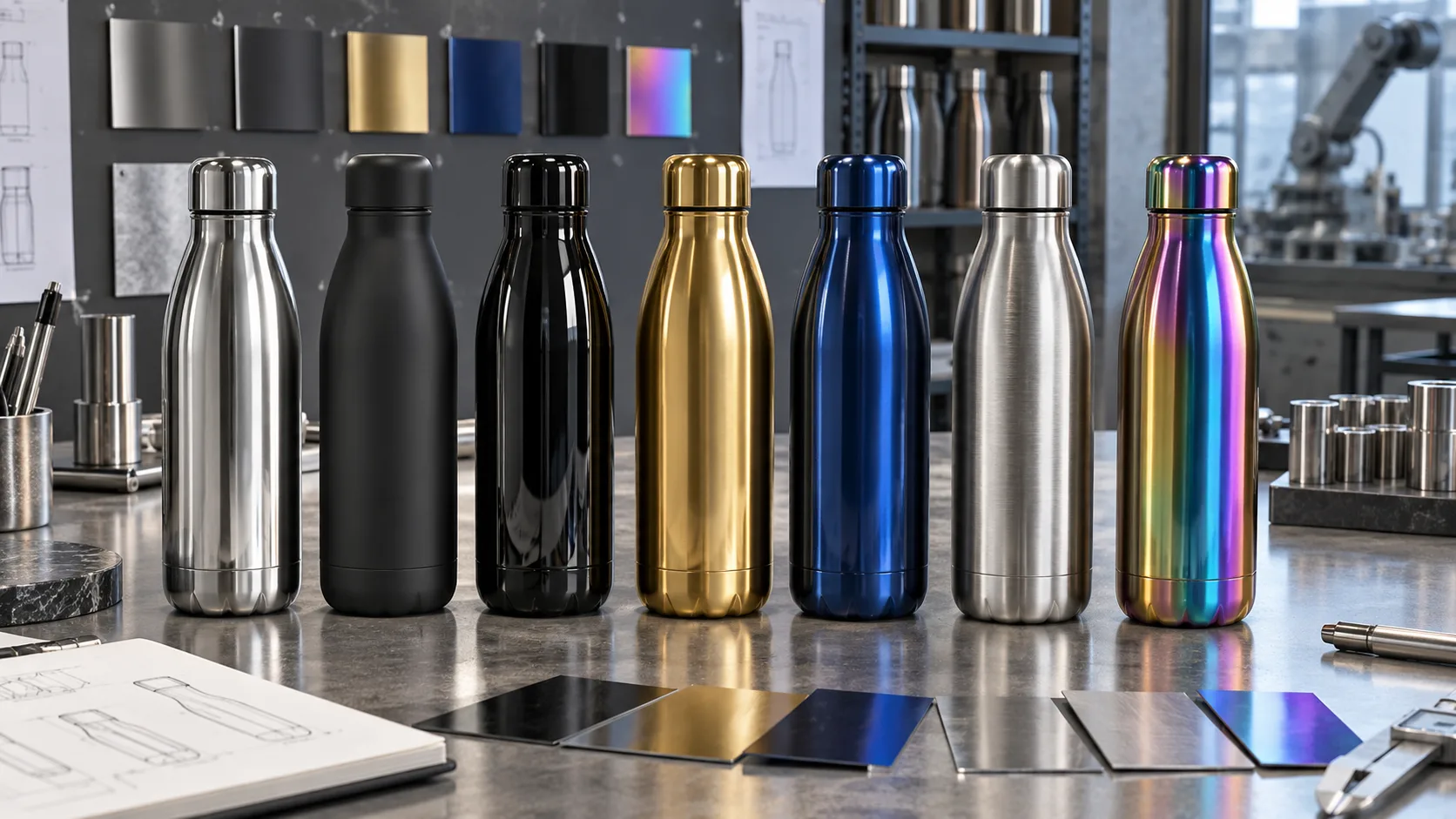
Vacuum coating offers a wide range of durable, metallic finishes, including classic silver, matte black, gold, and vibrant colors like blue or rainbow. We can achieve glossy, matte, or brushed textures. However, some complex gradients or specific Pantone-matched colors are better suited for other methods12.
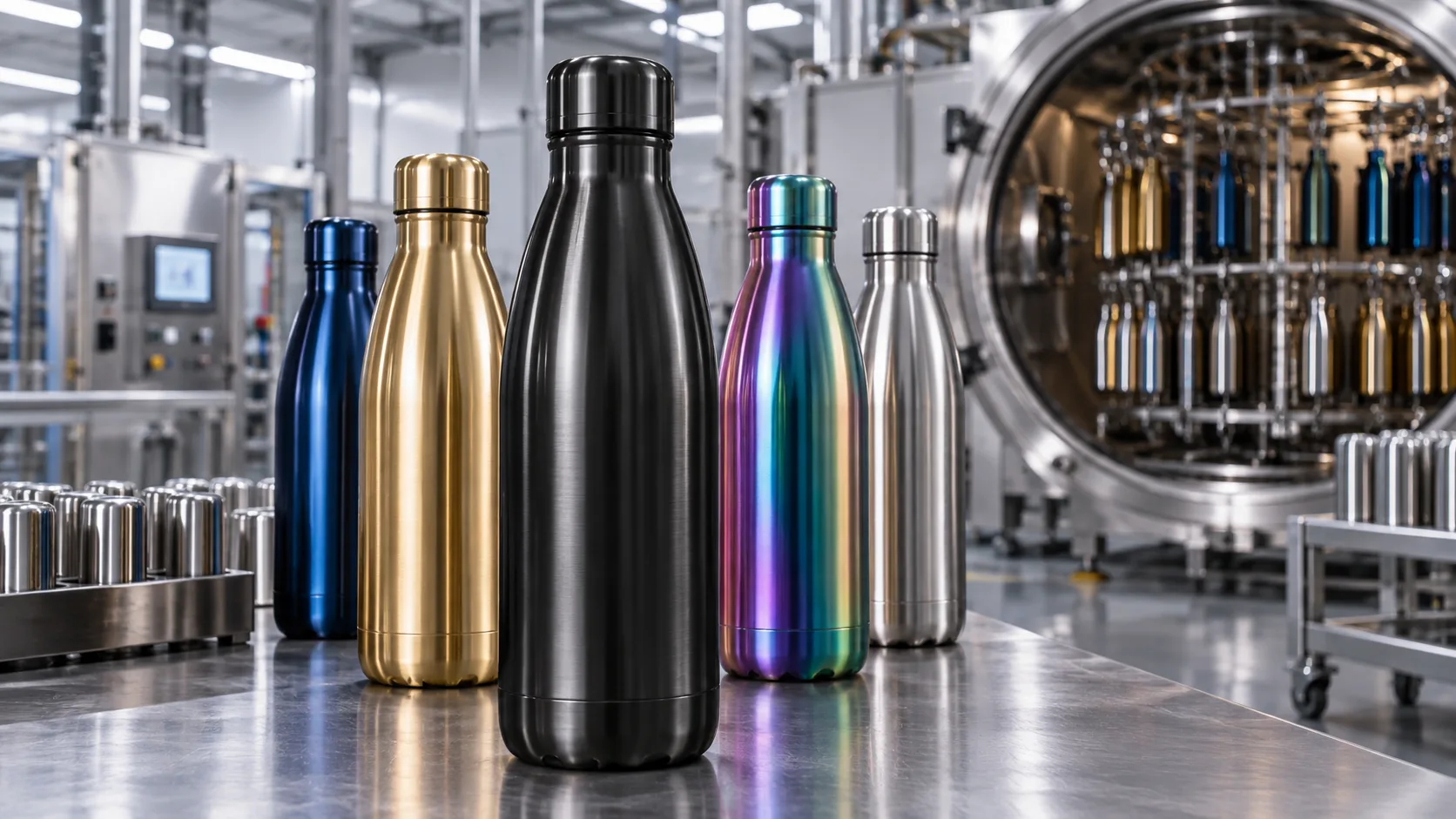
As a manufacturer, our goal is to be a partner, not just an order-taker. That means being honest about what a process can and cannot do. Acknowledging the limits of a technology builds trust and leads to a better final product. We often have clients who, after seeing the durability of a standard finish on a test order, come back to develop a more ambitious custom color for their next product line. This collaborative approach works best when everyone understands the capabilities. PVD is fantastic for creating rich, durable, and premium metallic looks. When a client requests a specific finish, we first determine if PVD is the best method to achieve their vision.
PVD Capabilities: A Quick Guide
| What PVD Does Well | When to Consider Alternatives |
|---|---|
| Solid metallic colors (black, gold, blue, etc.) | Specific, non-metallic Pantone matching |
| Matte, glossy, and brushed finishes | Complex multi-color graphic patterns |
| High-durability, scratch-resistant surfaces | Finishes requiring a soft, rubbery texture |
| Creating a premium, high-value perception | Very low-cost, high-volume promotional items |
| Rainbow/iridescent effects | Photo-realistic image printing |
Conclusion
Vacuum coating is a superior, safe, and durable finish for stainless steel bottles. It’s an investment in your brand’s quality and longevity, not just another layer of paint.
"Effects of Design Aesthetics on the Perceived Value of a Product - PMC", https://pmc.ncbi.nlm.nih.gov/articles/PMC8359925/. Research in sensory marketing suggests that tactile qualities, such as the texture and finish of a product, can significantly influence a consumer's perception of its quality and value. Evidence role: general_support; source type: research. Supports: The claim that a premium, durable finish can increase the perceived value of a product.. Scope note: The source would provide general support for the link between finish and perceived value, but may not specifically compare PVD coating to paint on water bottles. ↩
"Physical vapor deposition - Wikipedia", https://en.wikipedia.org/wiki/Physical_vapor_deposition. Sources in materials science define Physical Vapor Deposition (PVD) as a family of vacuum deposition methods where a solid material is vaporized in a vacuum environment and deposited on a substrate, forming a thin film with a strong bond to the surface. Evidence role: definition; source type: encyclopedia. Supports: The claim that Physical Vapor Deposition (PVD) involves depositing a thin film onto a substrate where the bond is formed at a molecular or atomic level.. ↩
"Titanium Nitride Coatings on CoCrMo and Ti6Al4V Alloys - PMC", https://pmc.ncbi.nlm.nih.gov/articles/PMC12931815/. Studies on surface coatings show that PVD films, such as those made from titanium nitride, often have significantly higher hardness (exceeding 2000 HV) and better wear resistance compared to traditional organic coatings like paint. Evidence role: statistic; source type: paper. Supports: The claim that PVD coatings exhibit superior scratch and abrasion resistance.. Scope note: Specific performance metrics can vary based on the exact PVD material, substrate, and deposition process used. ↩
"Guidance on Imported Traditional Pottery Intended for Use with Food", https://www.fda.gov/regulatory-information/search-fda-guidance-documents/guidance-industry-safety-imported-traditional-pottery-intended-use-food-and-use-term-lead-free. Food safety regulations, such as those from the U.S. Food and Drug Administration (FDA), primarily focus on materials that come into direct contact with food. For drinkware, this means the interior surface, while external coatings are generally not subject to the same food-contact substance requirements. Evidence role: general_support; source type: government. Supports: The claim that a coating applied only to the exterior of a food container does not pose a safety risk.. Scope note: The source would confirm the regulatory principle but would not specifically endorse PVD coatings themselves as 'food-safe'. ↩
"Physical vapor deposition", https://en.wikipedia.org/wiki/Physical_vapor_deposition. Educational resources on materials engineering explain that many PVD techniques, such as sputtering or cathodic arc deposition, use energy to eject atoms from a solid target material, creating a vapor that is then ionized into a plasma state before deposition. Evidence role: mechanism; source type: education. Supports: The claim that PVD processes often involve turning a solid metal into a plasma.. ↩
"Zirconium nitride", https://en.wikipedia.org/wiki/Zirconium_nitride. The materials science field widely documents the use of titanium, zirconium, and their nitrides (TiN, ZrN) as target materials in PVD processes to create hard, corrosion-resistant, and biocompatible coatings for various industrial and decorative applications. Evidence role: general_support; source type: research. Supports: The claim that titanium and zirconium are common materials for creating durable PVD coatings.. ↩
"Micromechanical versus chemical bonding between CoCr alloys and ...", https://pubmed.ncbi.nlm.nih.gov/17022056/. Materials science principles indicate that the atomic-level, often metallurgical, bond formed between a PVD coating and its substrate results in significantly higher adhesion strength compared to the weaker, mechanical adhesion of paints, which contributes directly to the coating's resistance to chipping and flaking. Evidence role: mechanism; source type: education. Supports: The claim that the strong physical bond of PVD coatings is key to their durability.. ↩
"PVD for Decorative Applications: A Review - PMC - NIH", https://pmc.ncbi.nlm.nih.gov/articles/PMC10381906/. Comparative studies on surface coatings consistently demonstrate that PVD films exhibit superior hardness, adhesion, and abrasion resistance when subjected to standardized mechanical tests, in contrast to conventional paint layers which are more susceptible to scratching and delamination. Evidence role: general_support; source type: paper. Supports: The claim that PVD coatings are significantly more resistant to scratching and abrasion than paint.. Scope note: Performance can vary based on the specific type of paint and PVD process being compared. ↩
"Food Grade Stainless Steel: 304 vs 316 - AZoM", https://www.azom.com/article.aspx?ArticleID=24472. Industry standards and materials science institutions recognize austenitic stainless steels, particularly types 304 and 316, as 'food-grade' due to their high corrosion resistance and stability, which prevents them from reacting with foodstuffs or leaching harmful substances. Evidence role: definition; source type: institution. Supports: The claim that stainless steel types 304 and 316 are considered food-grade.. ↩
"SAE 304 stainless steel - Wikipedia", https://en.wikipedia.org/wiki/SAE_304_stainless_steel. Research on food contact materials confirms that the passive chromium oxide layer on the surface of stainless steel provides excellent corrosion resistance and chemical stability, preventing the migration of metal ions into food and beverages, thus ensuring its safety. Evidence role: mechanism; source type: research. Supports: The claim that stainless steel's stability and corrosion resistance are the basis for its safety in food applications.. ↩
"Stainless Steel Leaches Nickel and Chromium into Foods ...", https://pmc.ncbi.nlm.nih.gov/articles/PMC4284091/. Studies analyzing beverage containers have shown that food-grade stainless steel is highly inert, exhibiting negligible leaching of metals and no detectable impact on the flavor profile of liquids, including water, coffee, and acidic juices. Evidence role: general_support; source type: paper. Supports: The claim that stainless steel is inert and does not alter the taste of beverages.. ↩
"PVD for Decorative Applications: A Review - PMC - NIH", https://pmc.ncbi.nlm.nih.gov/articles/PMC10381906/. Technical literature on PVD explains that colors are produced through thin-film interference effects, which makes it excellent for metallic sheens but challenging for precise replication of specific Pantone color codes or complex, multi-color graphics, which are often better suited to printing or painting techniques. Evidence role: general_support; source type: research. Supports: The claim that PVD has limitations in achieving specific, non-metallic colors and complex patterns.. ↩