
Struggling with steel grades for your tumblers? A wrong choice leads to rust, bad reviews, and lost money. We’ll clarify which steel protects your brand's reputation.
For most insulated tumblers, 304 stainless steel is the industry standard1 and the best choice. It offers excellent corrosion resistance for daily use. 316 is for specific high-acid or marine uses, while 430 steel is not food-safe for inner walls2 and poses a brand risk.
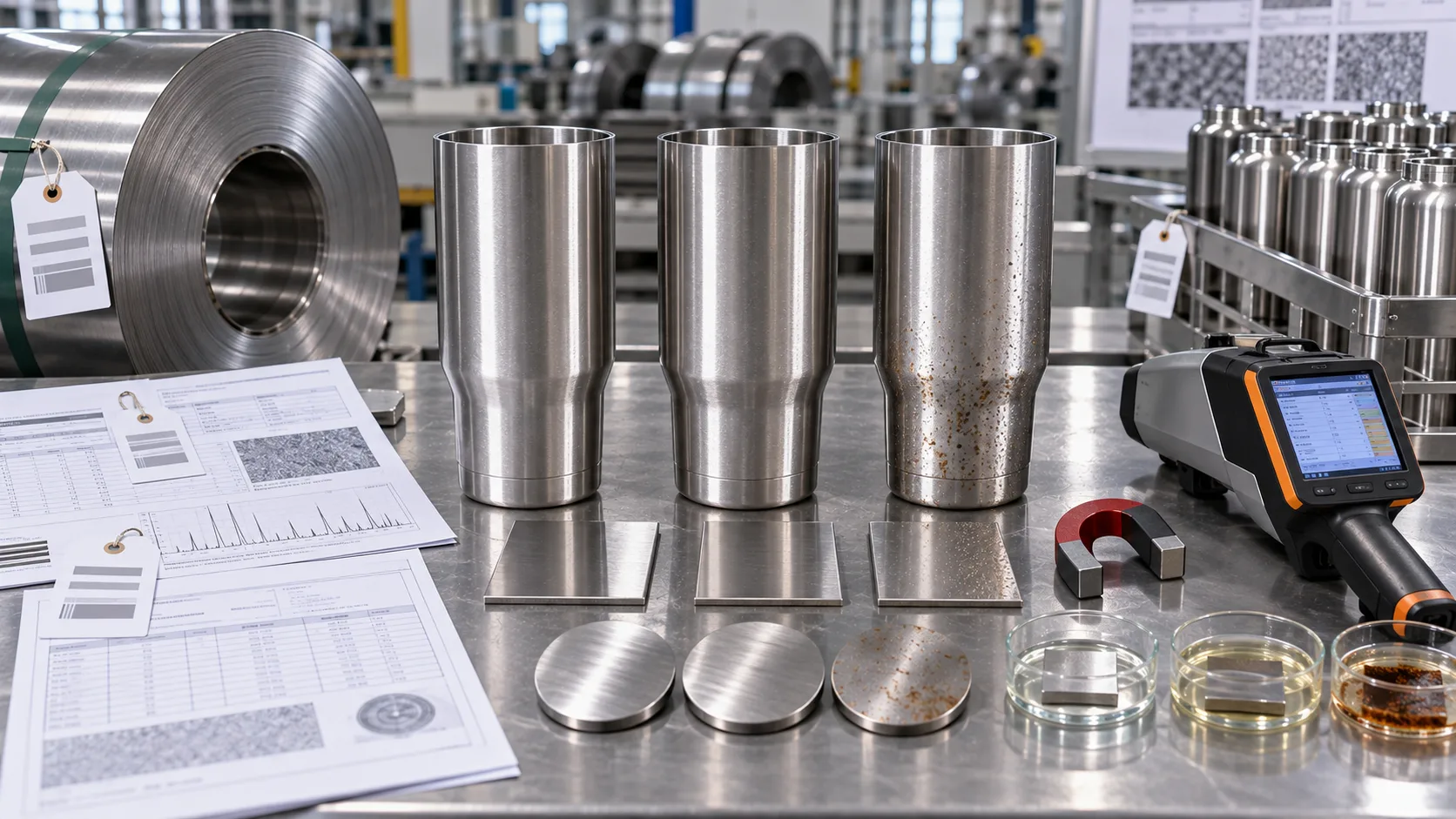
Choosing the right material feels complicated, but it's simpler than you think. It's not just about specs on a sheet; it's about matching the steel to your customer's experience. This decision is one of the most important you'll make, as it directly impacts your product's quality and your brand's reputation. Let’s break down what really matters for your business.
Is 304 Stainless Steel Good Enough for Your Tumbler?
Worried that 304 steel is just a "basic" option? This fear can lead to overspending on materials you don't need. Let’s confirm why 304 is the professional standard.
Yes, 304 stainless steel is more than good enough; it's the correct industry-standard choice for high-quality insulated tumblers. Its composition is perfect for handling coffee, tea, water, and other daily beverages without any risk of rust or taste transfer for the vast majority of users.
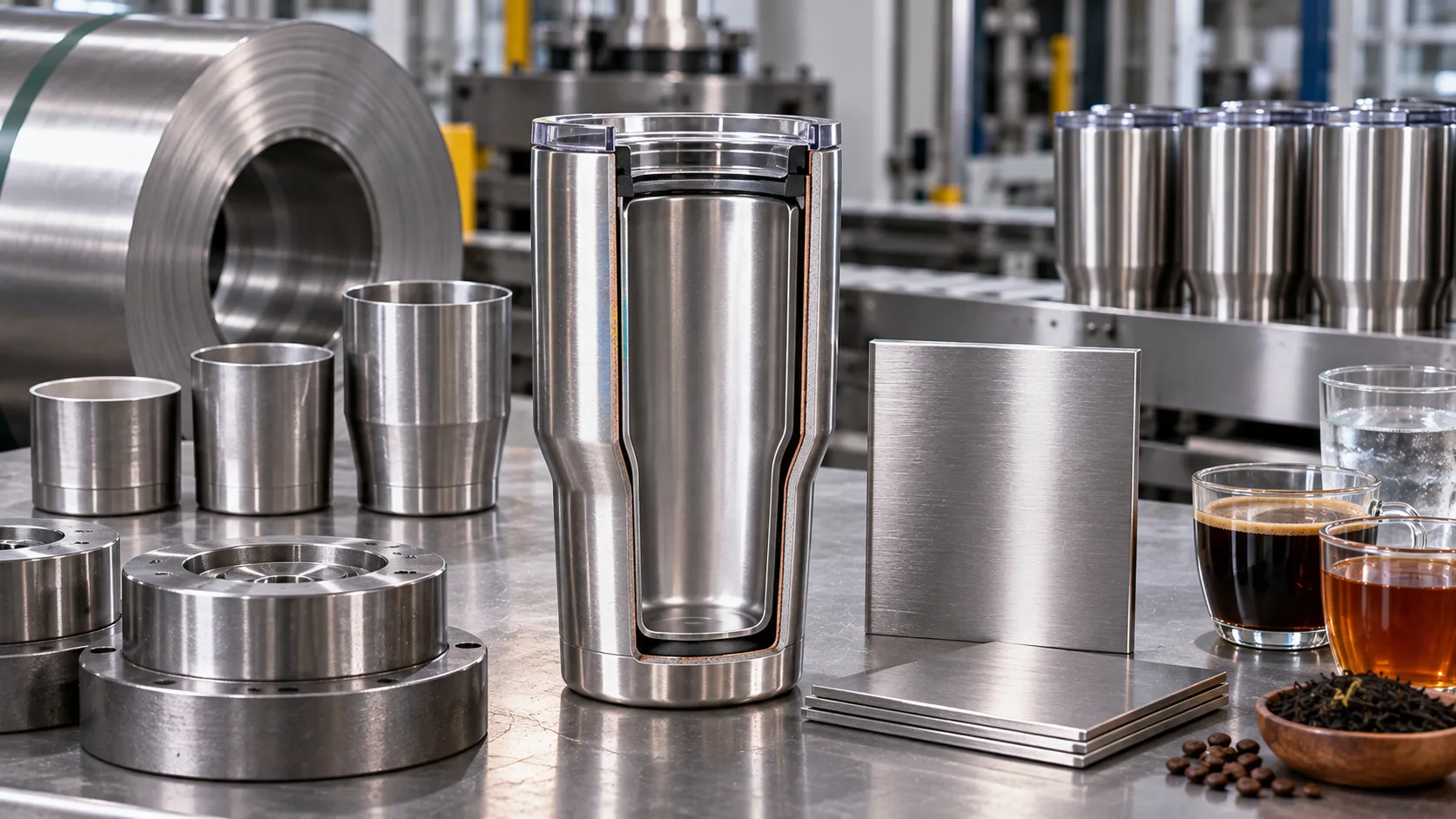
In our production experience, 304 stainless steel is the workhorse of the drinkware industry, and for good reason. It’s what most people know as 18/8 stainless steel, which refers to its composition: 18% chromium and 8% nickel%%%FOOTNOTE_REF3%%%. This makeup is the key to its performance. [The chromium forms a microscopic passive layer on the surface that self-repairs and protects the steel from oxidation](https://en.wikipedia.org/wiki/Passivation(chemistry))4—what we commonly call rust. The nickel adds to this corrosion resistance while also providing the durability and ductility needed to form the steel into complex tumbler shapes5 without cracking.
We've manufactured millions of tumblers using 304 for the inner wall. For standard uses like holding hot coffee, cold water, or tea, the number of complaints we see related to corrosion is virtually zero. The material simply does its job perfectly. Some brand owners believe they must "upgrade" to a different steel to market their product as premium. But in doing so, they are often spending extra money to solve a problem that doesn't exist for their customers. Choosing 304 isn't a compromise; it's the correct, professional choice that balances performance, food safety, and cost-effectiveness.
Is 316 Stainless Steel Worth the Extra Cost?
Suppliers might push 316 steel as a premium upgrade. But will it actually benefit your customers, or just increase your costs? Here is how to know if you really need it.
316 stainless steel is only worth the extra cost for specific applications. If your tumblers will consistently hold highly acidic drinks or be used in marine environments, the added molybdenum provides superior corrosion resistance. Otherwise, 304 steel is sufficient and more cost-effective.
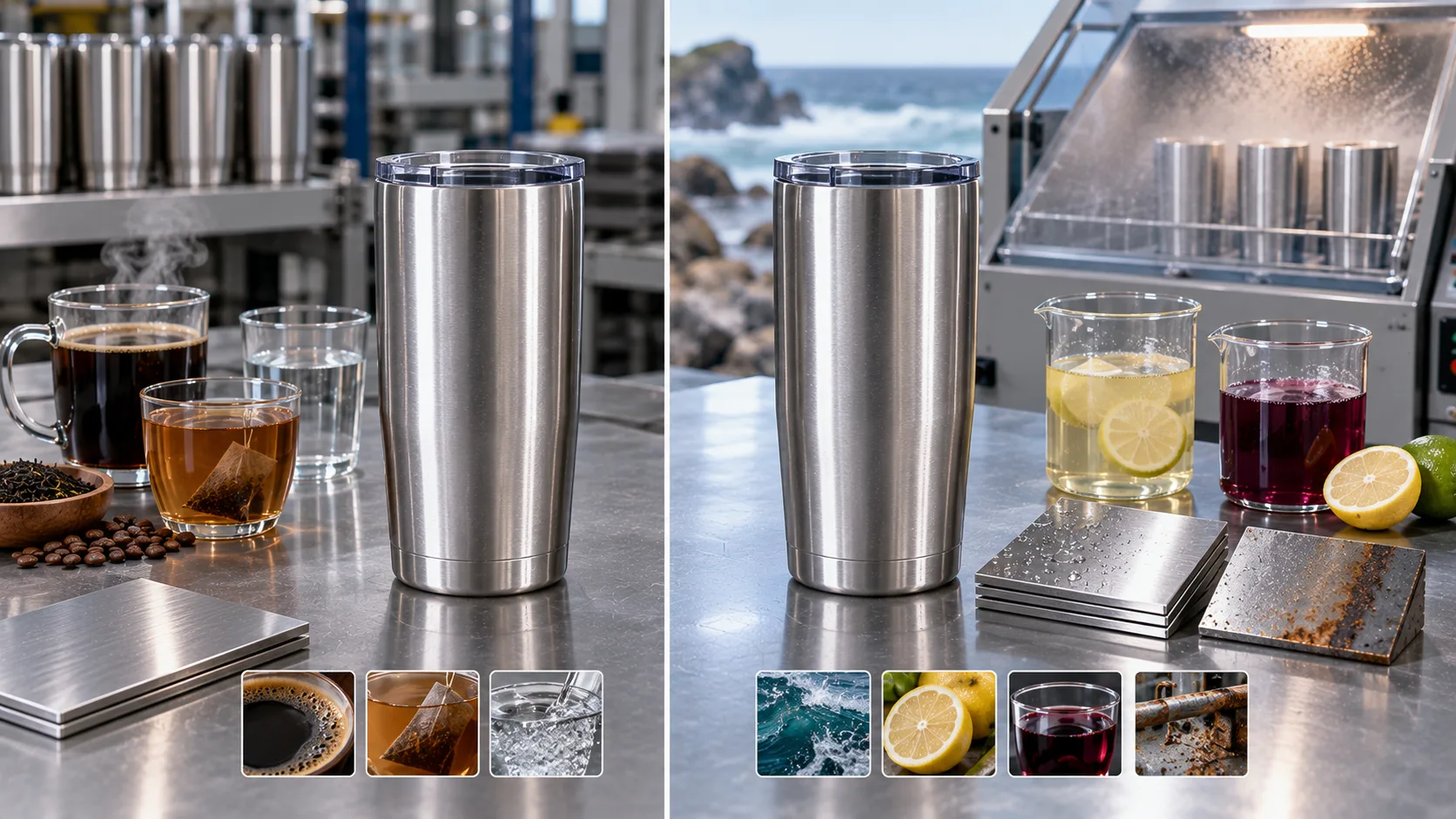
The primary difference between 304 and 316 steel is a small but important addition: molybdenum6. This element gives 316 stainless steel, often called "marine-grade" steel, a major boost in its ability to resist corrosion from chlorides (like salt) and harsh acids7. When clients come to us requesting 316 for their tumblers, the first question we always ask is, "What specific problem are you trying to solve?" If their answer is "to have a more premium product" for a coffee or lifestyle brand, we usually explain that the added cost of 316 won't translate into a noticeable benefit for their end-user.
However, if the client is a brand that sells concentrated electrolyte mixes, ready-to-drink cocktails, or other highly acidic beverages, 316 becomes a smart investment. The same is true for promotional products targeted at coastal communities or the marine industry, where exposure to salt in the air is constant. In these specific scenarios, 316 acts as an insurance policy against potential corrosion, protecting the product's integrity and the brand's reputation.
When to Choose 304 vs. 316
| Use Case Scenario | Recommended Steel | Why It's the Right Choice |
|---|---|---|
| Daily Use (Coffee, Tea, Water) | 304 (18/8) | Offers excellent, reliable corrosion resistance for everyday beverages. |
| General Corporate Gifts | 304 (18/8) | Provides the best balance of premium feel, performance, and cost. |
| High-Acidity Drinks (e.g., drink mixes) | 316 | The molybdenum content prevents pitting corrosion from strong acids. |
| Marine or Coastal Markets | 316 | Superior resistance to chloride corrosion from salt spray and air. |
What's the Real Danger of Using 430 Stainless Steel?
Some price quotes look too good to be true. The hidden reason is often cheap 430 steel, which can ruin your products and your brand. Learn the risk before you place an order.
The real danger of using 430 steel in tumblers is that it rusts easily when in contact with liquids. It lacks nickel, making it unsuitable for inner walls.8 This leads to metallic taste, customer complaints, negative reviews, and ultimately, damages your brand's reputation.
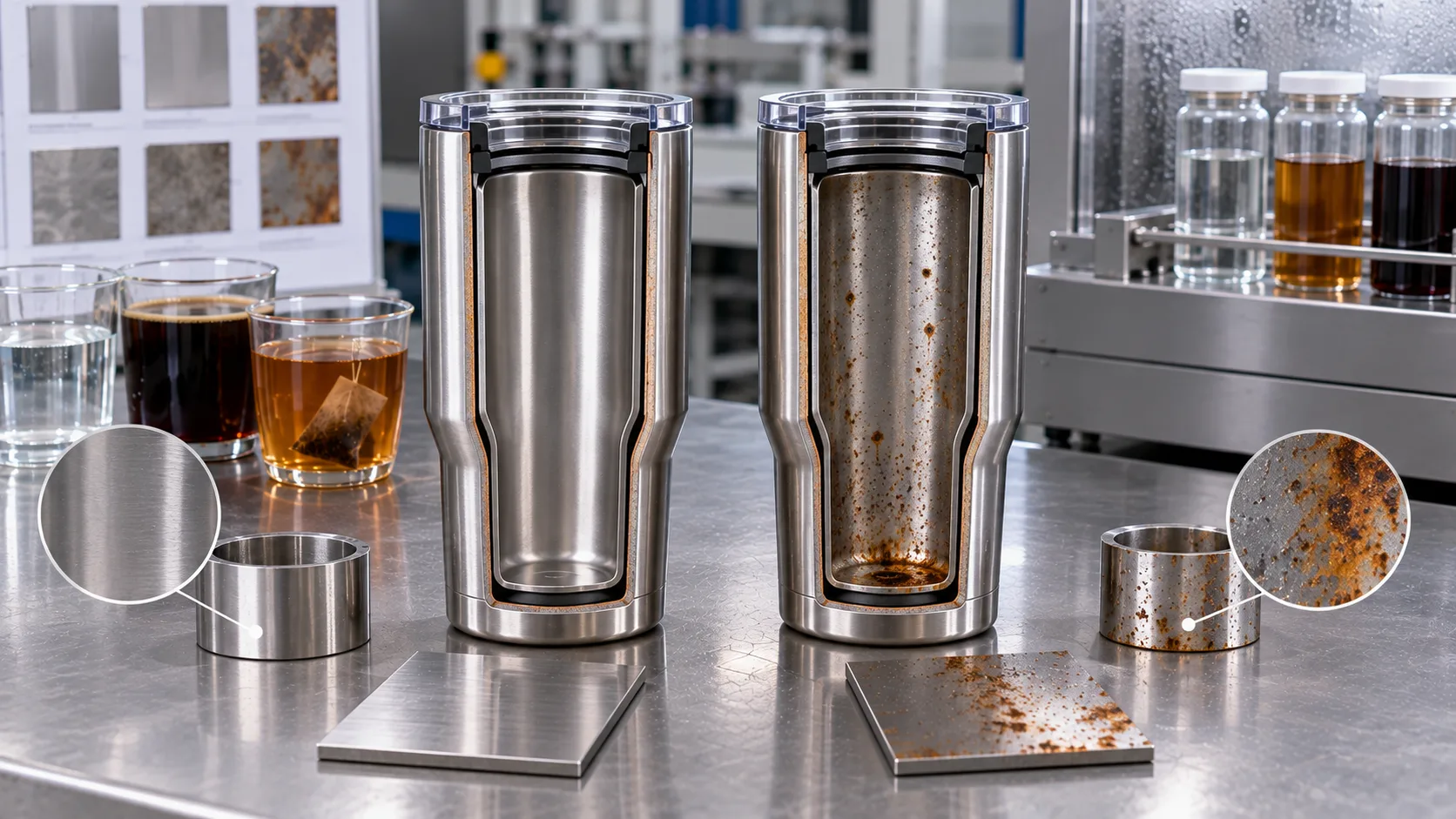
The most frightening thing about 430 steel is that, to an untrained eye, a tumbler with a 430 inner wall can look identical to a high-quality 304 tumbler. This is where uninformed brand owners get into trouble. To offer an unbelievably low price, some factories will secretly substitute 430 steel for the inner wall—the part that comes into direct contact with the beverage. 430 is a "ferritic" stainless steel, which means it contains no nickel. Nickel is a critical element for fighting corrosion. Without it, the steel is far more susceptible to rust, especially when exposed to moisture and the mild acids found in coffee, tea, and soda.
We've had new clients come to us after a disastrous first production run with another supplier. Their customers were flooding them with complaints about a "metallic taste" in their water or, worse, seeing "little orange spots" of rust inside their tumblers after just a few uses. These are brand-killing issues. The few cents saved per unit on the cheaper material are instantly wiped out by the cost of handling returns, managing angry customers, and trying to repair a damaged reputation. While 430 steel has its uses in manufacturing—perhaps for an external decorative part—it is never safe or appropriate for the food-contact surfaces of drinkware.
Can a Magnet Test Tell You the Steel Quality?
You heard a magnet can expose fake stainless steel. But this common test is misleading and can cause you to reject good products. Let’s clarify what a magnet really tells you.
A magnet test is not a reliable way to determine steel quality. While it can suggest the presence of inferior, magnetic 430 steel, it's not definitive. High-quality 304 and 316 steels are non-magnetic, but manufacturing can sometimes make 304 slightly magnetic. The only real proof is a material certificate.
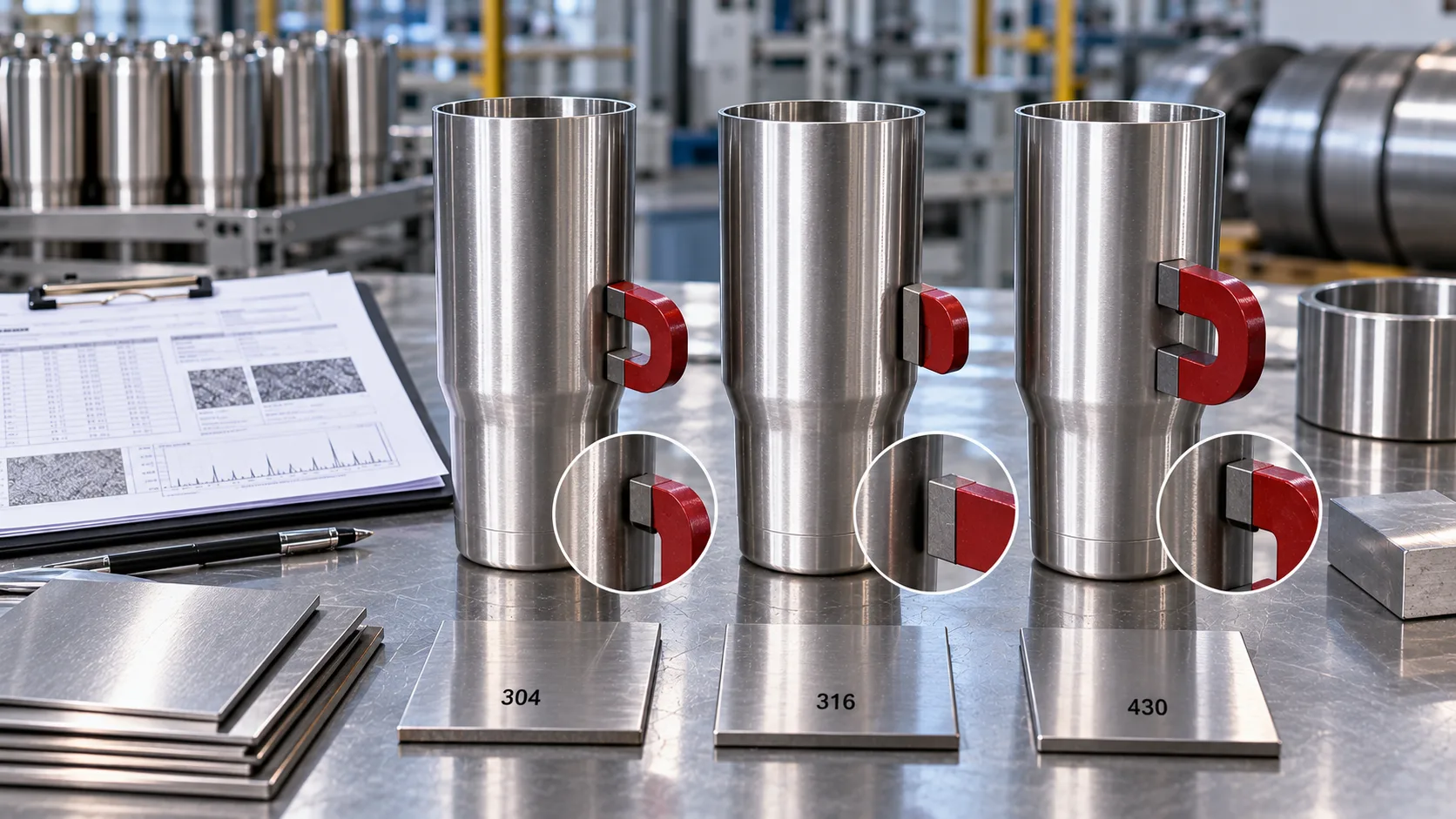
There's a widespread belief among buyers that if a magnet sticks to stainless steel, it must be low-quality or "fake." This is a dangerous oversimplification that can lead to bad decisions. As a manufacturer, we see this confusion all the time. Here is the practical breakdown you need to know.
Understanding Steel and Magnetism
- High-Quality Steel (304 & 316): These are "austenitic" steels. In their raw, unprocessed state, they are non-magnetic.
- Low-Quality Steel for Tumblers (430): This is a "ferritic" steel. It is always magnetic.
Because of this, if you take a magnet and it sticks firmly to the inside of a tumbler, that is a major red flag. It strongly suggests the manufacturer used 430 steel. However, the story doesn't end there. The manufacturing process of forming 304 steel into a tumbler shape, known as "cold working," can slightly alter its molecular structure and induce a weak magnetic response. I have personally seen clients ready to reject a whole shipment of perfectly good 304 tumblers because a magnet showed a slight pull. The magnet test is a tool for raising suspicion, not for final judgment. The only way to be certain about the material is to demand a material mill certificate from your supplier9 for your specific production batch. This document is the ultimate proof of grade and composition.
Conclusion
Choosing the right steel is simple: use 304 as your default, consider 316 for extreme cases, and always avoid 430 for inner walls to protect your brand integrity.
"Exploring the Different Types of Stainless Steel Water Bottles", https://elementalbottles.com/blogs/news/exploring-the-different-types-of-stainless-steel-water-bottles?srsltid=AfmBOopWafkedE6CMy06K1K8fGoYl0pGOXp1bXioryaAvNXX_KIEdJtj. Food safety organizations and materials suppliers confirm that Type 304 (or 18/8) stainless steel is widely used for kitchen equipment and drinkware due to its proven corrosion resistance and durability in contact with a wide range of foods and beverages. Evidence role: general_support; source type: institution. Supports: That 304 stainless steel is a widely accepted and commonly used material for food and beverage applications, including drinkware.. Scope note: While sources confirm its widespread use and suitability, they may not explicitly label it the singular 'industry standard' over other possible food-safe grades. ↩
"Stainless Steel Leaches Nickel and Chromium into Foods During ...", https://pmc.ncbi.nlm.nih.gov/articles/PMC4284091/. Materials science resources explain that Type 430 stainless steel, a ferritic alloy, lacks the nickel found in austenitic grades like 304. This makes it far more susceptible to corrosion, particularly from mild acids and chlorides, rendering it generally unsuitable for surfaces in constant contact with beverages. Evidence role: mechanism; source type: education. Supports: That 430 stainless steel has significantly lower corrosion resistance than 304, making it prone to rusting in wet environments.. Scope note: Sources focus on material properties (corrosion) rather than labeling it 'not food-safe' in all contexts. 430 steel is considered food-safe for applications with minimal moisture exposure, such as utensil handles or appliance paneling. ↩
"SAE 304 stainless steel - Wikipedia", https://en.wikipedia.org/wiki/SAE_304_stainless_steel. Engineering and materials encyclopedias define '18/8 stainless steel' as a common name for Type 304 stainless steel, referring to its nominal composition of approximately 18% chromium and 8% nickel. Evidence role: definition; source type: encyclopedia. Supports: The definition and typical composition of 18/8 stainless steel.. ↩
"Passivation (chemistry) - Wikipedia", https://en.wikipedia.org/wiki/Passivation_(chemistry). Scientific literature on metallurgy explains that the corrosion resistance of stainless steel is due to a thin, inert, and self-repairing surface film, primarily composed of chromium oxide. This 'passive layer' forms spontaneously when the chromium content exceeds approximately 10.5% and is exposed to oxygen. Evidence role: mechanism; source type: paper. Supports: The mechanism by which chromium creates a protective, self-healing passive layer on stainless steel.. ↩
"Nickel release from stainless steels", https://pubmed.ncbi.nlm.nih.gov/9330816/. Materials engineering resources indicate that nickel is a key alloying element in austenitic stainless steels like 304. It acts as an austenite stabilizer, enhances general corrosion resistance, and provides the high ductility required for deep drawing and forming complex shapes without cracking. Evidence role: mechanism; source type: education. Supports: That nickel improves corrosion resistance, toughness, and formability in austenitic stainless steels.. ↩
"SAE 316L stainless steel - Wikipedia", https://en.wikipedia.org/wiki/SAE_316L_stainless_steel. Technical specifications and materials databases show that while both 304 and 316 stainless steels contain chromium and nickel, Grade 316 is distinguished by the intentional addition of approximately 2-3% molybdenum to its composition. Evidence role: definition; source type: encyclopedia. Supports: That the addition of molybdenum is the key differentiator in the standard composition of 316 steel compared to 304.. ↩
"Marine grade stainless - Wikipedia", https://en.wikipedia.org/wiki/Marine_grade_stainless. Metallurgical studies demonstrate that the addition of molybdenum to chromium-nickel stainless steel significantly enhances its resistance to localized corrosion, particularly pitting and crevice corrosion, in chloride-containing environments like seawater. Evidence role: mechanism; source type: paper. Supports: That molybdenum significantly enhances resistance to pitting and crevice corrosion caused by chlorides.. ↩
"Austenitic stainless steel - Wikipedia", https://en.wikipedia.org/wiki/Austenitic_stainless_steel. Materials data sheets classify Type 430 as a ferritic stainless steel, which by definition has a low carbon content and contains little to no nickel. Nickel is the primary element used to stabilize the more corrosion-resistant austenitic structure found in grades like 304. Evidence role: definition; source type: education. Supports: That 430 stainless steel is a ferritic grade that contains little to no nickel, a key factor in its lower corrosion resistance compared to 304.. ↩
"Mill test report - Wikipedia", https://en.wikipedia.org/wiki/Mill_test_report. Manufacturing and quality assurance standards recognize the Mill Test Certificate (MTC), also known as a Certified Mill Test Report (CMTR), as the authoritative legal document provided by a material manufacturer that certifies a metal's chemical and physical properties, confirming its compliance with a specific grade standard. Evidence role: general_support; source type: institution. Supports: That a Mill Test Certificate (MTC) is the standard industry document for verifying the properties and composition of a metal batch.. Scope note: While the certificate is the standard proof, its authenticity can still be fraudulent; ultimate verification may require independent lab testing. ↩