Tired of hand-washing your favorite steel cup? Worried the dishwasher will ruin it? You're right to be cautious, as the wrong choice can damage your cup's finish and performance.
The answer depends on its construction. While the stainless steel itself is safe, high heat and harsh detergents can damage the vacuum seal1, printed logos, and powder-coated finishes on many cups. Always check the manufacturer's specific instructions.
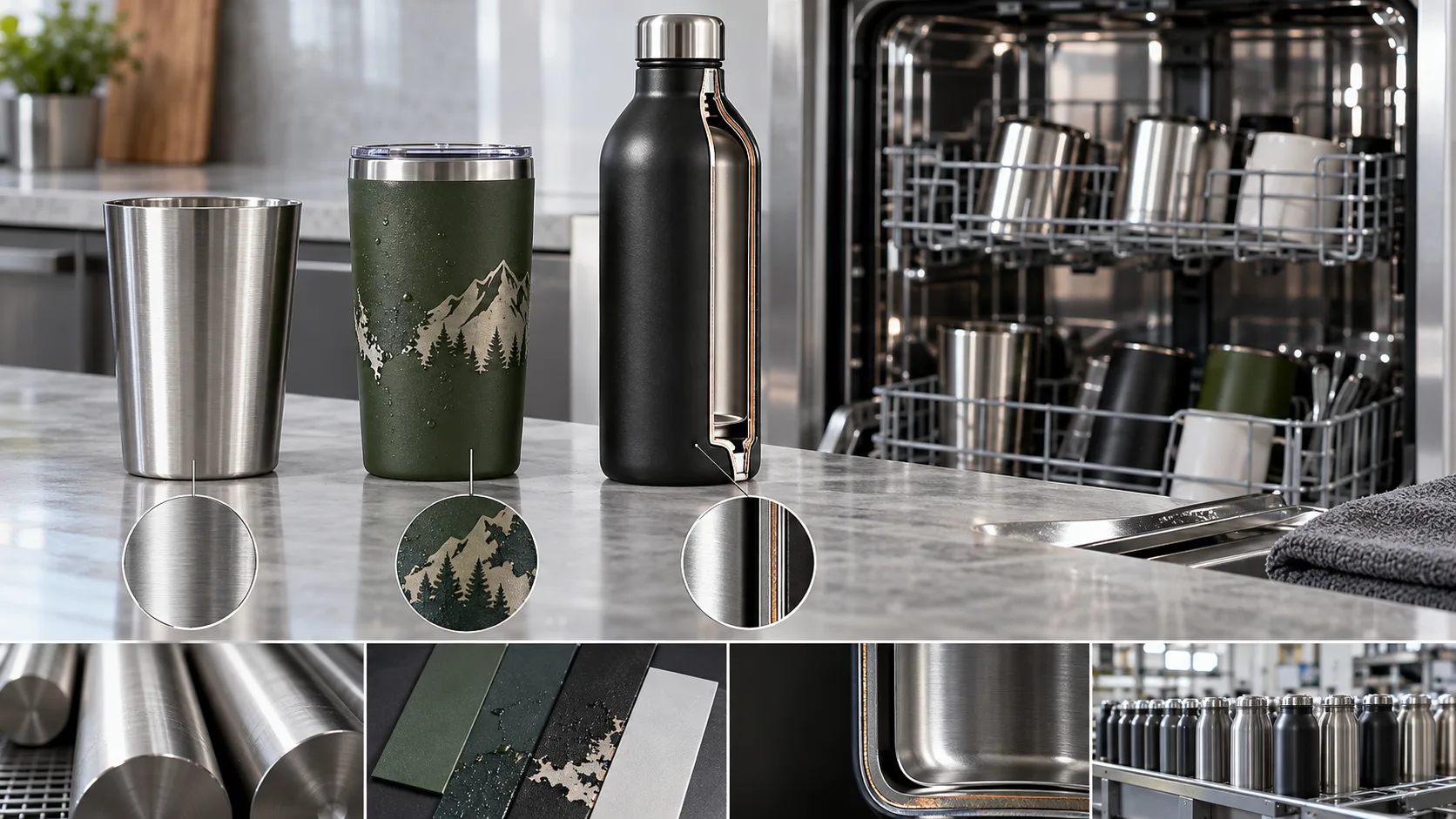
As a manufacturer of custom stainless steel water bottles, this is one of the most common questions our clients ask. They want to provide the right care instructions to their customers, and the answer is more complex than a simple "yes" or "no." The real issue isn't the steel itself—it's everything we add to make the cup stylish, branded, and functional. Understanding how your cup is built is the key to knowing how to care for it, so let's look closer at the components that are actually at risk.
Will the dishwasher ruin your cup's custom logo or finish?
Worried that beautiful logo will peel off? The dishwasher's intense heat and detergents can be a real threat to your cup's custom finish, turning a premium product into a worn-out mess.
Yes, it's a major risk. Dishwasher cycles use high heat and abrasive detergents that can break down powder coatings, fade electroplating, and cause printed logos to chip or peel. The steel survives, but your branding might not.
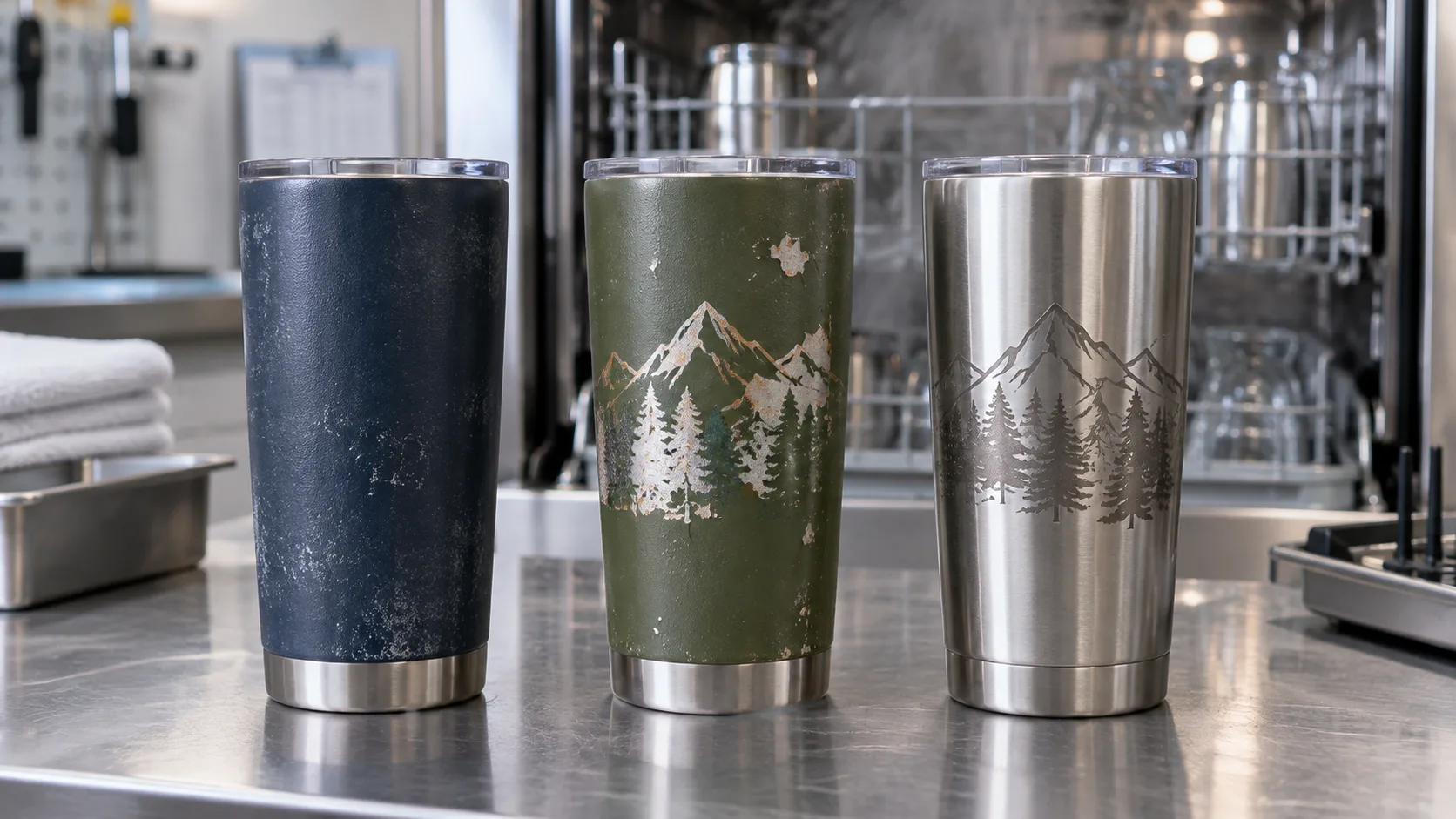
When our clients invest in custom drinkware, they are investing in their brand's image. The finish and the logo are everything. From our experience on the factory floor, we know these surface layers are the most vulnerable parts of the cup in a dishwasher. The base 304 stainless steel is incredibly durable2, but the finish is a different story. High-temperature water combined with powerful detergents acts like a slow-motion solvent, attacking the bond between the coating and the steel3. Over many cycles, you'll see visible degradation. This is why when a client asks, "How many cycles can our logo survive?" we explain that it depends on the finishing method.
How Different Finishes React to Dishwashers
| Finishing Method | How It's Applied | Dishwasher Risk |
|---|---|---|
| Powder Coating | A dry powder is electrostatically applied and then cured under heat. It creates a durable, thick layer. | The high heat and harsh detergents can slowly break down the polymer bonds, leading to chalking, fading, or chipping4 over time. |
| Silk-Screen Printing | Ink is pushed through a mesh screen to apply a logo or design directly onto the cup's surface. | This is a layer of ink sitting on top of the finish. It is highly susceptible to chipping and peeling from abrasive detergents and high pressure water jets5. |
| Laser Engraving | A laser removes the top layer of the finish (e.g., powder coat) to reveal the raw stainless steel underneath. | This is the most durable option6. Since it's etched into the cup, it cannot peel or fade. The design will last as long as the cup itself. |
Does machine washing affect the insulation of a vacuum-sealed bottle?
Your bottle keeps drinks cold for hours, but will it lose its magic after a dishwasher cycle? This is a common fear, and it's based on a real mechanical risk.
It can. The intense heat of a dishwasher's drying cycle7 can stress the tiny seal that protects the vacuum insulation. Over time, repeated exposure can cause this seal to fail8, letting air in and ruining the bottle's ability to insulate.
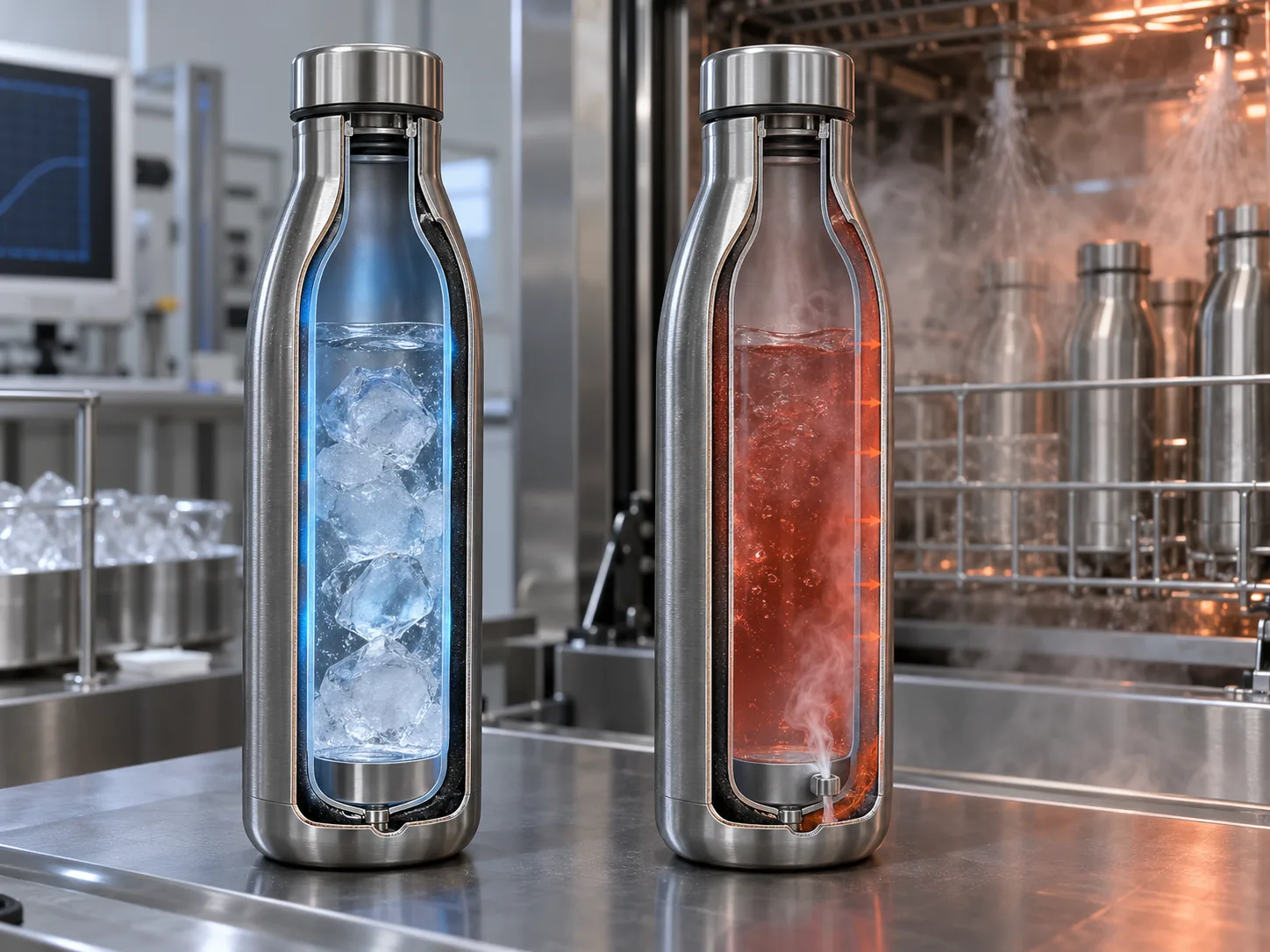
The "magic" of a high-performance tumbler or bottle comes from its double-wall vacuum construction. In our factory, we build this by taking two separate stainless steel walls, placing one inside the other, and welding them together at the rim. Then, we pump all the air out from the space between the walls and seal the small exit point, which is often a tiny solder point9 on the bottom of the bottle. This vacuum is what stops heat transfer10, keeping your drinks hot or cold.
The high heat of a dishwasher, especially during the drying cycle, causes the metal and the solder point to expand and contract11. This puts physical stress on that tiny seal. While it might survive one or two washes, repeated cycles can eventually cause a micro-fracture. Once the seal is broken, air rushes into the space between the walls, and the vacuum is gone forever12. The bottle will no longer insulate effectively. This is why we often tell our clients that a "Hand Wash Only" recommendation isn't just a suggestion; it's a structural requirement to preserve the bottle's core function.
So how can you tell if your specific cup is dishwasher safe?
You have a stainless steel cup, but is it a simple tumbler or a complex vacuum bottle? Knowing the difference is key to deciding whether it can safely face the dishwasher.
Look at its construction. A simple, unpainted, single-wall steel cup is likely safe. But if it has a colored finish, a printed logo, or is advertised as "vacuum insulated," you should be cautious and check for manufacturer instructions.
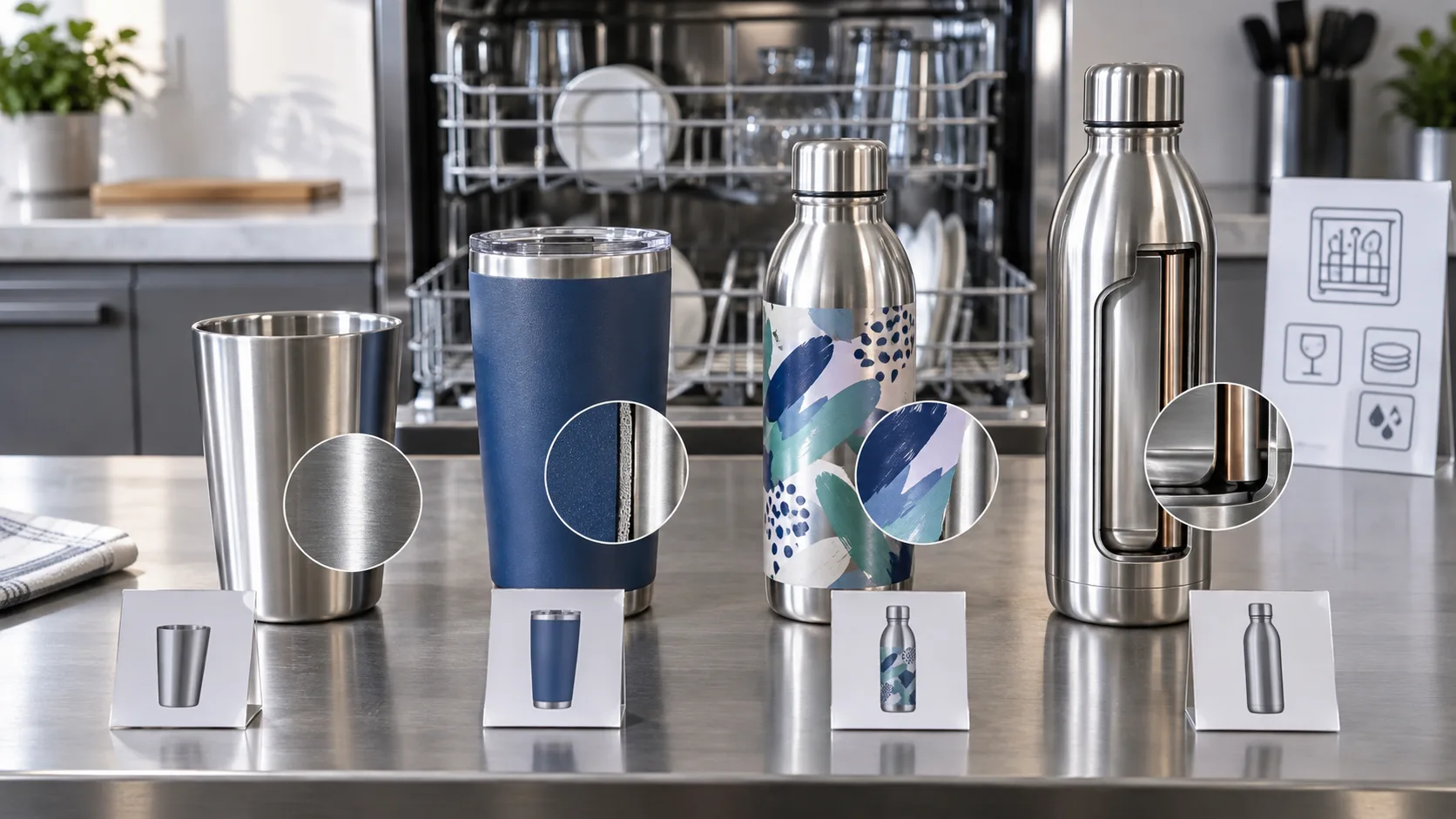
As a manufacturer, we produce many different types of drinkware, each designed for a specific purpose and price point. The right way to care for the product is tied directly to how it was built. A simple, single-wall cup made of pure stainless steel has no coatings or vacuum seals to protect, so it's generally fine in a dishwasher. But as soon as you add complexity like a powder-coat finish, a custom logo, or vacuum insulation, you introduce new points of failure. The best approach is to identify what kind of cup you have and understand its specific risks. If you're a brand owner, this will help you provide accurate care instructions. If you're a user, it will help you protect your cup.
Quick Guide to Dishwasher Safety by Cup Type
| Cup Type | Key Components at Risk | Dishwasher Recommendation | Why? |
|---|---|---|---|
| Single-Wall, Uncoated | None | Generally Safe | It's just a solid piece of stainless steel. There are no finishes to peel or seals to break. |
| Powder-Coated Tumbler | Powder-Coat Finish | Hand Wash Recommended | To protect the color and texture of the finish from fading, chalking, or chipping due to heat and detergents. |
| Bottle with Printed Logo | Printed Ink | Hand Wash Only | The ink layer is the most fragile part and can easily be damaged, ruining the branding and appearance. |
| Double-Wall Vacuum Bottle | Vacuum Seal & Finish | Hand Wash Strongly Recommended | To protect both the exterior finish and, more importantly, the integrity of the vacuum seal that provides insulation. |
Ultimately, the best advice is to always check the bottom of the cup or its original packaging for the manufacturer's specific guidance. They know exactly how it was made and what it can handle.
Conclusion
In short, whether your cup is dishwasher-safe depends on its finish and vacuum seal, not just the steel. Check its construction to protect your investment and its long-term performance.
"Contribution of household dishwashing to microplastic pollution", https://pmc.ncbi.nlm.nih.gov/articles/PMC10076389/. Research on material degradation shows that the combination of high temperatures and alkaline detergents found in automatic dishwashers can break down polymers used in coatings and place thermal stress on metal seals. Evidence role: mechanism; source type: research. Supports: The claim that dishwasher environments can damage common materials used for cup finishes and seals.. ↩
"Study of the Corrosion Resistance of Austenitic Stainless Steels during ...", https://pmc.ncbi.nlm.nih.gov/articles/PMC5503400/. Type 304 stainless steel is a common chromium-nickel austenitic stainless steel known for its excellent corrosion resistance and durability, making it a standard material for kitchen equipment and drinkware. Evidence role: definition; source type: encyclopedia. Supports: The claim that 304 stainless steel is a durable material.. ↩
"Powder coating", https://en.wikipedia.org/wiki/Powder_coating. The alkaline nature of many dishwasher detergents, combined with high temperatures, can facilitate the hydrolysis of polymer bonds in coatings, weakening their structure and adhesion to the underlying substrate over repeated cycles. Evidence role: mechanism; source type: paper. Supports: The claim that dishwasher detergents can chemically attack coatings.. ↩
"Contribution of household dishwashing to microplastic pollution", https://pmc.ncbi.nlm.nih.gov/articles/PMC10076389/. According to industry resources, 'chalking' is a known form of degradation for some powder coatings, where the polymer binder at the surface breaks down due to environmental factors like UV radiation or chemical attack, leaving behind a loose powder. Evidence role: general_support; source type: institution. Supports: The claim that powder coatings can degrade in specific ways (chalking, fading) under stress.. Scope note: The source may discuss degradation in a general sense, not specifically within a dishwasher, but the underlying mechanism is relevant. ↩
"Silk-Screening for Sheet Metal Parts (Updated for 2026)", https://www.approvedsheetmetal.com/blog/silk-screening-for-sheet-metal-parts. While modern inks offer good adhesion, screen printing applies a layer of ink on top of a surface, which remains susceptible to physical abrasion and chemical attack from harsh detergents, unlike methods that etch the material itself. Evidence role: general_support; source type: other. Supports: The claim that silk-screened ink is vulnerable to physical and chemical abrasion.. ↩
"Laser Engraving vs Etching vs Silk Screen Printing for CNC ...", https://www.machining-custom.com/blog/laser-engraving-vs-etched-vs-silk-screen-logo.html. Laser engraving is considered a permanent marking method because it works by ablating, or removing, the surface material rather than adding a layer on top of it. The resulting mark is as durable as the substrate itself. Evidence role: general_support; source type: education. Supports: The claim that laser engraving is a highly durable marking method.. ↩
"Product Specification for Commercial Dishwashers", https://www.energystar.gov/sites/default/files/specs//Final_Draft_CD_Test_Method.pdf. Standard residential dishwashers can reach temperatures of 65-70°C (150-160°F) during the main wash and final rinse cycles, particularly for models with sanitizing options, to ensure proper cleaning and drying. Evidence role: statistic; source type: government. Supports: The claim that dishwashers reach high temperatures.. ↩
"Thermal Fatigue Failure of Micro-Solder Joints in ... - PMC - NIH", https://pmc.ncbi.nlm.nih.gov/articles/PMC11123225/. In materials science, the process of thermal cycling, or repeated heating and cooling, is known to induce mechanical stress that can lead to fatigue failure in materials, including solder joints and welds used to create seals. Evidence role: mechanism; source type: paper. Supports: The claim that repeated heating and cooling can cause a seal to fail.. ↩
"Vacuum flask - Wikipedia", https://en.wikipedia.org/wiki/Vacuum_flask. The manufacturing process for vacuum-insulated flasks involves welding two nested walls together, evacuating the air from the space between them through a small port, and then permanently sealing this port, often with a plug of solder or by using a getter material. Evidence role: general_support; source type: other. Supports: The claim about how vacuum flasks are sealed during manufacturing.. ↩
"Vacuum flask", https://en.wikipedia.org/wiki/Vacuum_flask. A vacuum acts as an effective insulator because it has an extremely low density of particles, which minimizes heat transfer by the processes of conduction and convection that require a medium. Evidence role: definition; source type: encyclopedia. Supports: The claim that a vacuum prevents heat transfer.. ↩
"Thermal expansion", https://en.wikipedia.org/wiki/Thermal_expansion. According to the principles of physics, most materials, including metals, exhibit thermal expansion, meaning they increase in volume when heated and decrease in volume when cooled. Different materials expand at different rates, which can create stress at joints. Evidence role: mechanism; source type: education. Supports: The claim that metal expands and contracts with temperature changes.. ↩
"Vacuum insulated panel - Wikipedia", https://en.wikipedia.org/wiki/Vacuum_insulated_panel. If the vacuum in a double-walled flask is compromised and replaced by air, the flask loses its insulating properties because heat can now readily transfer across the gap via conduction and convection through the air molecules. Evidence role: mechanism; source type: encyclopedia. Supports: The claim that a broken vacuum seal ruins the insulation.. ↩