
Your brand deserves a unique bottle, but you fear manufacturing limits will force a generic design. Hydroforming offers a solution, but the possibilities and pitfalls are often misunderstood.
Yes and no. While hydroforming allows for far more complex and organic shapes than traditional methods1, it is not limitless. Success depends on understanding the material's properties, including draw depth, corner radii, and draft angles2. It expands the design envelope, but it doesn't eliminate physical constraints.
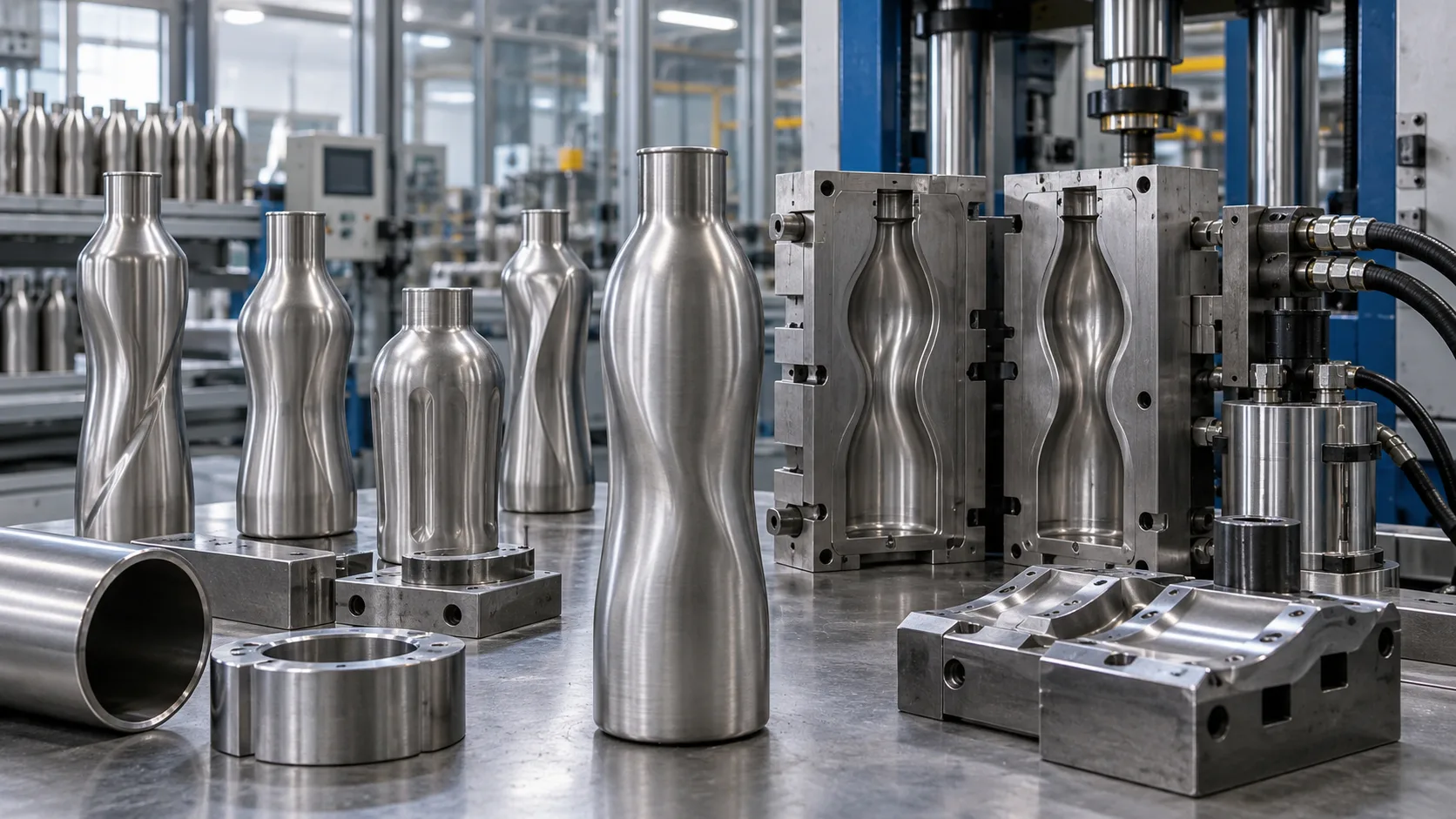
I remember a client who came to us with a beautiful render for a bottle inspired by sculpted stone. It had elegant, flowing lines that were perfect for hydroforming. However, another client brought a design with sharp, geometric edges that looked great in a CAD file but would have torn the stainless steel during production. This is the reality we navigate every day. "Any shape" is a myth, but "your unique shape" is often possible if you know the rules. Let's break down what really works, what doesn't, and how to know if this process is right for your brand.
What Shapes Are Actually Possible with Hydroforming?
You see competitors with unique bottle shapes and want one too. But designing in the dark is risky, potentially wasting time and money on a concept that can't be made.
Feasible shapes include bottles with defined waists, asymmetrical curves, and embossed or debossed patterns.3 Designs that are not feasible often have sharp 90-degree corners, extremely deep and narrow sections, or undercuts that trap the bottle inside the mold4. It’s about collaboration with the material.
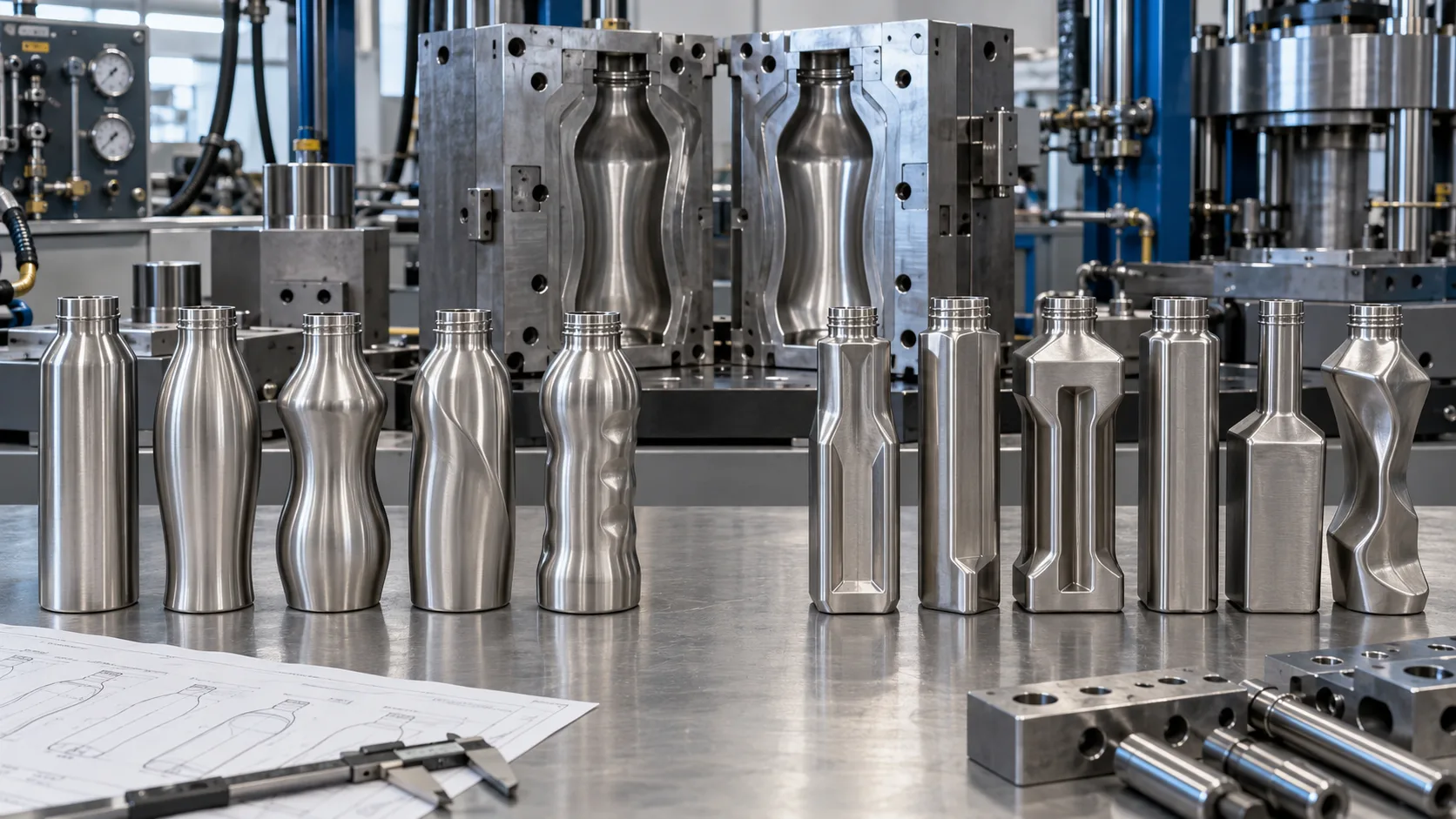
In our factory, we review customer CAD files every week, and the same few principles determine success or failure. It's less about aesthetics and more about physics. Think of it like working with clay; you can guide it into amazing forms, but you can't force it to do things it physically can't. The three main factors we look at are draw depth, corner radius, and draft angle.
Key Design Considerations
-
Draw Depth & Ratios: This simply means how deep a feature can be pressed into the steel relative to its width. If you want a very deep, narrow indent, the steel has to stretch a lot. Too much stretch in one small area can cause it to thin out and tear.5 A gentle, wide curve is much easier to form than a deep, tight dimple.
-
Corner Radius: Stainless steel cannot be folded into a perfect, sharp 90-degree corner.6 It needs a slight curve, or radius, to prevent stress and cracking. A design that requires a razor-sharp edge is a red flag for us, and we'll immediately suggest softening it.
-
Draft Angle: Imagine trying to pull a cup straight out of wet sand. The vertical walls create suction. Now, imagine the cup's walls are slightly angled. It slides right out. That angle is the draft angle.7 Your bottle needs it so we can safely remove it from the two halves of the hydroforming mold.
| Feature Type | Works Well with Hydroforming | Challenging or Impossible |
|---|---|---|
| Body Shape | Waisted, hourglass, asymmetrical curves | Internal channels, hollow handles8 |
| Corners | Soft, rounded corners (generous radii) | Sharp 90-degree edges, knife-edge details |
| Surface | Gentle waves, wide embossed logos | Deep, narrow grooves or patterns |
| Base/Top | Tapered or slightly angled walls | True vertical walls, undercuts (lips) |
Understanding these constraints early in your design process can save countless hours of revision and frustration.
Is the Investment in Hydroforming Worth It for My Brand?
You want a custom bottle, but the phrase "tooling cost" sounds intimidating. You worry the investment will kill your project's profitability before it even gets off the ground.
The investment is worth it when your order volume is large enough to make the per-unit cost of the custom mold negligible9. For smaller runs or promotional items, using a standard, in-stock bottle shape is almost always more cost-effective. The decision is a simple business calculation.
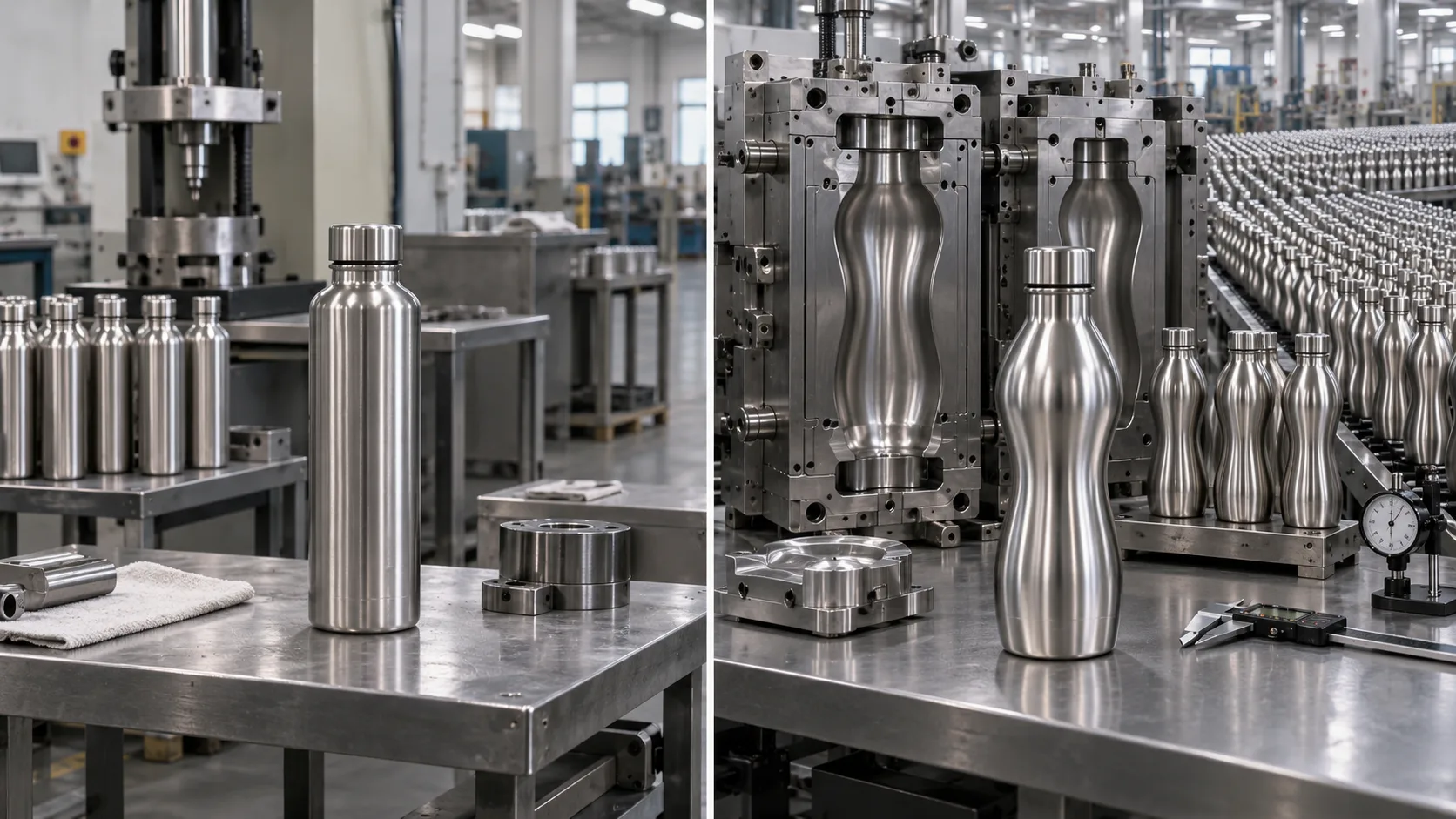
The real decision gate for most brand owners isn't geometry; it's the budget. A custom hydroforming mold is a significant, one-time investment.10 This tooling is what allows us to shape flat steel tubes into your unique design11, and its cost is influenced by the complexity of your bottle. Once the mold is made, however, it can produce thousands of units. The critical question becomes: at what volume does that initial investment make sense?
Breaking Down the Costs
The two main numbers to consider are the tooling fee and the Minimum Order Quantity (MOQ).
- Tooling Cost: This is the upfront cost to design, machine, and test the mold for your specific bottle shape. More complex shapes with multiple parts require more expensive tooling. While this can seem high, think of it as a long-term asset for your brand.
- Minimum Order Quantity (MOQ): This is the smallest order we can run efficiently. Setting up the hydroforming machinery, calibrating the pressure, and running test pieces takes time. A high MOQ ensures that this setup cost is spread across enough units to keep the per-bottle price reasonable.12
We often walk clients through this simple comparison:
| Cost Factor | Standard Bottle Shape | Custom Hydroformed Shape |
|---|---|---|
| Tooling Cost | $0 (We already have the molds) | Varies (contact for estimate) |
| Per-Unit Cost | Lower | Slightly Higher (due to process) |
| MOQ | Lower | Higher |
| Best For | Startups, small batches, promotions | Established brands, high-volume retail |
Ultimately, hydroforming becomes profitable when you plan to sell thousands of units, not hundreds. At that scale, the per-unit cost of the tooling becomes pennies, and the value of a unique, brand-defining product far outweighs the initial investment.
How Do I Know If My Design Is Feasible Before Spending Money?
You have a brilliant design concept in your head or as a sketch. But you hesitate to invest in professional CAD design, fearing the factory will ultimately reject it as impossible.
Start with a simple, no-cost design feasibility conversation. Share your sketches, inspiration images, or even a rough 3D model with us. An experienced manufacturer can provide quick, honest feedback on potential production challenges before you commit significant time or money.
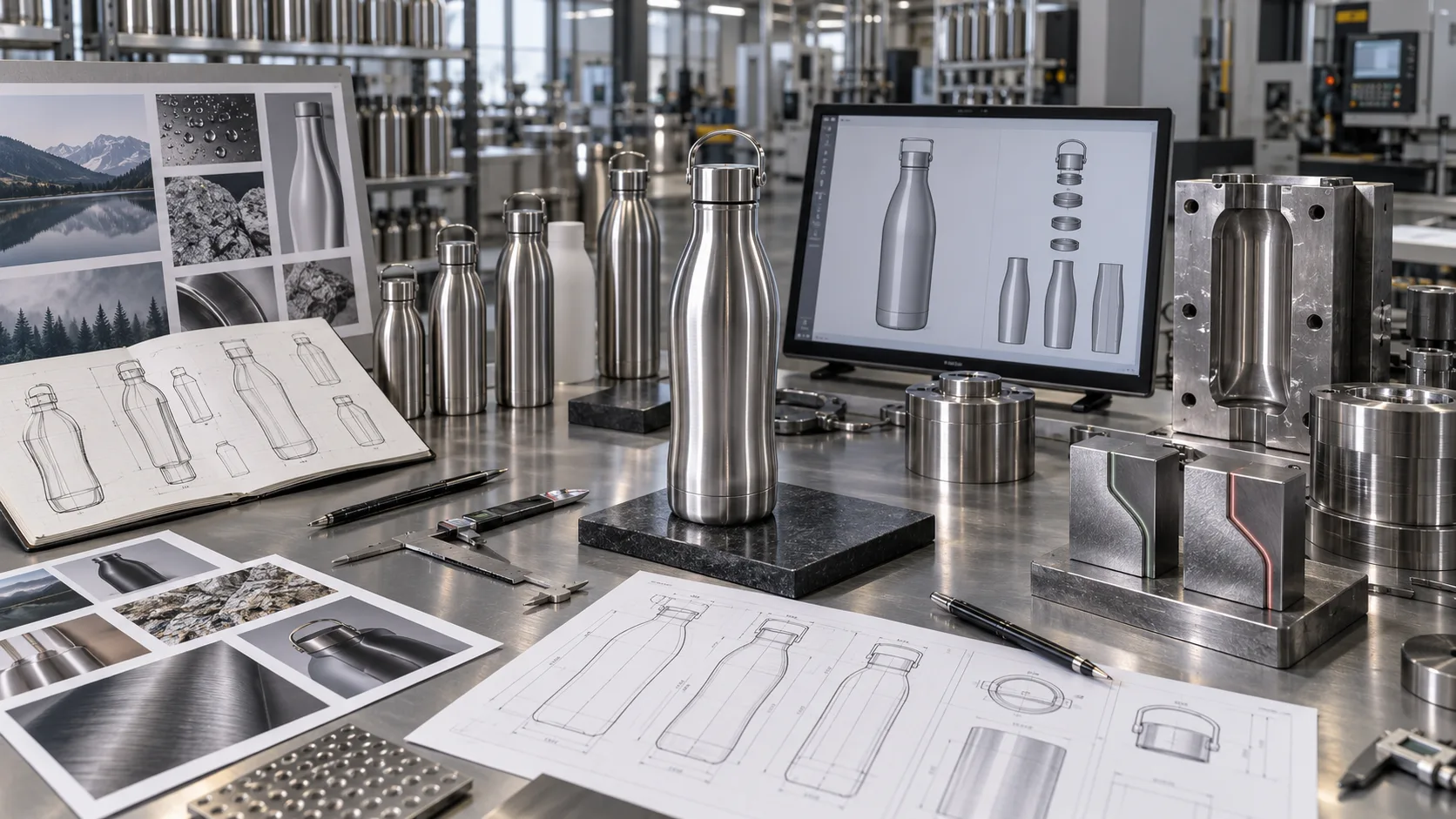
My favorite part of this job is the initial conversation with a brand owner. It's where the creative vision meets manufacturing reality. Our goal in that first call is not to send you a quote; it's to act as an advisor. We want to tell you honestly if your design is a home run, needs a few tweaks, or requires a different approach entirely. This collaborative step is the single most effective way to de-risk your project.
What to Prepare for a Feasibility Discussion
You don't need a perfect, engineered file to start. To get the most out of our conversation, just bring your ideas. The most helpful items are:
- Visuals: This can be anything from a hand-drawn sketch to a link to a competitor's product you admire, or a simple 3D render. The more visual information you can provide, the better we can assess it.
- Target Capacity: Let us know if you're aiming for a 16 oz (approx 500ml) coffee mug or a 32 oz (approx 1L) water bottle. Size impacts the material draw and proportions.
- Key Features: Point out the non-negotiable elements of your design. Is it the hexagonal base? The ergonomic grip? The tapered top? Knowing your priorities helps us suggest effective solutions.
What You'll Get in Return
In this initial review, we will provide a frank assessment based on our years of experience on the factory floor. We'll tell you things like, "This curve is perfect for hydroforming," or "We may need to increase the radius on this corner to ensure consistency." You will leave the conversation with a clear understanding of the manufacturing viability of your design and a concrete list of next steps, all before you spend a single dollar on tooling.
Conclusion
Hydroforming opens a world of custom shapes, but success lies in smart design. By understanding the process limits and engaging in an early feasibility talk, your unique bottle can become reality.
"When To Use Deep Draw Sheet Stamping or Hydroforming - YouTube",
. A technical paper or engineering resource can provide a comparison of metal forming techniques, illustrating how hydroforming overcomes some of the geometric limitations of traditional stamping and deep drawing, allowing for more complex and asymmetrical designs. Evidence role: general_support; source type: paper. Supports: The claim that hydroforming enables the production of more intricate and non-symmetrical shapes than conventional methods like stamping or deep drawing.. ↩"Hydroforming - Wikipedia", https://en.wikipedia.org/wiki/Hydroforming. An engineering design guide or university course material on metal forming can confirm that draw depth, corner radius, and draft angle are fundamental design considerations that determine the feasibility and success of a hydroformed part. Evidence role: definition; source type: education. Supports: The claim that draw depth, corner radii, and draft angles are critical parameters in the hydroforming design process.. ↩
"Hydroforming - Wikipedia", https://en.wikipedia.org/wiki/Hydroforming. A research paper or manufacturer's technical guide can illustrate the types of complex geometries achievable with hydroforming, often including examples of parts with asymmetrical curves, variable cross-sections, and embossed features. Evidence role: case_reference; source type: research. Supports: The claim that hydroforming is well-suited for creating features like waists, curves, and surface patterns.. ↩
"Hydroforming process of thin-walled tubular components with ...", https://ui.adsabs.harvard.edu/abs/2023ACME...23..169C/abstract. A study on formability limits in tube hydroforming can explain that sharp radii lead to high stress concentrations and material tearing, while deep, narrow sections can exceed the material's elongation limits, and undercuts prevent the part from being removed from the die. Evidence role: mechanism; source type: paper. Supports: The claim that sharp corners, deep draws, and undercuts are common causes of failure in hydroforming.. ↩
"Computational simulation of strain localization: From theory to ...", https://digitalcommons.latech.edu/dissertations/481/. A paper on metal forming mechanics can explain how excessive localized strain, particularly in areas of complex curvature, leads to material thinning and can result in fracture when the forming limit of the material is exceeded. Evidence role: mechanism; source type: paper. Supports: The claim that excessive localized stretching causes material thinning and tearing.. ↩
"Failure of Martensitic Sharp Edges: A Micro-Mechanical Exploration ...", https://dspace.mit.edu/handle/1721.1/143927. A materials engineering resource or handbook can define the concept of a minimum bend radius, explaining that attempting to form a metal like stainless steel with a radius smaller than this value creates stress concentrations that lead to cracking. Evidence role: mechanism; source type: education. Supports: The claim that stainless steel requires a radius at corners to prevent failure.. ↩
"Draft Angle Guidelines for Injection Molding - Protolabs", https://www.protolabs.com/resources/design-tips/improving-part-moldability-with-draft/. An engineering design guide or encyclopedia entry defines 'draft angle' and explains its necessity for part ejection from a rigid two-part mold, a principle that applies to processes like casting, injection molding, and hydroforming. Evidence role: definition; source type: encyclopedia. Supports: The claim that a draft angle is required for part removal from a mold.. ↩
"Hydroforming - Wikipedia", https://en.wikipedia.org/wiki/Hydroforming. A research paper on advanced hydroforming techniques can explain that standard tube hydroforming is not capable of producing separate internal channels, as the process involves pressurizing the tube as a single chamber. Creating such features would require more complex, multi-stage processes or different technologies. Evidence role: mechanism; source type: paper. Supports: The claim that hydroforming is not suitable for creating internal channels or hollow handles.. ↩
"Economies of scale - Wikipedia", https://en.wikipedia.org/wiki/Economies_of_scale. A business or manufacturing economics resource can explain how high, fixed tooling costs are amortized over large production volumes, which dramatically reduces the per-unit cost and makes custom processes economically viable at scale. Evidence role: general_support; source type: other. Supports: The claim that high production volume makes the per-unit tooling cost negligible.. ↩
"Hydroforming - Wikipedia", https://en.wikipedia.org/wiki/Hydroforming. A manufacturing industry report or engineering article can discuss the costs associated with creating dies for metal forming, noting that tools for hydroforming are often made from hardened tool steel and require precise machining, representing a substantial capital investment. Evidence role: general_support; source type: institution. Supports: The claim that hydroforming molds are a significant investment.. ↩
"Hydroforming - Wikipedia", https://en.wikipedia.org/wiki/Hydroforming. A technical overview of the tube hydroforming process shows that the starting workpiece is typically a straight, cylindrical metal tube, which is placed into the die before being sealed and pressurized with fluid. Evidence role: historical_context; source type: research. Supports: The claim about the starting material for the hydroforming process.. Scope note: This source would clarify the starting material is a cylindrical tube, not a 'flat' tube as stated in the article. ↩
"Minimum Order Quantity (MOQ): Formula, Tips, & Benefits | NetSuite", https://www.netsuite.com/portal/resource/articles/inventory-management/minimum-order-quantity-moq.shtml. A business or operations management resource can define Minimum Order Quantity (MOQ) and explain its economic function in manufacturing, specifically how it ensures that fixed setup costs (e.g., machine calibration, tooling changes) are sufficiently amortized across a production batch. Evidence role: definition; source type: other. Supports: The claim that MOQs are used to make production runs economically viable by offsetting setup costs.. ↩